


Modern businesses are constantly searching for smarter ways to operate, compete, and grow. This is where Enterprise AI steps in. More than a trend, it acts as a powerful transformation tool that reshapes how organizations function at every level. From automating routine tasks to enabling data-driven decisions, Enterprise AI is no longer optional, it’s becoming essential.
Let’s break it down in a clear, practical way.
What Is Enterprise AI?
Enterprise AI refers to the integration of artificial intelligence technologies into large-scale business operations, systems, and processes. As businesses grow, managing operations, data, and decision-making becomes increasingly complex. Traditional systems often fall short in handling this scale efficiently. This is where Enterprise AI comes into play, offering intelligent capabilities that go beyond basic automation.
Unlike basic AI tools used for individual tasks, Enterprise AI is designed to work across departments, handling complex workflows, analyzing vast datasets, and supporting strategic decision-making.
In simple terms, Enterprise AI helps organizations become smarter, faster, and more efficient by embedding intelligence into their core operations.
How Enterprise AI Differs from General AI
While artificial intelligence is widely discussed today, not all AI applications are built the same. Many businesses start with basic AI tools, but scaling those capabilities across an organization requires a more structured and powerful approach.
1. Scale and Complexity
General AI tools (like chatbots or image generators) usually handle specific tasks. Enterprise AI, on the other hand, operates across entire business ecosystems, handling large volumes of data and multiple workflows simultaneously.
2. Integration with Business Systems
Enterprise AI connects with existing systems like ERP, CRM, HR platforms, and supply chain tools. Platforms from companies like Amazon Web Services and Oracle offer AI capabilities deeply integrated into enterprise infrastructure.
3. Customization
Enterprise AI solutions are often tailored to specific business needs, unlike off-the-shelf AI tools.
4. Governance and Security
Enterprises require strict compliance, data security, and governance, making Enterprise AI more robust and controlled.
Why Enterprise AI Matters Today
In the age of digital transformation, businesses are generating more data than ever before. However, without the right tools, this data often remains underutilized or siloed across departments.
Enterprise AI helps organizations:
- Turn data into actionable insights
- Automate repetitive processes
- Improve customer experiences
- Make faster, smarter decisions
In a competitive market, this translates directly into growth and efficiency.
Key Benefits of Enterprise AI
Adopting Enterprise AI is also about unlocking tangible business value. Organizations that successfully implement AI often see measurable improvements across multiple areas of their operations.
1. Improvement in Working Efficiency: AI automates routine tasks such as data entry, reporting, and customer queries. This allows teams to focus on high-value work.
2. Decision-Making Gets Easier: Enterprise AI analyzes historical and real-time data to provide insights, predictions, and recommendations.
3. Enhanced Customer Experience: AI-powered systems can personalize interactions, predict customer needs, and provide faster support.
4. Cost Reduction: Automation reduces manual effort, minimizes errors, and optimizes resource utilization.
5. Scalability: As your business grows, Enterprise AI systems scale with you, handling increasing workloads seamlessly.
How Enterprise AI Works in Organizations
To truly understand its impact, it’s important to look at how Enterprise AI functions behind the scenes. It’s not a single tool, but a combination of technologies working together to create intelligent systems.
Enterprise AI typically functions through a combination of:
- Data Collection: Gathering data from multiple sources (CRM, ERP, IoT devices, etc.)
- Data Processing: Cleaning and organizing data for analysis
- Machine Learning Models: Identifying patterns and making predictions
- Automation Systems: Executing tasks based on insights
- Integration Layers: Connecting AI with existing enterprise software
This creates a continuous loop of learning and improvement.
Real-World Use Cases of Enterprise AI
One of the best ways to understand Enterprise AI is by seeing how it is applied in real-world scenarios. Across industries, businesses are leveraging AI to solve practical challenges and improve efficiency. Here are some of the real-world applications:
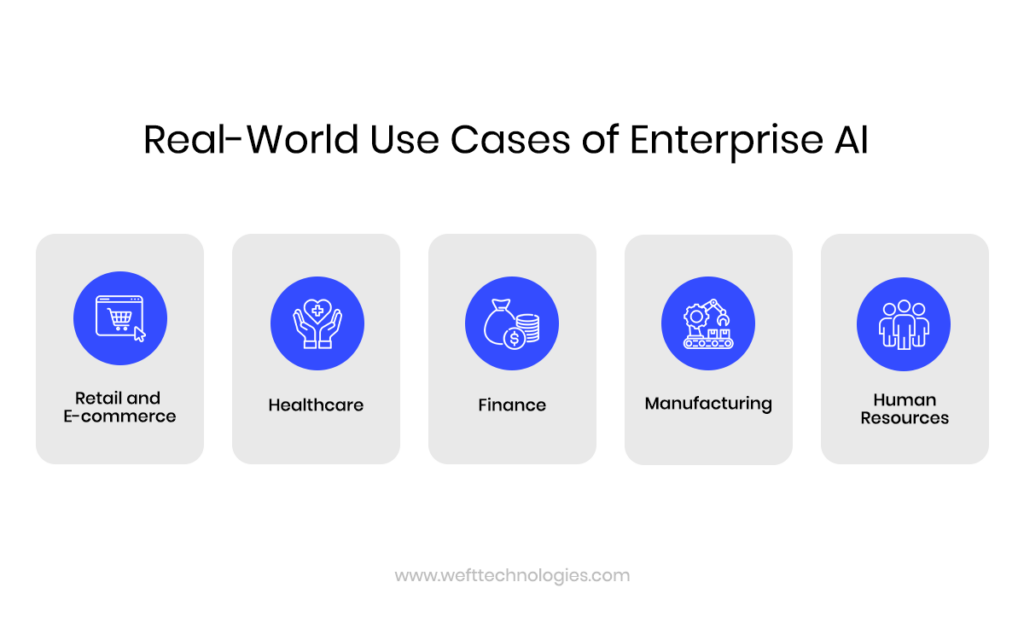
1. Retail and E-commerce
- Personalized product recommendations
- Demand forecasting
- Inventory optimization
2. Healthcare
- Predictive diagnostics
- Patient data analysis
- Automated administrative workflows
3. Finance
- Fraud detection
- Risk assessment
- Automated trading insights
4. Manufacturing
- Predictive maintenance
- Quality control automation
- Supply chain optimization
5. Human Resources
- AI-driven recruitment
- Employee performance analysis
- Workforce planning
These examples show how Enterprise AI is not limited to one industry, it’s transforming all of them.
Types of Enterprise AI Solutions
Enterprise AI is not a one-size-fits-all approach. Depending on business goals and industry requirements, organizations can adopt different types of AI solutions tailored to their needs.
Businesses typically adopt different types of Enterprise AI solutions based on their needs:
- Predictive Analytics: Helps forecast future trends using historical data.
- Natural Language Processing (NLP): Enables machines to understand human language (chatbots, virtual assistants).
- Computer Vision: Used in quality control, surveillance, and automation.
- Robotic Process Automation (RPA): Automates repetitive business processes.
- Custom AI Solutions for Business: Tailored systems designed specifically for unique enterprise needs.
Enterprise AI Services Businesses Can Leverage
Implementing Enterprise AI successfully often requires the support of experienced technology partners. Many organizations rely on specialized services to ensure smooth adoption and maximum return on investment.
Modern organizations often rely on specialized providers offering:
- Enterprise AI consulting
- AI integration services
- AI development services for enterprises
- Enterprise AI solutions tailored to business goals
- Digital transformation services powered by AI
These services ensure smooth adoption and maximize ROI.
Challenges of Implementing Enterprise AI
While Enterprise AI offers significant advantages, adopting it is not without challenges. Understanding these potential hurdles helps businesses prepare better and avoid common pitfalls.
1. AI systems are only as good as the data they are trained on.
2. Implementing AI infrastructure can be costly.
3. Connecting AI with legacy systems can be challenging.
4. Organizations often lack in-house AI expertise.
5. Handling sensitive data requires strict governance.
However, with the right strategy and partners, these challenges can be effectively managed.
The Future of Enterprise AI
As technology continues to evolve, Enterprise AI is expected to play an even more central role in shaping the future of businesses. Its capabilities are expanding rapidly, opening new opportunities across industries.
Key trends include:
- Increased adoption of AI-driven automation
- Rise of AI-powered decision intelligence
- Greater use of generative AI in enterprises
- Stronger focus on ethical AI and governance
- Seamless AI integration across all business functions
Businesses that embrace Enterprise AI early will gain a significant competitive advantage.
How Enterprise AI Supports Digital Transformation
Digital transformation is more than just adopting new technologies, it is about fundamentally changing how businesses operate and deliver value. Enterprise AI acts as a key enabler in this journey.
Enterprise AI plays a central role by:
- Enabling smarter workflows
- Improving agility and responsiveness
- Enhancing innovation
- Driving customer-centric strategies
In essence, Enterprise AI is the backbone of modern digital transformation.
Choosing the Right Enterprise AI Partner
Selecting the right partner is a critical step in any AI journey. The right expertise can make the difference between a successful transformation and a costly implementation failure.
To successfully implement Enterprise AI, businesses should look for partners who offer:
- Deep industry expertise
- Scalable AI solutions
- Strong integration capabilities
- Focus on security and compliance
- Proven track record in digital transformation
A reliable partner ensures that AI initiatives align with business goals and deliver measurable outcomes.
By integrating AI into core operations, organizations can unlock new levels of efficiency, innovation, and growth.
If your organization is looking to implement AI solutions for businesses, now is the time to act. The right Enterprise AI strategy can unlock efficiency, accelerate growth, and give you a strong competitive edge.
At Weft Technologies, we don’t just deliver technology, we help you build intelligent, future-ready systems tailored to your business goals. From Enterprise AI consulting to custom AI solutions and seamless integration, our experts are here to guide you at every step. Connect with the Weft team to explore how Enterprise AI can drive real results for your business.