


Most teams still think product scoping means writing a long, exhausting BRD. A document so big and so rigid that no one wants to open it again. But building digital products is different today. Things move fast. Ideas shift every week. Requirements change as you learn more. And you simply can’t plan a modern digital product by locking yourself into a document that tries to predict everything upfront.
In this blog, let’s break down a simpler way of scoping a digital product. A way that helps you plan clearly, move fast, and avoid endless documentation. We’ll go through how lean product scoping works, what to include, what to avoid, and how to create clarity without creating chaos. You’ll also see how modern product documentation methods replace bulky BRDs and make your digital product development smoother.
Why Big BRDs Fail in Digital Product Development
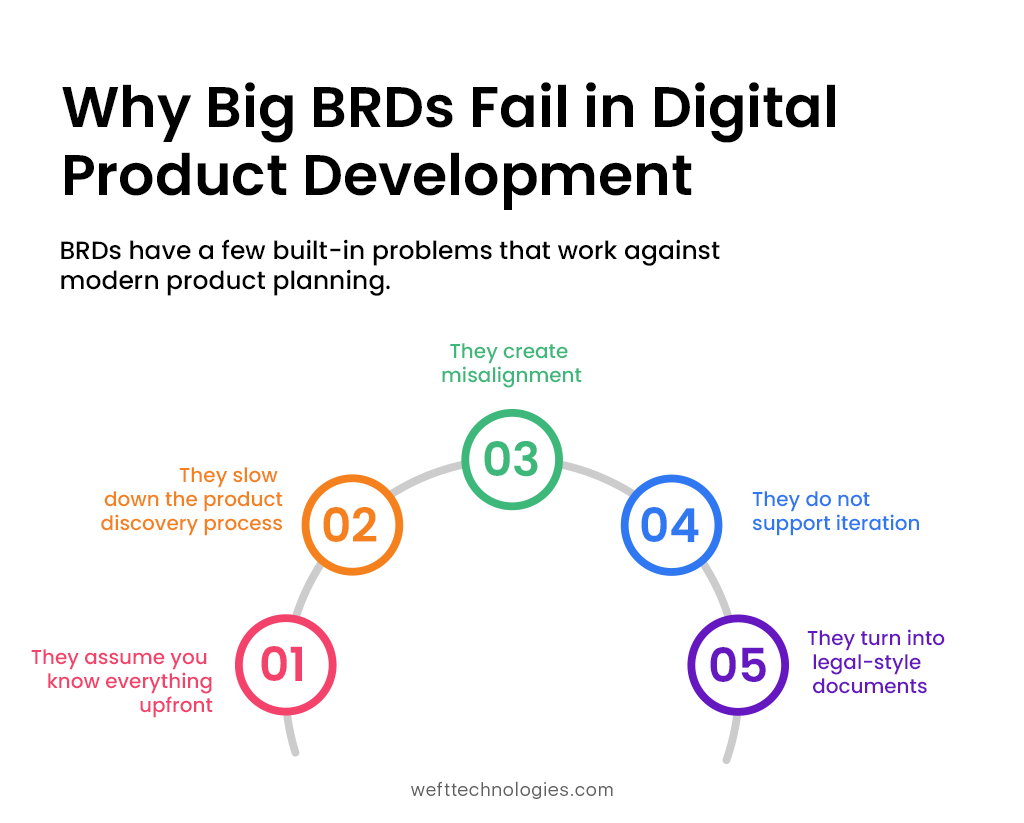
BRDs have a few built-in problems that work against modern product planning.
1 .They assume you know everything upfront
But you don’t. You discover a lot during development. User research changes your understanding. Technical constraints change the direction. New insights shift priorities.
2 .They slow down the product discovery process
You spend more time writing than learning. This creates a gap between what the document says and what the product needs.
3 .They create misalignment
Different teams interpret long documents differently. More pages mean more confusion.
4 .They do not support iteration
Every time something changes, you need a revision. No one updates the BRD consistently, so it loses relevance.
5 .They turn into legal-style documents
They focus on listing “everything possible” instead of “what matters now.” This leads to bloated, unusable documentation.
This is why modern digital product planning is shifting to BRD alternatives that are simple, visual, and easy to update.
Why You Don’t Need a 100-Page BRD Anymore
A BRD (Business Requirements Document) was useful years ago, when product cycles were slow, and requirements barely changed. But for digital product development today, a BRD causes more problems than it solves. Here’s why:
- It takes weeks to write.
- It becomes outdated within days.
- It encourages over-planning instead of discovering what users actually need.
- It locks teams into a rigid plan that doesn’t match the real world.
- It becomes a handover document, instead of a living reference.
- No one reads it after the first review.
Teams still write them because they think detailed documentation equals clarity. But in reality, clarity comes from understanding the problem, validating assumptions, and scoping the right features. Not from writing long documents.
This is where lean product scoping enters the picture. It gives you the structure you need without the clutter. It keeps everyone aligned without drowning them in unnecessary detail.
What Is Lean Product Scoping?
Lean product scoping is a simple and effective way to define your product. It focuses on clarity instead of complexity. It focuses on learning instead of guessing. It helps you shape the right version of the product without spending months writing documentation.
At its core, lean product scoping is built on four principles:
- Understand the problem deeply
- Capture only what matters for the first version
- Validate assumptions early
- Keep documentation simple and living
Instead of long BRDs, you rely on short, clear artifacts that evolve with your product. This approach is widely used in digital product development hubs and modern product teams that prefer learning over guessing.
How Lean Scoping Saves Money
Lean scoping reduces waste at every stage. You don’t spend weeks writing. You don’t design features no one needs. You don’t build complex flows without validation. This means you save money by:
- Avoiding development rework
- Reducing design cycles
- Minimizing communication gaps
- Building only what delivers value
- Catching risks early
- Keeping the product small before it scales
Most overruns happen because teams plan too much, too early, with too many assumptions. Lean scoping cuts these costs by keeping everything simple, validated, and outcome-driven.
Why Lean Product Scoping Works for Modern Digital Products
Digital products are never final. They evolve. They improve. They adapt to users. They shift based on market needs. This means you need a planning method that supports that flexibility.
Lean scoping gives you:
- Faster decision-making
- Fewer assumptions and surprises
- Clear priorities
- A simpler roadmap
- Better alignment across teams
- Fewer revisions
- Faster development cycles
Most importantly, this approach saves you from writing things that your team doesn’t need. You focus on what matters now, not everything that might matter someday.
The Real Goal of Scoping a Digital Product
You are not trying to predict the future. You are trying to build a version of the product that:
- Solves a real problem
- Delivers value fast
- Reduces waste
- Sets a strong foundation for future iterations
This means scoping is not about creating a 100-page document. It is about making informed decisions. Your goal is to answer questions like:
- Who is this for?
- What problem does it solve?
- What outcomes do we want?
- What are the must-have features?
- What can wait?
- What assumptions do we need to validate?
- How will users move through the product?
- What is the simplest version we can build?
If your documentation helps you answer these questions clearly, you are already doing product scoping right.
The Role of a Digital Product Development Hub in Scoping
A digital product development hub brings structure to this entire process. Instead of scattering planning across teams, tools, and documents, a hub brings everything under one roof. It helps teams move from ideas to clarity faster. It aligns strategy, design, engineering, and business teams without long meetings or hundred-page documents.
A hub drives the scoping process by offering:
- Shared understanding of the problem
- A single source of truth
- Faster validation cycles
- A practical approach to prioritization
- Lightweight documentation everyone uses
This setup makes scoping feel collaborative instead of overwhelming. You get momentum without losing direction. You get clarity without writing more than you need.
A Modern, Practical Way to Scope a Digital Product
We’ll now walk through a digital product scoping guide that is simple, structured, and value-driven. This is how most digital product development hubs create clarity without the chaos of documentation-heavy processes.
You can follow these steps for any product, including an app, a SaaS platform, an internal tool, or a customer-facing digital transformation project.
Step 1 – Start With a Clear Problem Statement
A good product starts with a clear problem. Not with features. Not with UI ideas. Not with assumptions.
Your problem statement should be one short paragraph. That’s it.
Ask:
- What problem are we solving?
- Who faces this problem?
- What happens if we don’t solve it?
- Why is this a priority now?
A simple problem statement is more powerful than pages of background.
Step 2 – Define the Target Users Clearly
A 100-page BRD will list every possible user type. But you don’t need that. You only need the core users.
Capture:
- Primary users
- Secondary users
- Internal stakeholders
- User challenges
- Expected benefits
You can keep this short. One or two lines per user type is enough. This helps you scope features based on user value instead of assumptions.
Step 3 – Clarify Your Outcomes, Not Features
This is where most scoping documents fail. They jump straight into features. But features should never lead. Outcomes should.
Ask:
- What change should this product create?
- What should users be able to do that they can’t do today?
- How will we measure success?
These outcomes will guide the entire scoping process.
Step 4 – Capture Assumptions You Need to Validate
Every product has assumptions. Hidden or explicit. It’s better to list them early.
Examples:
- Users prefer mobile-first.
- Customers will adopt automated workflows.
- The current team can integrate with existing software.
- Users will pay for these features.
Your goal is to reduce risks by validating assumptions before writing full specifications. This is a core part of modern product documentation methods.
Step 5 – Create a Simple Feature List (But Keep It Lean)
Instead of long feature descriptions, break your features into:
- Must-have
- Should-have
- Could-have
- Won’t-have-now
This MoSCoW method keeps your scoping clean and practical. Under each feature, include only what is essential:
- Purpose
- Basic flow
- Dependencies
Not more. Not less.
Step 6 – Map Key User Flows
Instead of writing long descriptions, use simple user flow diagrams. This is a major BRD alternative used in digital product development.
User flows explain:
- How users move through the system
- How tasks get completed
- How screens connect
You don’t need detailed wireframes yet. Just the main flow.
Example flows:
- User registration
- Order placement
- Inventory update
- Reporting
- Admin approval
These flows give clarity to your development team immediately.
Step 7 – Build a Lightweight Scope Document
This is your lean product documentation. It replaces 100 pages with 10–15 pages of clarity. Your document includes:
- Problem statement
- User personas
- Outcomes
- Assumptions
- Feature list (prioritized)
- User flows
- Success metrics
- Technical notes
- Risks
- Timeline outline
It’s short. It’s practical. It’s easy to update. This is the modern way to scope a digital product.
Step 8 – Validate Early With a Quick Product Discovery Process
This step ensures you are building the right thing. Validation includes:
- User interviews
- Prototype testing
- Technical feasibility checks
- Market comparison
- Risk evaluation
You only need 1 to 2 weeks for this. Not months. Discovery prevents wasted effort and aligns the entire team.
Step 9 – Create a First Version Roadmap
Once your scope is validated, you create a simple roadmap that tells:
- What gets built first
- What comes next
- What gets delayed
- How the product will evolve
Your roadmap is not a contract. It’s a plan that adjusts when you learn more. This helps your digital product development team move fast with clarity.
Step 10: Use Living Documentation Instead of BRDs
This is the biggest shift. Instead of writing a 100-page BRD and letting it rot, you create documentation that changes with your product. It includes:
- Updated user flows
- Updated feature list
- Updated scope
- Updated insights
- Updated decisions
Your documentation becomes something your team actually uses. It supports learning and improves collaboration. A digital product hub would always use living docs, because they help teams stay aligned across design, development, QA, and strategy.
How Digital Transformation Services Use Lean Scoping
Digital transformation projects often involve multiple systems, multiple teams, and complex workflows. If you try to scope them with BRDs, you slow down the entire transformation. Modern digital transformation services rely on:
- Workshops
- Rapid Scoping Cycles
- Iterative Planning
- Small Documents With Big Clarity
- Visual Diagrams
- Agile Discovery
This approach helps them deliver results faster and reduce risk.
Simple Tools That Replace BRDs
You don’t need a heavy document to communicate clearly. Modern teams use lightweight tools that fit the way digital products evolve. Useful tools include:
- Notion pages
- Google Docs
- Miro boards
- Figma flows
- Product wikis
- Lightweight requirement cards
- Feature canvases
These tools work because they are fast to update. They help teams collaborate in real time. They make scoping feel alive, instead of fixed. You get clarity without committing to a rigid document that slows everyone down.
Modern Documentation Tools That Replace BRDs
Here are practical BRD alternatives used across the industry:
- User stories
- Acceptance criteria
- User flow diagrams
- Journey maps
- Feature canvases
- Technical notes
- Product wikis
- Roadmaps
- RICE prioritization
- Problem-solution mapping
All of them are short, visual, and easy to update.
Why This Matters for Digital Product Development
By avoiding long BRDs, you:
- Speed up the planning phase
- Reduce wasted effort
- Reduce friction between teams
- Encourage collaboration
- Focus on outcomes, not paperwork
- Deliver functional products faster
- Maintain clarity as the product grows
You get a better product with less stress.
Final Thoughts
Scoping a digital product doesn’t need hours of writing and reading. It doesn’t need hundreds of pages. It doesn’t need complicated documentation that no one understands. It needs clarity, structure, and alignment. And most importantly, it needs a lean approach that helps you understand your users, define outcomes, prioritize features, and move forward confidently.
Modern digital product scoping is simple. It’s practical. It’s fast. It supports your digital transformation without slowing you down. Once you shift from long BRDs to lean product documentation, you will never go back. You get a product planning process that feels lighter, smoother, clearer, and far more effective. This is how you scope a digital product the right way, without creating a 100-page BRD.

We are here to help you with growth
Contact Our ExpertsLatest Blogs
- From Prototype to Production: Building Custom AI Software for Long-Term ROI
- How to Achieve Product-Led Growth in 2026? The Right Strategies for a Successful Product
- How to Pivot a SaaS Startup Successfully: A Strategic, Data-Driven Guide for Founders
- A Complete Guide to Go-To-Market for Products and Services