

In the early stages of production, UX debt is a way to ship faster. But as your product grows, the cracks begin to show. Buttons feel inconsistent. Navigation becomes cluttered. Users struggle to find what they need. And fixing it all suddenly feels like rebuilding from scratch. In its essence, it is a cost that silently grows until one day you can no longer ignore it.
That might have sounded a bit scary, but UX debt can also be a necessity at times. What we need to understand is how to manage and repay UX debt. And this blog was created to help those who wish to manage UX debt the right way.
What is UX Debt?
Before we move on, let’s get this out of the way. UX debt is a lot like technical debt. It is the design compromises made along the way. It’s the small usability issues, inconsistent elements, and neglected feedback that slowly pile up. You might think that these small issues are harmless. But the problem is that over time, they make your product harder to use and harder to love.
The UX debt of your product could be anything from a skipped usability test to an outdated layout. These compromises on usability and design quality often have long-term consequences. If you wait too long to fix them, they become more expensive to fix.
Here are some UX debt examples:
- A button that works differently across pages.
- A confusing checkout flow that nobody revisits because it “works fine for now.”
Types of UX Debt
UX debt doesn’t always look the same. It comes in several forms:
- Visual Debt
This is the most visible kind. This includes inconsistent colors, typography, spacing, etc. Visual debt makes your product look unpolished and inconsistent. Over time, it weakens brand perception.
- Interaction Debt
These are the unpredictable elements in actions. For example, a swipe interaction on one page will delete, but on another page, the same interaction stands for archiving. These inconsistencies break user flow, and you lose user trust.
- Information Debt
These are the issues with the content. The content on your product might be unclear, redundant, or hard to understand. Information debt silently grows when development teams neglect copy updates.
- Process Debt
This might be the least visible user experience debt. It occurs when your design decisions are not documented or usability tests are skipped. This kind of debt can be very damaging in the long run.
How it Builds Up
UX debt doesn’t arrive with a warning. It builds slowly, as teams make small trade-offs to meet immediate goals.
Here’s how it usually happens:
- Rushed releases – Deadlines force teams to skip polish or usability checks
- Inconsistent design systems – New designers or developers create variations without realizing it
- Poor documentation – Design decisions aren’t recorded, so old mistakes get repeated.
- Ignored feedback – User complaints are logged but never prioritized.
Each of these moments adds a little debt. At first, you barely notice. Then one day, the product feels inconsistent. Small UX design mistakes multiply, fixes take longer, and the overall user experience begins to suffer.
The Early Dilemma – Shipping Fast vs Designing Right
In the early stages of a product, speed feels essential. You want to validate fast, get user feedback, and prove your concept works. So it’s tempting to cut corners in design. And that’s okay to an extent.
Shipping fast often means accepting some UX debt intentionally. You may skip animations, reuse layouts, or skip detailed testing. These decisions help you move quickly. The danger lies in forgetting to revisit them later. Speed gets you to market. But poor design choices made in haste can follow you for years.
This is why many teams partner with MVP development services to move quickly while still designing right. Good teams understand that UX debt is not inherently bad. It’s a temporary trade-off. The key is to take on intentional debt consciously, with a plan to repay it when the product stabilizes.
Intentional vs Accidental UX Debt
We already mentioned that UX debt is not inherently bad. The key difference lies in whether it’s intentional or accidental.
Intentional UX Debt
Sometimes teams cut corners to achieve short-term goals. For instance, animations might be skipped to meet a release deadline. This kind of UX debt is done intentionally and makes for a strategic choice. Moreover, these intentional UX debts will also have a clear repayment plan.
Accidental UX Debt
The kind of UX debt that happens unintentionally or accidentally is known as accidental UX debt. This debt can arise due to poor communication, lack of documentation, or even neglect. The problem with this kind of debt is that it grows silently and ultimately becomes expensive to fix.
The difference is awareness. Intentional debt can be managed. Accidental debt can only be repaired after damage has been done.
Why UX Debt Hurts Long-Term Growth
Here’s how UX debt affects your product and team in the long run:
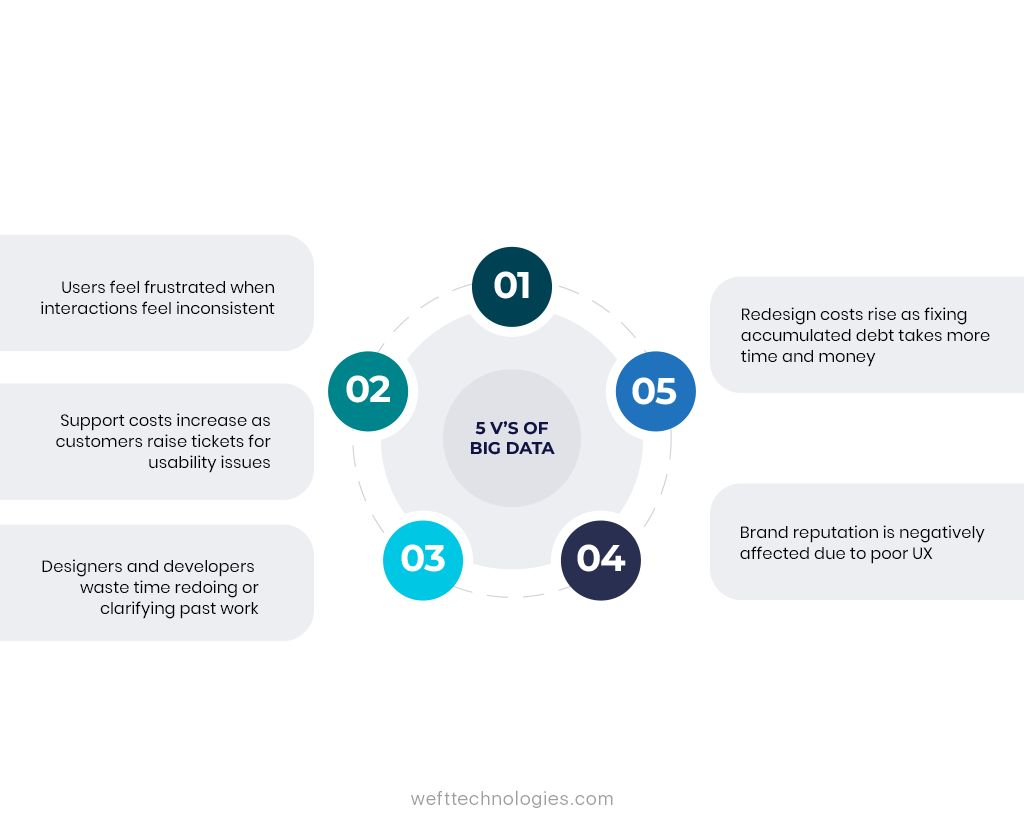
- Users feel frustrated when interactions feel inconsistent
- Support costs increase as customers raise tickets for usability issues
- Designers and developers waste time redoing or clarifying past work
- Redesign costs rise as fixing accumulated debt takes more time and money
- Brand reputation is negatively affected due to poor UX
The more your product grows, the more layers of complexity you add. This means that it also becomes harder to repair the foundation of your product. A seasoned UI/UX design company in India always ensures you have a design foundation that scales smoothly.
The Domino Effect of UX Debt
UX debt doesn’t just affect usability. It slows down growth. As products mature, the hidden cost of early design shortcuts becomes visible. Small inconsistencies turn into blockers for innovation. Every new feature takes longer because the foundation is messy.
Imagine a house built without a clear structure. Adding a new room later means tearing down walls. That’s what unmanaged UX debt feels like. It impacts:
- Release Speed – because changes break existing designs
- Team Morale – because designers spend more time fixing than creating
- Customer Experience – because users sense friction at every step
Over time, UX debt becomes a drag on creativity and progress.
The Ultimate Cost of UX Debt
Imagine a startup that builds an internal analytics tool. To meet early deadlines, they skip some UX refinements – inconsistent icons, unclear filters, and missing onboarding guides.
A year later, their product is stable but hard to use. New users struggle to understand features. Support tickets pile up. More and more development updates are needed.
Ultimately, the cost of fixing all the inconsistencies outweighs the cost of doing it right the first time.
That’s how UX debt silently eats into growth.
How to Identify UX Debt
You might now be wondering if your product has also incurred a similar UX debt. It might not always be obvious. But here are some warning signs that you can look out for:
- Multiple button styles for the same action
- Users keep reporting the same issues
- Inconsistency across platforms
- Long onboarding process
- Design reviews often include ‘quick fixes’
UX Debt Checklist: Is Your SaaS Product Falling Behind?
Every SaaS product collects UX debt over time. It usually starts small – a quick fix here, an added feature there. But soon, these small issues pile up. Users start getting confused. Your once-clean interface begins to feel cluttered.
Before you plan a major redesign, it’s worth auditing where you stand. Use this quick checklist to find out if your product is carrying UX debt:
- Users often ask for help to complete simple tasks
- You’ve added multiple features without revisiting the core flow
- Design inconsistencies appear across dashboards, buttons, or typography
- Onboarding feels long, confusing, or outdated
- Customer support handles issues that could be fixed with better UX
- Important actions take more than three clicks to complete
- Mobile experience feels secondary
- You’ve postponed design fixes because they “can wait”
If you nodded to even a few of these, your product likely needs a UX clean-up.
Preventing UX Debt Before It Happens
Prevention is always better, isn’t it? Here’s how to reduce UX debt from the start:
- Design for scalability – Create flexible, reusable components
- Document decisions – Every design rationale should be recorded
- Involve users early – Test prototypes before development
- Keep your design system alive – Regularly review and update your design system
- Foster a culture of design accountability – Every team member should care about UX quality
These are foundational UX design best practices used by mature teams across the globe.
Note – When everyone on the team, from engineers to PMs, values good UX, debt stops piling up unnoticed.
How to Manage UX Debt in Product Design
Here is how you can manage UX debt:
1. Conduct UX Audits
It is imperative that you conduct regular reviews of your product’s usability, visual consistency, and accessibility. Keep in mind that even the most minor issues have to be documented. Such thorough UX audits will help you immensely.
2. Maintain a Design System
Always maintain a design system. This will help your team keep colors, typography, and other components consistent. Even when you make changes to the design, make sure that the design system is also updated accordingly. When updated regularly, it prevents new debt from forming.
3. Prioritize Fixes by Impact
We mentioned that UX debt has to be eventually repaid. But not all debt needs immediate repayment. You have to prioritize those fixes that affect your core user journeys. This will include core actions like signup, checkout, onboarding, and navigation.
4. Strengthen Collaboration
Your teams need to work together to ensure that accidental UX debt doesn’t pile up. For this, you have to enhance the collaboration between designers, developers, and product managers. The fewer silos you have, the fewer misaligned decisions occur.
5. Track UX Debt Like Technical Debt
Use a ‘UX Debt Register’ to log known issues. Include details like impact, priority, owner, and estimated effort. This keeps the debt visible and manageable.
6. Integrate User Feedback
Use customer insights and behavior data to guide which issues to fix first. This will help you prioritize those issues that frustrate users the most.
These are exactly the processes followed by any reliable product development company that prioritizes long-term product health.
Tracking UX Debt – A Practical Framework
Here’s a simple framework you can use in tracking and managing UX debt:
| Issue | Impact Level | Priority | Fix Plan | Owner |
| Confusing navigation in settings | High | P1 | Redesign flow based on user feedback | Design Lead |
| Inconsistent button colors | Medium | P2 | Update via design system refresh | UI Designer |
| Outdated tooltip copy | Low | P3 | Update content in next sprint | Content Team |
This visibility helps teams discuss UX debt objectively – not as “nice-to-have” fixes, but as measurable improvements that affect product health.
When to Pay Down UX Debt
Not all debt needs to be cleared at once. Timing matters. You should prioritize repayment when:
- Major usability metrics (like churn or session duration) decline
- Customer complaints focus on recurring pain points
- A redesign or new feature rollout is planned
- Your product moves from MVP to scale
In short, the best time to fix UX debt is before it starts costing you customers.
The Best Approach to Product Development
The best approach is to build fast and design smart. In other words, you have to find the right balance between building fast and providing a smooth experience for users. But how do you accomplish that? The answer is simple. Just plan for UX debt instead of ignoring it. That means:
- Making small, controlled compromises
- Documenting these compromises clearly
- Creating a plan to revisit and fix them later
Speed helps you test ideas. UX quality helps you retain users. You need both for long-term success.
Final Thoughts
Every product carries some form of UX debt. It’s almost impossible to avoid when you’re moving fast. But ignoring it is what turns a growing product into a struggling one. UX debt is not a failure, it’s a reminder. A reminder that every small design decision matters. That clarity, consistency, and usability are what keep products lovable as they scale.
You can’t remove debt entirely, but you can manage it wisely. Take on debt only when necessary. Track it diligently. Repay it early. This is where strong UI/UX design services can make a difference, so your product doesn’t just work better – it feels better.

We are here to help you with growth
Contact Our ExpertsLatest Blogs
- From Prototype to Production: Building Custom AI Software for Long-Term ROI
- How to Achieve Product-Led Growth in 2026? The Right Strategies for a Successful Product
- How to Pivot a SaaS Startup Successfully: A Strategic, Data-Driven Guide for Founders
- A Complete Guide to Go-To-Market for Products and Services