


If you work in tech long enough, you’ll hear one statement almost everywhere: “We need microservices.” It usually comes up when your product starts growing. When features are piling up. When your engineering team wants more flexibility. When scaling becomes a real concern instead of a distant future problem. And at first glance, microservices look like the perfect answer. They promise speed, independence, agility, parallel development, better scaling, and a modern architecture. Who wouldn’t want that?
But here’s the truth most companies learn the hard way: “Microservices help only when you actually need them. And they hurt when you don’t.”
Still confused? This blog breaks the whole thing down in a simple way – what microservices really mean, when teams should move to them, when they absolutely shouldn’t, and how to avoid the painful mistakes most companies make.
What Microservices Really Mean
In a microservices architecture, your product is broken into small, independent services. Each service handles one job, has its own codebase, and can be built, tested, deployed, and scaled independently. And each of these services communicates with the others through APIs.
Here’s the simplest way to think about it.
A microservices architecture is like a city:
- Billing service is one building
- Search is another building
- Notifications is another one
Each of these buildings has its own power supply, staff, rules, and maintenance schedules. So, if something breaks in one building, the entire city doesn’t collapse.
Microservices Drawbacks
Microservices grant you a lot of freedom. But they also come with a lot of responsibility. Many teams underestimate microservices’ complexity issues, especially around communication, deployment, and coordination. Microservices are:
- Harder to manage
- Costlier to run
- Slower to debug
- More complex to secure
- Heavier on DevOps
- Very dependent on strong engineering discipline
- Prone to microservices maintenance challenges
What a Monolithic Architecture Means
Before we compare anything, let’s keep one thing clear. A monolithic architecture is just a single, unified codebase. Everything lives together. Everything is deployed together. Your product is one big application.
Here’s the simplest way to think about it.
A monolith is like a single building where the rooms share:
- The same electricity
- The same plumbing
- The same walls
- The same entrance
If one room has a problem, it can spread faster. But the building is also easier to maintain, because everything is in one place.
Monolith Drawbacks
For many businesses, the monolithic architecture advantages, like simplicity, clarity, easier debugging, and lower operational costs, are quite attractive. However, even though a monolith is great for early growth, it does come with challenges when the product becomes large:
- Deployments get slower
- One bug can break the entire system
- Teams block each other
- You can’t scale specific modules independently
- The codebase becomes harder to understand over time
- Technical debt piles up faster
Microservices vs Monolith: The Simple Difference
You don’t need a complex comparison chart. Here’s the clean, simple way to understand it.
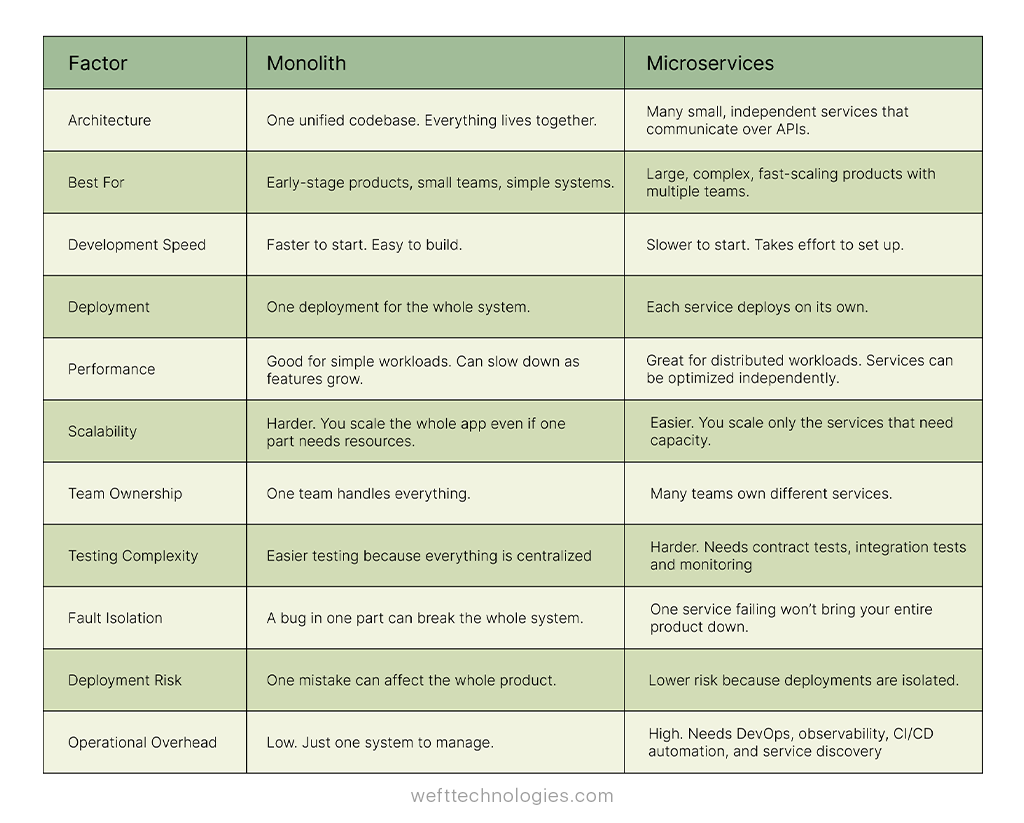
The choice often comes down to simple architecture vs microservices. One gives you speed and focus. The other gives you flexibility and scalability.
The Real Question
Many companies adopt microservices because they think it is what modern companies use. But microservices are not a fashion statement. They are an architectural decision that changes the way your product behaves forever. So the real question is not “Microservices vs Monolith.”
It’s:
- When does your business actually need microservices?
- When is a monolith the smarter choice?
When You Should Use Microservices
Here are the clear situations where microservices make perfect sense:
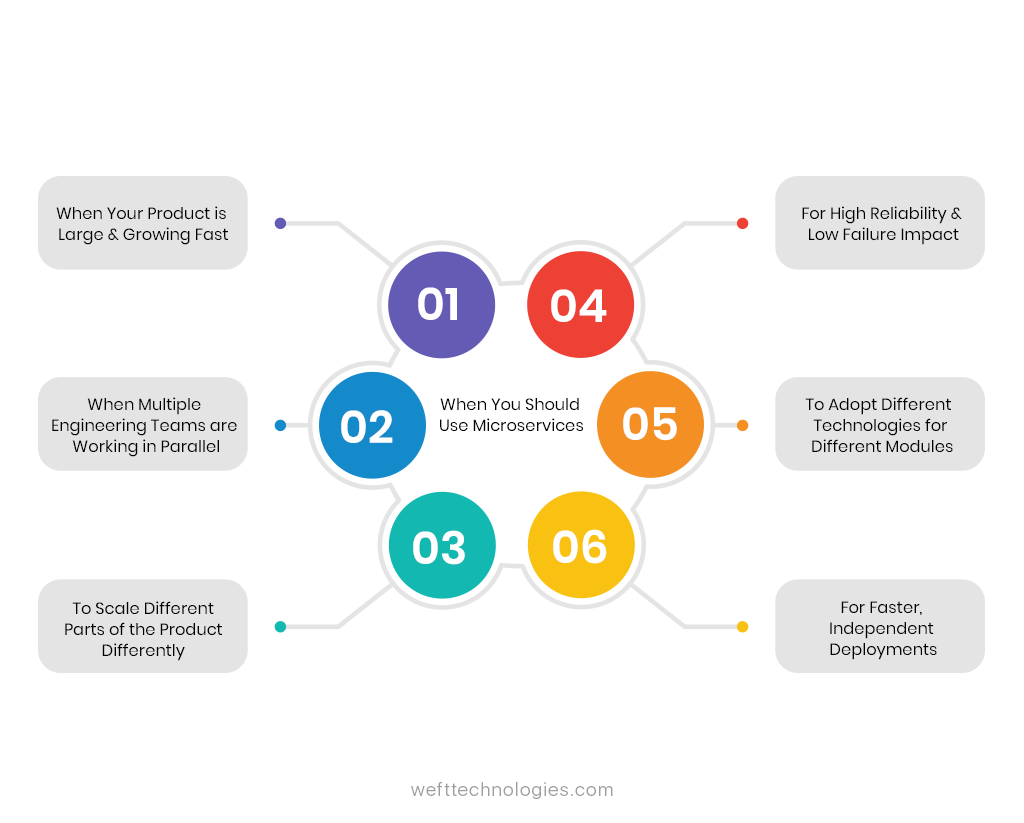
1. When Your Product is Large & Growing Fast
If your product has many modules that operate semi-independently, a monolith becomes harder to manage. For example, your product might have the following modules:
- Search
- Billing
- Authentication
- Recommendations
- Notifications
- Analytics
- Chat
- Integrations
In this case, as your codebase grows, deployments get slower. A small change in one part of the system can break another part.
So, if you’re at this stage, microservices help you:
- Break complexity into manageable pieces
- Isolate issues
- Deploy faster
- Reduce the ‘ripple effect’ of changes
In short, you don’t have to start with microservices. You can just move on to them when your product becomes too big.
2. When Multiple Engineering Teams are Working in Parallel
In a monolith, everyone pushes code into the same place. Which means:
- Merge conflicts
- Slower releases
- More coordination
- More dependencies between teams
Microservices can remove this friction. Each team gets its own codebase and deployment pipeline.
For example:
- A ‘Search team’ owns the search service
- A ‘Billing team’ owns the billing service
- A ‘Messaging team’ owns notifications and chat
This way, teams don’t block each other, work moves faster, and ownership becomes clear.
So, if you have 25+ developers, multiple independent feature teams, and fast-moving squads, microservices unlock a lot of productivity.
3. To Scale Different Parts of the Product Differently
Not all parts of your product scale the same way. For example:
- Search gets 1,000,000 requests per day
- Billing gets 50,000
- Notifications get 300,000
- Authentication gets 500,000
With a monolith, you have to scale everything at once, even the parts that don’t need it. With microservices, you scale only the services that require it. This reduces costs and improves performance. So if your traffic patterns are uneven, microservices make scaling much more efficient.
4. For High Reliability & Low Failure Impact
In a monolith:
- One bug can crash the entire application
- A database lock can affect all modules
- One slow service can slow down everything
In microservices:
- Failures are contained
- Only the affected service goes down
- Other services continue running
For example, in a microservice architecture, if the ‘Recommendation Service’ fails, users will still be able to log in, make payments, browse products, etc. This is why mission-critical products shift away from monoliths as they grow.
5. To Adopt Different Technologies for Different Modules
Microservices allow you to pick the best tool for each service. Here are some examples:
- Python for analytics
- Node.js for real-time chat
- Go for high-performance APIs
- Java for large enterprise workflows
If you’re building a diverse platform, this flexibility helps a lot. A single technology stack becomes a limitation over time.
6. For Faster, Independent Deployments
In a monolith:
- You deploy everything at once
- Even small changes need full regression testing
- Rollbacks are slow
- A failed deployment affects everyone
In microservices:
- Each service has its own deployment pipeline
- You deploy only what changed
- Rollbacks are quick
- Risk is isolated
If you’re releasing frequently and want continuous deployment, microservices help you ship safely without slowing teams down.
When You Should Not Use Microservices
You might now be thinking that microservices sound modern. They sound efficient. They sound scalable. But in many situations, they actually slow you down. Here are the situations when not to use microservices:
1.When You’re an Early-Stage Startup
Early-stage startups sometimes build microservices because:
- They want future scalability
- They want to follow best practices
- They want to grow fast
But the truth is that early-stage products do not need microservices. At this initial stage, what they need is:
- Speed
- Focus
- Experimentation
- Quick iterations
- Ability to pivot
- Ability to rewrite easily
But microservices add more DevOps, more infrastructure, more maintenance, more communication between services, and more debugging complexity. At this stage, the operational cost of microservices becomes an unnecessary weight. Ultimately, you end up spending time on architecture instead of product. So, in the beginning, a monolith is almost always the better choice. You can always move to microservices later.
2. When Your Team is Small
Microservices require:
- A DevOps team
- Clear ownership models
- Logging and monitoring systems
- Distributed tracing
- CI/CD pipelines for each service
- Engineers experienced with distributed systems
A 4-person engineering team does not need all this overhead. Such teams can ship faster with a monolith. Remember, small teams need focus, not fragmentation.
3. When Your Product is not Complex
If your product is simple, like a SaaS dashboard, a booking system, a marketplace MVP, a CRM for small businesses, or a simple custom software development project, microservices will only add complexity. On the other hand, a monolith will do the job perfectly and will be easier to manage.
4. When You Don’t Have Strong Engineering Maturity
Microservices demand discipline. You need:
- API versioning
- Log aggregation
- Observability tools
- Retry logic
- Rate limiting
- Authentication between services
- Monitoring dashboards
- Database isolation
- Clear team ownership
- A culture of documentation
Without these, microservices collapse into chaos. Thus, instead of solving problems, they create new ones.
5. When You Don’t Have the Infrastructure Budget
Microservices cost more. You need more compute, more storage, more databases, more containers, more load balancers, API gateways, monitoring tools, logging tools, security layers, and DevOps engineers. On the other hand, a monolith is much cheaper to run. For many businesses, jumping early into microservices becomes a financial burden.
6. When Your Product Still Changes Too Frequently
Microservices work best when boundaries are stable. If your features are changing every week, splitting the product early creates:
- Poor service boundaries
- Constant refactoring
- API rewrites
- Services that don’t make sense after a few months
You’ll spend more time reorganizing the architecture than building the product.
The Realistic Path for Companies Looking to Move to Microservices
Most successful companies follow this pattern:
Start with a monolith
Fast. Simple. Great for MVPs and early growth.
Modularize the monolith internally
Break the codebase into internal modules, but keep it as one deployment.
Identify bottlenecks
This includes search, notifications, billing, authentication, media processing, and real-time features.
Extract services one by one
Move one module into its own service. Test. Stabilize. Repeat.
Keep core logic inside the monolith
Until it absolutely needs to move.
This approach reduces risk and helps teams adopt microservices gradually.
How to Know if You are Ready for Microservices
Here is a checklist to help you out. If you check 3 or more of these boxes, you’re ready for microservices:
- Your monolith deploy times are slowing down the team
- Different teams are waiting on each other
- Bugs in one module break unrelated modules
- You want to release features independently
- Some modules receive far more traffic than others
- You plan to scale internationally
- You want to use different technologies for different parts
- You have a DevOps team
- You have engineering maturity
- You have the budget
If you check fewer than 3, stick to a monolith for now.
Common Microservices Mistakes to Avoid
A lot of companies jump into microservices and struggle. Not because microservices are bad, but because teams adopt them for the wrong reasons. Here are the mistakes that happen most often.
- Moving Too Early
This is the biggest one. Teams adopt microservices when:
- They don’t have traffic
- They don’t have users
- They don’t have a stable product
- They don’t have PMF
- They don’t have a DevOps team
This slows everything down and increases cost for no reason.
- Splitting Services Without Clear Boundaries
If the boundaries are unclear, you will face:
- Endless API rewrites
- Constant refactoring
- Circular dependencies
- Poor ownership
- Fragile services
Microservices only work when boundaries are clear. If they’re not, the architecture collapses.
- Building Too Many Services At Once
Breaking everything into microservices leads to:
- Too many pipelines
- Too much monitoring
- Too much infra
- Too much cognitive load
The right way is always one service at a time.
- No Proper Observability
Without logs, dashboards, tracing, monitoring, and alerts, microservices are almost impossible to debug. Distributed systems need visibility.
- Each Service Choosing a Different Tech Stack Unnecessarily
Flexibility is good. Chaos is not. You don’t need 8 languages, 5 frameworks, 6 database engines, and 4 API protocols. This will only make hiring, debugging, and scaling extremely painful. Use diverse stacks only when necessary.
- Forgetting The Cost
Microservices increase infrastructure spend. Many teams underestimate this. Each service may need:
- Separate compute
- Separate storage
- Load balancing
- Caching
- API gateways
- CI/CD pipelines
- Monitoring systems
The bill adds up fast.
- Not Preparing for Distributed Failures
In a microservices world, network calls fail, APIs timeout, services go down, and messages get lost. If you don’t design for failure, the architecture becomes unstable very quickly.
Final Thoughts
Microservices are not a silver bullet. They solve real problems. But only when you’re facing those problems. Microservices give you scalability, flexibility, reliability, independent deployment, and team autonomy. But they also require higher costs, more DevOps, more tools, stronger processes, clear boundaries, experienced engineers, and a stable product.
Ultimately, like most things in tech, the right answer is not the ‘cool’ one. It’s the one that fits your stage of growth. So, build simple at first, then move on to build strong. Only build scalable when the scale arrives. That’s the right way to use microservices.

We are here to help you with growth
Contact Our ExpertsLatest Blogs
- From Prototype to Production: Building Custom AI Software for Long-Term ROI
- How to Achieve Product-Led Growth in 2026? The Right Strategies for a Successful Product
- How to Pivot a SaaS Startup Successfully: A Strategic, Data-Driven Guide for Founders
- A Complete Guide to Go-To-Market for Products and Services