


When you are building the first version of your product, one question will always come up. Should you move fast, or build for scale?
This is one of the most common dilemmas founders face in early product development. On one hand, you want to get your product out there quickly. On the other hand, you don’t want to build something that breaks when you grow. Balancing speed vs scalability in product development is not as simple as choosing one over the other. You need to know which to prioritize and why.
The First Version of Your Product – V1
The first version of your product is called V1. When you start building this, you have to remind yourself that the V1 is not your forever product. It is just your starting point.
With the V1, your aim should be to build the simplest, functional version of your product that solves one core problem. That’s how Duolingo, Dropbox, and Spotify began. Each of them started small, validated early, and then scaled with confidence. Speed helped them reach the market faster. But scalability helped them stay there.
How to Choose the Right Features for V1
The temptation to add “just one more feature” never goes away. But when building your first version, restraint is key. Ask yourself: ‘Does this feature directly support the core value my user came for?’ If not, it can wait.
Pro Tip – Group your feature ideas into three:
- Must-haves
- Nice-to-haves
- Later-to-haves
Build only the first list. Everything else can wait for version 2. Remember, simplicity drives speed. Complexity delays validation.
Here’s a quick checklist you can refer to before you start building the V1 product:
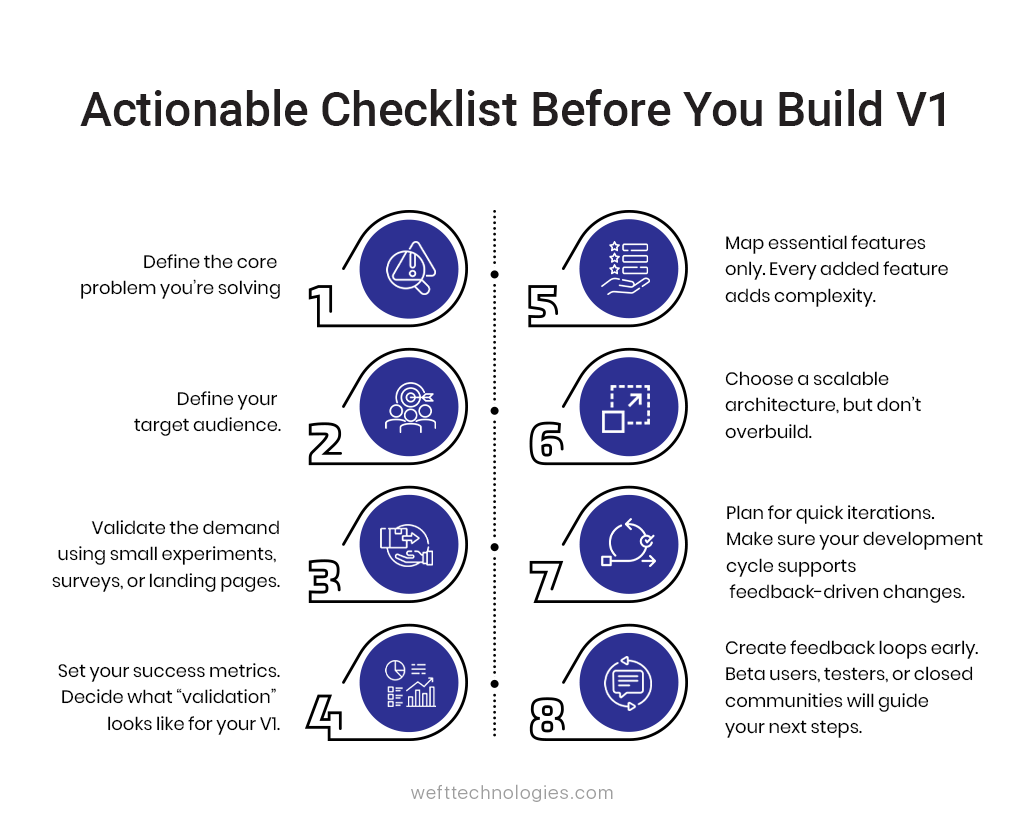
Define the core problem you’re solving.
Define your target audience.
Validate the demand using small experiments, surveys, or landing pages.
Set your success metrics. Decide what “validation” looks like for your V1.
Map essential features only. Every added feature adds complexity.
Choose a scalable architecture, but don’t overbuild.
Plan for quick iterations. Make sure your development cycle supports feedback-driven changes.
Create feedback loops early. Beta users, testers, or closed communities will guide your next steps.
These steps don’t slow you down. They make sure the speed you choose is directionally correct.
Why Founders Prioritize Speed
When we talk about speed vs scalability for startups, it’s easy to see why speed wins the early rounds. Speed means:
- Faster time to market
- Quicker validation
- Lower cost
- Early user feedback
Many startups struggle with limited funding, limited teams, and high uncertainty. The solution to all these challenges is to ship fast and learn faster. By focusing on speed, you can get your V1 product in the hands of users quickly. You can collect insights, make changes, and refine. After all, that’s what early-stage product development is all about. It’s all about movement over perfection.
The story of Dropbox proves this. Even before they launched the product, they launched an explainer video. The purpose of this video was to test demand. Consequently, this innovative V1 proved interest long before a single line of complex, scalable code was written. That’s what speed can do for you. It can open doors before you spend big.
Technical Debt in Early Development
Sometimes, in a rush to build quickly, we make compromises. This could include skipping documentation, testing less, or using quick fixes. These shortcuts are called technical debt.
Technical debt isn’t bad by itself. It becomes a problem when it’s ignored. If you don’t plan to “repay” that debt later, it can slow your team down and make scaling painful.
The trick is to be intentional. Take on small, manageable technical debt early to move fast. However, create a plan to clean it up once your product shows traction. That’s how you keep speed and scalability from working against each other.
Balancing Speed and Quality in Early Development
Speed is exciting, but unchecked speed can lead to a poor user experience. Founders often confuse “fast” with “rushed.” Here’s how you can maintain quality while building fast:
- Use modular code so that you can swap parts later without breaking the system.
- Document everything. Future developers (including you) will thank you.
- Set clear standards for testing, even if it’s basic.
- Choose proven frameworks instead of building everything from scratch.
A fast, high-quality V1 comes from structure and clarity, not chaos.
Scalability Can’t Wait Forever
We just saw how speed can positively impact your digital product development journey. However, scalability cannot be avoided. Here is the thing. Speed gets you to market, but scalability keeps you there.
Think about it like this – Your product may have satisfied 100 users. But what if it collapses when 10,000 people sign up? This is where product scalability vs speed comes into play. If your product isn’t built on a scalable base, every new user becomes a new headache. You will face:
- Slow load times
- Server crashes
- Messy architecture
So, while you prioritize speed, don’t ignore scalability. Build light, but build smart. Make choices that allow you to expand when needed. This way, you won’t have to rebuild from scratch.
Think of Amazon. Its first version was simple. It was just an online bookstore. But Jeff Bezos designed it with a long-term vision in mind. He knew books were only the beginning. That’s why the foundation he built could later support millions of products across categories. That’s the balance you need. Build fast, but leave room to grow.
Planning for Future Scalability Without Overbuilding
Scalability isn’t about building a giant, bulletproof system from day one. It’s about making choices today that won’t block you tomorrow.
Some practical ways to prepare for growth without slowing down your V1:
- Design modular features that can be updated or replaced easily.
- Choose lightweight frameworks and architecture that allow expansion.
- Keep your code and systems simple but organized—future teams should be able to understand and scale them quickly.
- Think API-first. Even small integrations today can save months later.
The idea is simple: you don’t need to build everything for millions of users immediately. But if you lay a flexible foundation now, scaling later becomes easier, faster, and less painful.
The Real Challenge
It’s not a battle between speed and scalability. It’s a balance. You need to master this balance between speed and scalability for your product to succeed.
Here’s how you can prioritize speed and scalability at different stages of the product development journey:
| Development Stage | Priority | Reasoning |
| Validation Stage | Speed | You need quick feedback to test if the problem is worth solving. |
| Early Market Fit | Scalability Foundations | You need to refine your architecture and workflows for steady growth. |
| Growth & Expansion | Scalability | You need to optimize systems, design, and infrastructure for scale. |
What you need to know is that perfection is not a goal at this point. Precious time could be wasted if you try to perfect scalability before you even test for demand. On the other hand, if you ignore scalability completely, you will later end up wasting resources trying to fix that.
Measuring Speed vs Scalability: What Metrics Matter
Speed and scalability can both be measured.
When you move fast, measure things like:
- Deployment frequency
- Time from idea to release
- Customer feedback cycles
For scalability, track:
- Load capacity
- System uptime
- Performance under stress
- Cost per user as you grow
Metrics give you visibility. They help you know whether you’re building momentum or bottlenecks.
Speed vs Scalability in MVP Development
When you’re in the MVP stage, the speed vs scalability in MVP development discussion becomes even more crucial. MVPs are meant to be fast, flexible, and focused. You don’t need to worry about scaling, at least, not beyond your test audience. But that doesn’t mean you build carelessly. The key here is to build an MVP that can be later improved upon.
Here’s how you can accomplish that:
- Use frameworks that allow quick iterations
- Build a product that allows features to be added or replaced later
- Focus on functionality and avoid over-engineering
- Focus on scalability during architecture planning
Spotify did this well. Their MVP started as a simple, closed beta in Sweden. But their backend was designed to support more users once the feedback confirmed demand. That’s what we mean when we say build fast, but build smart.
The Role of Team and Tools in Balancing Both
Your team plays a bigger role in the speed vs scalability debate than most people realize. The right idea, the right plan, and the right market are not enough. You also need the right team. And the right MVP development company/team will know what matters now and what can wait. That clarity alone can save weeks in development.
The tools you use also shape how smoothly things move. You don’t need too many. You just need the ones that help you build fast without losing control. Tools that help with version control, quick testing, and simple deployment can keep things flexible. In short, it’s not about using every new tool out there. It’s about using the right ones that keep your team focused and your process simple.
When your team communicates well and your tools work quietly in the background, speed and scalability stop feeling like opposites. They start working together.
The Funding Factor
Your funding/budget can also influence your speed vs scalability decision.
- Bootstrapped startups often prioritize speed because they need validation before investing more.
- Seed-funded startups can afford to plan scalability early while still moving fast.
- Growth-stage companies should focus on scalability since their audience and data demands are growing.
In short, your budget determines your flexibility, but your vision determines how wisely you use it.
Common Mistakes Founders Make
Many startups get the development priorities for V1 wrong. They either:
- Over-optimize for scale too soon.
- Or rush through development without a clear long-term plan.
Let’s look at both sides.
- Over-Optimizing for Scalability
This happens when founders want their first version to be “perfect.” They build complex systems, plan for millions of users, and spend months refining before launch. But the truth? Most first products never need that level of infrastructure right away.
Result – You end up losing speed, and maybe your market window too.
- Ignoring Scalability Completely
On the other hand, some founders treat V1 as a throwaway build. They patch features together quickly, use shortcuts, and ignore future growth. That’s equally dangerous.
Result – Once you gain traction, rebuilding everything becomes costly and time-consuming.
The smarter path is in between. Build lean, but keep scalability in the blueprint.
Building V1 – Speed or Scalability?
So what’s the answer? When it comes to first version development: speed or scalability, the answer depends on your stage, your market, and your resources.
Choose speed if:
- You’re validating an idea
- You’re bootstrapped or in an early funding stage
- You need real-world feedback fast
Choose scalability if:
- You already have validation and funding
- The market is high demand
- Your product needs to support large volumes
What Happens after Launch?
Once your V1 is out, your real work begins. Every click, complaint, and compliment is a clue. Use that data to refine your product decisions.
A few tips to make feedback actionable:
- Group feedback by frequency and impact.
- Prioritize those issues that affect user experience.
- Filter suggestions based on your product vision.
- Measure key metrics like user retention, churn rate, and engagement.
Following these steps will help you scale in the right direction, not just grow for the sake of it.
When to Move from MVP to Full Product
Here’s how to know when it is time to scale to a full product:
- Consistent Demand – Your user base grows naturally.
- Stable Feedback Loop – Users rely on your product and engage regularly.
- Technical Readiness – Your system can handle more load without major rewrites.
When those signs appear, move from testing mode to scaling mode. Expand your team, refine your architecture, and invest in optimization.
Final Thoughts
Speed helps you ship. Scalability helps you sustain. The best founders don’t choose one over the other; they time them right. Building a product is not about racing or over-preparing. It’s about learning fast, adapting smart, and laying the groundwork for growth. Your V1 doesn’t have to be perfect. It just has to work well enough to prove that your vision deserves to scale.

We are here to help you with growth
Contact Our ExpertsLatest Blogs
- From Prototype to Production: Building Custom AI Software for Long-Term ROI
- How to Achieve Product-Led Growth in 2026? The Right Strategies for a Successful Product
- How to Pivot a SaaS Startup Successfully: A Strategic, Data-Driven Guide for Founders
- A Complete Guide to Go-To-Market for Products and Services