


If you spend enough time around founders, product teams, or startup circles, you’ll hear one term come up again and again. GTM. “We need a GTM.” “Our GTM isn’t working.” “Let’s rethink our go-to-market.” You will keep hearing it again and again. It sounds important. And it is.
But here’s the problem. Most people talk about Go-To-Market without really understanding what it means. It gets reduced to a launch plan. Or a sales strategy. Or a marketing checklist. In reality, GTM is none of those things alone.
This guide breaks it down properly. We’ll cover the go-to-market meaning, why it matters, how GTM actually works, and how startups can build a GTM strategy that doesn’t fall apart after launch.
The Basics: Go-To-Market Meaning
Go-To-Market is the plan for how a product reaches its customers. Not just how you launch it. But how you:
- Identify the right audience
- Position the product
- Price it
- Distribute it
- Sell it
- Support it
In simple terms, a Go-To-Market strategy explains how your product moves from being built to being bought. This is why GTM for products is not optional. Even the best product fails without a clear path to market.
Note – In many businesses, GTM is closely tied to digital transformation strategy. Especially when selling SaaS products, introducing automation, or replacing legacy systems. In these cases, GTM must address change management, not just adoption.
Why GTM Exists in the First Place
Most failed products don’t fail because of bad engineering. They fail because:
- The wrong people were targeted
- The problem wasn’t urgent enough
- The pricing didn’t match the value
- Sales and marketing weren’t aligned
GTM exists to prevent these mistakes. It forces teams to answer uncomfortable questions before money, time, and energy are wasted.
GTM Is Not Just for Big Companies
There’s a common misconception that Go-To-Market is something you worry about after you scale. That’s wrong. GTM for startups is even more critical. Why? Because startups don’t have the luxury of:
- Long trial-and-error cycles
- Large marketing budgets
- Brand recognition
A clear GTM strategy for startups helps focus limited resources on what actually moves the needle.
GTM for Services vs GTM for Products
Not every business goes to market the same way. Yet many founders apply product-style GTM thinking to service businesses. Or worse, service-style thinking to products. This mismatch creates confusion, slow growth, and weak positioning.
While the fundamentals of Go-To-Market remain the same, how they play out differ significantly between services and products.
GTM for Products
When you’re selling a product, especially a digital one, your GTM revolves around scale. Products are built once and sold many times. This changes how you think about:
- Distribution
- Pricing
- Sales effort
- Customer onboarding
A Go-To-Market strategy for products focuses heavily on:
- Clear positioning around a specific problem
- Repeatable acquisition channels
- Reducing friction in adoption
- Driving product-market fit before aggressive growth
This is why GTM for products is deeply tied to:
- MVP development strategy
- Product usage data
- Feedback loops
- Retention metrics
In product-led or SaaS models, GTM decisions often show up inside the product itself. Onboarding flows. Feature gating. Trial experiences. Pricing tiers. These are not just product decisions. They are GTM decisions.
Another key difference is risk. With products, you invest heavily upfront. Engineering, design, infrastructure. If GTM fails, the cost is high. This makes early validation critical. A weak GTM can hide problems until scale exposes them painfully.
GTM for Services
Services go to market differently because they scale through people, not code. In service-based businesses, GTM revolves around:
- Trust
- Expertise
- Relationships
- Delivery capability
You are not selling a packaged product. You are selling outcomes. And often, you are selling yourself or your team. This changes everything.
A Go-To-Market approach for services places more weight on:
- Credibility and proof
- Clear scoping of offerings
- Sales conversations over funnels
- Longer buying cycles
Pricing in services GTM is also more nuanced. It is rarely fixed. It depends on scope, effort, timelines, and perceived value. This makes positioning even more important. If the value is not clear, pricing conversations break down quickly.
Unlike products, services often rely on:
- Founder-led sales
- Referrals
- Partnerships
- Content-driven trust building
Here, GTM success is less about volume and more about the quality of leads. One wrong client can derail delivery. One misaligned promise can damage a reputation.
Why This Difference Matters
Many early-stage founders assume GTM means “marketing harder.” But in services, GTM often means:
- Saying no more often
- Narrowing focus
- Defining who you work best with
And in products, GTM often means:
- Reducing complexity
- Cutting features
- Obsessing over adoption, not just acquisition
Confusing the two leads to predictable problems. Service businesses chase scale before stability. Product businesses over-customize and lose focus.
A strong Go-To-Market strategy respects the nature of what you are selling.
Hybrid Businesses Need Hybrid GTM Thinking
Many modern startups sit in between. Productized services. SaaS with heavy onboarding. Consulting backed by platforms. In these cases, GTM must borrow from both worlds. This is where many GTM strategies fall apart. Teams treat GTM as a template instead of a design problem.
The right approach is intentional. You decide:
- What needs to scale
- What should stay high-touch
- Where automation helps
- Where human involvement is non-negotiable
There is no universal GTM playbook. Only alignment between what you sell and how you sell it.
The Core Elements of a Go-To-Market Strategy
A strong Go-To-Market strategy is built on a few non-negotiable fundamentals. Let’s break them down:
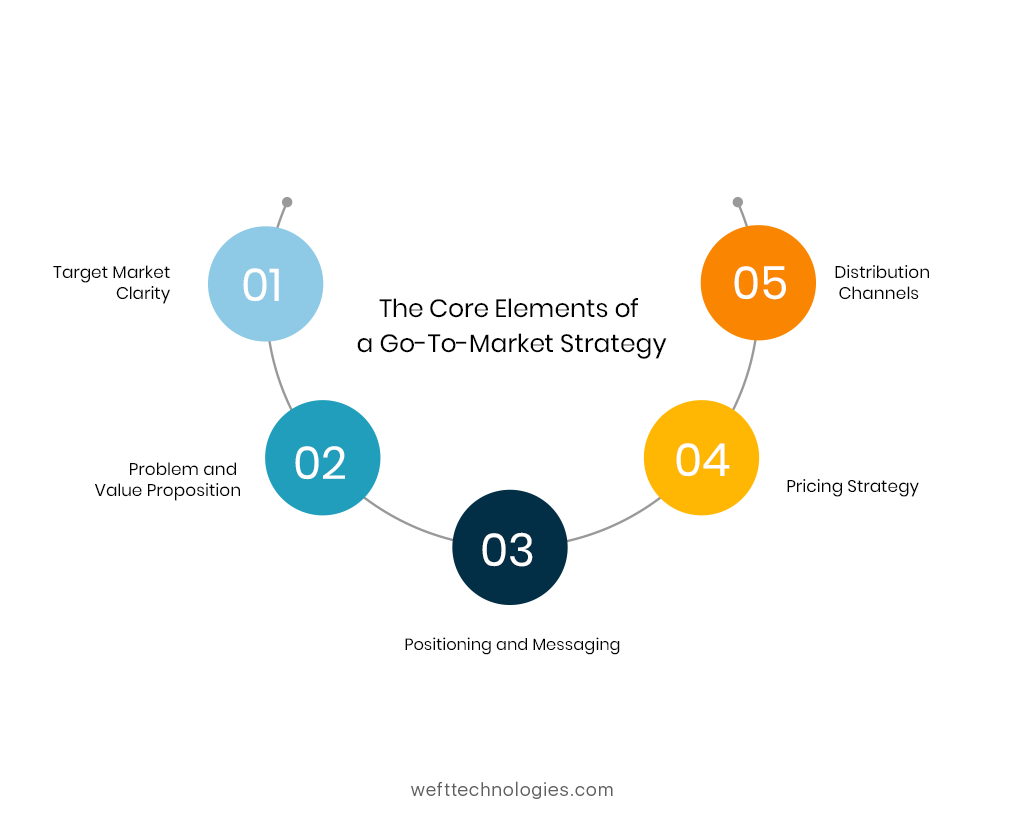
- Target Market Clarity
You cannot sell to everyone. Yet many products try to. A solid GTM starts with defining:
- Who the product is for
- Who it is not for
- Which segment feels the pain most acutely
In short, if the problem isn’t painful enough, no GTM model can save you.
This is also where GTM fundamentals overlap with product-market fit. GTM does not create product-market fit. But it helps you discover it faster. A weak GTM hides problems. A strong GTM exposes them early. This feedback loop is critical for startups.
- Problem and Value Proposition
Your product is not the hero. The customer’s problem is. A strong Go-To-Market approach clearly articulates:
- What problem you solve
- Why it matters now
- Why your solution is better or different
This clarity drives everything else. Messaging. Sales conversations. Marketing content.
- Positioning and Messaging
Positioning is about context. Messaging is about language. Together, they define how the market perceives you. A weak GTM often fails here. Not because the product is bad. But because the story doesn’t land.
- Pricing Strategy
Pricing is part of your GTM, whether you like it or not. Too low, and you signal low value. Too high, and you block adoption.
A good Go-To-Market strategy aligns pricing with:
- Customer expectations
- Competitive landscape
- Perceived value
- Distribution Channels
How will customers actually find and buy your product? Options include:
- Direct sales
- Inside sales
- Self-serve
- Partnerships
- Marketplaces
Your go-to-market model depends heavily on this choice.
Understanding the GTM Model
A GTM model is the structure behind your Go-To-Market strategy. It defines:
- Who sells the product
- How it’s sold
- At what scale
Common go-to-market models include:
- Founder-led sales
- Sales-led growth
- Product-led growth
- Channel-led growth
There is no universal best GTM model. The right one depends on the product, market, and stage.
A Misconception About GTM for Products
People assume GTM is something you do once. That is another common mistake. In reality:
- Every new product needs its own GTM
- Every major feature shift impacts GTM
- Every new market requires GTM rethinking
GTM for products is an ongoing process, not a one-time exercise.
Where an MVP Fits Into GTM
MVP and GTM are closely connected. An MVP development strategy should support your GTM assumptions. Not the other way around.
Your MVP exists to:
- Test the problem
- Validate demand
- Learn how users adopt the solution
These insights directly feed into your Go-To-Market approach. This is why startup product consulting often combines MVP development and GTM planning.
Product Launch Strategy vs. GTM Strategy
A product launch strategy is a subset of GTM.
A product launch strategy answers:
- When do we release?
- How do we announce it?
GTM strategy answers:
- Who do we sell to long-term?
- How do we grow?
- How do we retain customers?
Confusing the two leads to short-lived traction.
GTM Mistakes Founders Keep Repeating
These mistakes show up again and again. Across industries. Across stages.
- Treating GTM as a one-time launch task
- Targeting everyone instead of one clear segment
- Building features before validating demand
- Confusing activity with traction
- Letting sales, marketing, and product work in silos
Most of these mistakes don’t come from bad intent. They come from pressure. Pressure to grow fast. Pressure to look busy. Pressure to copy what others are doing.
Remember, a strong Go-To-Market approach slows things down just enough to make better decisions.
Building a Practical Go-To-Market Approach
Here’s a simple framework. Not perfect. But practical.
- Define a narrow target segment
- Validate the core problem
- Build an MVP aligned with GTM
- Test pricing and messaging
- Choose one primary channel
- Measure and iterate
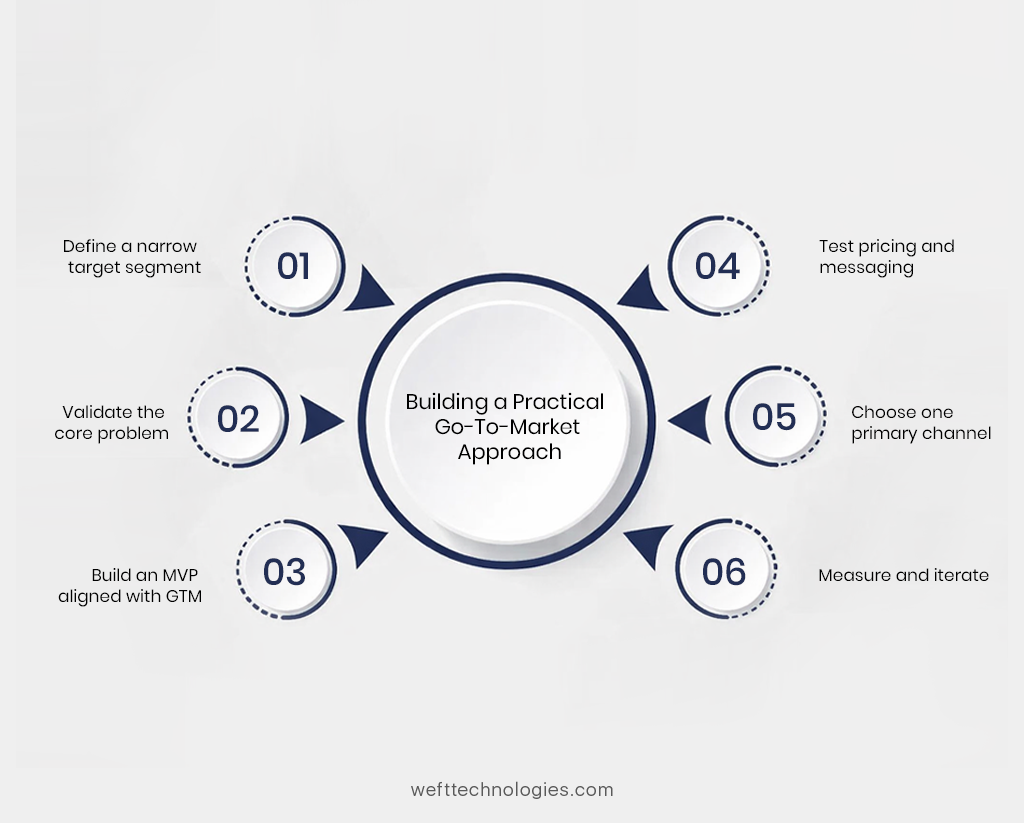
This keeps your GTM grounded and flexible.
A Practical GTM Framework for Early vs. Growth-Stage Startups
Not all startups need the same Go-To-Market approach. Yet many founders blindly copy GTM playbooks from companies that are at a completely different stage. That’s where things start breaking.
Your GTM should evolve as your company evolves. What works when you’re pre-seed will fail once you’re scaling. And what works at scale will crush a young startup under unnecessary complexity.
GTM for Early-Stage Startups (Pre-Seed to Early Seed)
At this stage, GTM is not about growth. It’s about learning. Your product is still taking shape. Your ideal customer is still slightly blurry. Your messaging will change. And that’s normal.
The goal of GTM here is to answer a few core questions:
- Does this problem really hurt?
- Are people willing to pay to solve it?
- How do they describe the problem in their own words?
Your GTM should be narrow and founder-led. This usually means:
- Direct conversations with customers
- Manual outreach
- Founder-led sales
- Small, controlled experiments
You are not trying to scale channels yet. You are trying to understand behavior. At this stage, a good GTM looks like:
- One clear target segment
- One core problem
- One primary channel
- One simple value proposition
Anything more than that creates noise.
This is also where GTM overlaps heavily with MVP development strategy. Your MVP is not meant to impress the market. It’s meant to validate assumptions. Every sales call, demo, or rejection is GTM feedback. Ignore it, and you lose your biggest advantage as a startup.
GTM for Seed to Early Growth Startups
Once you see repeatable demand, GTM starts to shift. You’re no longer asking if the product should exist. You’re asking how it should grow. At this stage, your GTM needs more structure, but still needs flexibility. Key focus areas now include:
- Sharpening positioning
- Refining pricing
- Identifying early repeatable channels
- Reducing friction in the sales process
This is where founders often make a mistake. They jump straight into ‘scaling’ before their GTM is stable. Instead, the right approach is:
- Double down on what’s already working
- Say no to new segments
- Improve conversion, not volume
Your GTM model here may still be founder-led, but with early sales or marketing support. Product, sales, and marketing alignment becomes critical. Silos start hurting more at this stage.
GTM for Growth-Stage Startups (Series A and Beyond)
Now, your GTM becomes a system. The product has traction. The market is clearer. The focus shifts from discovery to efficiency. At this stage, GTM is about:
- Predictable pipelines
- Channel optimization
- Scalable onboarding
- Retention and expansion
Your go-to-market model might now include:
- Dedicated sales teams
- Defined inbound and outbound strategies
- Partnerships
- Structured customer success
But even here, your GTM is not ‘done’. Markets change. Competitors adapt. Customer expectations evolve. A growth-stage GTM that doesn’t evolve quietly starts decaying.
This is also where the digital transformation strategy becomes more visible in GTM. Especially in B2B and SaaS, selling the product often means selling change. Your GTM must address adoption friction, not just acquisition.
One Important Reminder for Founders
GTM maturity should match your company’s maturity. If you:
- Add process too early you slow learning
- Delay structure too long, you block scale
The best GTM strategies evolve in layers. Simple first. Structured later. That’s how you avoid overengineering GTM before the market is ready for it.
Real-World GTM Signals Founders Should Track
Not all Go-To-Market signals live on dashboards. Some of the most important ones show up in everyday conversations and behaviour. Especially early on.
Here’s what actually matters:
- How people react when you explain the product
If your GTM is clear, people get it quickly. They relate it to their own problem. If you need long explanations or constant clarifications, something in your positioning is off.
- Sales conversations that move forward naturally
When GTM works, sales calls feel easier. Prospects ask about timelines, onboarding, or fit. When it doesn’t, you spend most of the call convincing instead of validating.
- Who reaches out to you
Good GTM attracts the right people. Not just more leads, but better-fit ones. If inbound interest is consistently misaligned, your targeting or messaging needs correction.
- Repeated customer language
When different customers describe the same pain in similar words, pay attention. That repetition is a strong GTM signal. It means you’re solving a real, shared problem.
- Less pushback on pricing
Price objections happen. But when the value is clear, pricing discussions change. Constant resistance usually points to weak value perception, not wrong pricing.
These signals show up before clean metrics do. Founders who notice them early adjust faster. And that’s what a strong GTM is really about.
When to Revisit Your GTM Strategy
GTM is not static. Revisit it when:
- Growth stalls
- Customer churn increases
- Entering a new market
- Launching a major product update
Remember, ignoring GTM signals is expensive.
The Role of Startup Product Consulting in GTM
Many founders struggle with GTM, not because they lack ideas. But because they lack perspective. Startup product consulting helps teams:
- Challenge assumptions
- Simplify strategy
- Align product and market realities
Good consulting doesn’t add complexity. It removes it.
Final Thoughts
Go-To-Market is not a slide deck. It’s not a launch checklist. It’s a discipline. One that sits at the intersection of product, sales, marketing, and customer success. Whether you’re building your first MVP or scaling an existing product, GTM determines how effectively your product meets the market. Get it wrong, and even great products struggle. Get it right, and growth becomes intentional. That’s what GTM is really about.

We are here to help you with growth
Contact Our ExpertsLatest Blogs
- From Prototype to Production: Building Custom AI Software for Long-Term ROI
- How to Achieve Product-Led Growth in 2026? The Right Strategies for a Successful Product
- How to Pivot a SaaS Startup Successfully: A Strategic, Data-Driven Guide for Founders
- Market Research for MVP Development: A Complete Guide for Founders