

Every startup founder eventually faces the same hard question time and again: Should we partner with a “product agency” or invest in an “in-house product team”?
If you are about to dismiss it as a mere staffing decision, you are wrong. It’s more of a strategic hinge point that influences so many factors, including speed to market, budget, ownership, scalability, etc.
Choosing between outsourcing and internal build, in fact, has the potential to define the trajectory of your startup product development.
A wrong move can delay your MVP launch or balloon up your budget altogether. The right approach, however, will have the potential to align with founders’ vision, technical maturity, and growth goals.
So to sum it up, your build vs buy product strategy will set the tone for the journey ahead.
And here is a little startup founders’ product development guide to help you unpack more details on the topic, like when to engage a product development company, when to build in-house, how to compare costs (especially in the Indian context), and how to apply a decision framework that suits your startup’s stage.
Understanding the Two Product Development Approaches
What Is a Product Agency and How Does It Work?
A product development agency typically provides full-cycle services: product discovery, UI/UX, engineering (frontend & backend), QA, launch, and often scaling.
Key aspects:
- You can hire an agency for very specific deliverables like MVP, upgrade, feature set, etc, rather than hiring them on a full-time basis.
- The agency usually brings in a multi-disciplinary team alongside them (including designers, developers, and product managers) immediately, thereby avoiding months of strategic planning and consecutive hiring.
- Ideal for startups without deep technical leadership or wanting to test a hypothesis before committing.
- The model is an example of outsourcing product development, in contrast with building everything in-house.
What Does It Mean to Build an In-House Product Team?
Building your own in-house product team basically means recruiting designers, developers, QA, maybe even a product manager or technical lead, with your money to work under your direction within your startup.
Key aspects:
- Here, you will have full control over the team, culture, process, architecture, and tooling.
- Over time, as the product matures, an in-house team can develop into your strategic asset that owns the knowledge.
However, the cost of building an in-house product team could be so much more than you imagine. Salaries of each employee, benefits, tooling, infrastructure, hiring delays, training overhead, etc, could burden you greatly.
Product Velocity vs Product Ownership: What Founders Often Overlook
Many founders focus on how fast a product can hit the market and often assume that speed is always the primary advantage. But here’s the nuance: product velocity (speed of delivery) and product ownership (deep knowledge and control) pull in different directions.
- Agency Advantage (Velocity):
A product agency is tuned to deliver quickly. They, in fact, may have ready teams, established workflows, and thus can bring an MVP from concept to launch in weeks rather than months. This speed, however, becomes critical when validating hypotheses, pitching investors, or entering competitive markets.
- In-House Advantage (Ownership):
An in-house product team accumulates institutional knowledge. They understand the ins and outs of your users, product quirks, architecture decisions, and long-term scalability. This depth rather allows for faster iterations in the medium-to-long term, even if the initial velocity is slower.
Why founders must sit down and analyze a bit before making a decision:
- Rushing to market without ownership can create a knowledge gap, and any chances or news for pivoting might become a point of pause and worry.
- Your roadmap planning, tech stack decisions, and MVP evolution all rely on knowing the product intimately.
- A hybrid approach could be the better answer here as it can leverage early velocity from agencies, then gradually shift ownership to an in-house team.
Founder Bandwidth and Focus: Another Most Overlooked Metric
Founders never really think much about their most finite resources: time and mental bandwidth.
- Many founders think they can simply juggle sprint planning, code reviews, hiring developers, and daily standups all at once if they invest a little time into each. While some others try to incorporate validating customers, fundraising, and defining market strategy simultaneously into this mess. This rarely works and could create a muddle even harder to get out of.
- Choosing an MVP development agency can free founders from all this mess and give them much time to focus on high-leverage tasks like building relationships with investors, shaping product-market fit, and developing partnerships, which tends to.
- Conversely, trying to manage an in-house team prematurely can, in fact, dilute focus, slow decision-making, and introduce operational stress that can be avoided if you choose to work with a product development agency.
- Evaluate your personal capacity and the technical maturity of your founding team before committing to in-house development. If bandwidth is limited, agency engagement will certainly be the better choice as it ensures product progress without burning out the team and leadership.
Key Factors Founders Should Evaluate Before Deciding between a product agency and an in-house product team
Before you decide which to choose, a product agency or building in-house, evaluate your startup against the following axes:
- Stage of your startup: Ask yourself if you are at the idea stage, preparing an MVP, or scaling a product with market traction?
- Budget and funding runway: Early-stage founders often have tighter budgets—outsourcing may make more sense in this particular case. Later-stage funding can bear better, the cost of in-house and things like that.
- Technical leadership and internal capability: Ask yourself if you have a CTO or senior engineer to hire/manage an in-house team completely. If not, an agency might certainly be the better choice.
- Talent availability: Consider if it is easy or tough to recruit the necessary tech talent for your company? If it is tough, outsourcing to a product development hub may help.
- Complexity and domain specificity: If you need very niche tech like AI/ML, real-time systems, or enterprise scale, you might hands down consider a specialist product development company or agency because it is always easier to find domain-specific talent in an agency rather than hunting one down for yourself.
Pros and Cons of Hiring a Product Development Agency
Pros
- Speed to market: Agencies come with a team and process; here, you don’t have to start from scratch and so the speed will be remarkable.
- Access to diverse expertise: Product agencies often have specialists across UI/UX, backend, mobile, and QA, and so product design and development services shall be far better.
- Lower upfront cost: For short-term or uncertain projects, you don’t have to commit to full-time hires. According to HQ, “to avoid long-term commitments” is a good enough reason to hire an agency.
Cons
- Less direct control: Because the team is external, you might face slower decision-making or weaker alignment with the overall product vision.
- Potential communication gaps: If the agency you went to is offshore or remote, factors like time zone, language, and cultural differences can come in between.
- Higher risk of dependency: You may become more and more dependent on the agency for updates, maintenance, or even scaling.
Pros and Cons of In-House Development
Pros
- Full control and alignment: You own the team, the process, and the product architecture, which means you get the full authority.
- Long-term strategic asset: As your product evolves and iterates rapidly, having an in-house team enables fast iteration, ownership of IP, etc.
- Team momentum: The hardest part is getting your in-house team aligned with the vision; once that is done successfully, they can move faster with the work.
Cons
- High upfront and ongoing cost: Salaries + benefits + infrastructure + training all add up to a huge amount.
- Time to hire and ramp up: Recruitment, onboarding, setting up processes, all make take a significant amount of time, eventually delaying product traction.
- Limited flexibility: If the product scope changes rapidly, a full in-house team might be under-utilised or somehow misaligned; that is, there is going to be less room for pivoting.
The “Knowledge Drain” Problem: What Happens When Your Agency Moves On
Once the agency leaves, the institutional memory of your product decisions, architecture rationale, and design trade-offs leaves your premises with them. But don’t worry, there are things you could do to avoid this.
Mitigation strategies:
- Maintain detailed documentation, versioned repositories, and clear handover plans.
- Ask the agency to create something like runbooks for ongoing maintenance.
- Involve a technical co-founder or interim tech lead during agency engagement to absorb maximum knowledge.
Cost Comparison: Agency vs Building In-House (Indian Market Insight)
For founders operating from India (or targeting India as a product development hub), cost dynamics matter greatly. Let’s review:
In-House Cost Considerations
- Salaries for developers, UI/UX, QA, product manager – plus benefits, infrastructure (hardware, software licenses), overheads. According to Revelo, employee cost is often 125–140 % of salary when factoring in benefits.
- Hiring delay: months of recruitment mean a lower time-to-market and cash burn.
- Risk of idle resources if product pivots or markets shift.
Agency/Outsourcing Cost Considerations
- You engage a product development agency for a defined period or scope, reducing fixed overhead.
- Outsourcing to countries with lower labour costs (including parts of India) can significantly reduce expenses while maintaining quality.
- You pay for what you use; when you don’t need full-time developers, you scale down.
Indian Market Angle
- India has emerged as a prominent product development hub good for agencies and outsourcing models.
- For Indian-based startups: starting with an Indian agency or hybrid model may provide near/off-shore cost benefits while still aligned with local time zones and cultures.
- However, a caution: some agencies may not offer the full end-to-end “startup product development” mindset (iteration, lean build, product-market fit) so founders should vet accordingly.
The Time-to-Market Tradeoff: How Product Development Timelines Differ
Time-to-market is a critical factor in digital product development, but founders often misjudge the trade-offs:
- Agencies bring processes, reusable frameworks, and ready talent. An MVP that might take 4–6 months in-house could be delivered in 6–8 weeks by a skilled MVP development agency.
- While initial timelines may be slower, an in-house product team may be able to iterate faster post-launch—handling bugs and updates efficiently, especially when scaling a startup product team for growth.
- Across SaaS, fintech, and IoT startups, agencies reduce initial development time by 30–60%, but in-house teams outperform agencies in iteration cycles after product-market fit is established.
Measuring ROI: How to Quantify Success Beyond Cost
Founders often evaluate in-house development vs outsourcing based solely on monetary cost, but ROI is multi-dimensional:
- Velocity ROI: How much time did you save by using an agency? Could you launch, validate, or secure funding faster?
- Knowledge ROI: How much product knowledge and capability is embedded in your team?
- Innovation ROI: Agencies may bring diverse industry expertise and best practices; in-house teams bring deep product context.
- Operational ROI: Reduced founder distraction, lower risk of technical debt, faster bug fixes, and smoother scaling are all critical metrics.
Common Mistakes Founders Make When Choosing Their Product Strategy
Here is a set of mistakes the founders are usually prone to:
- They often make the choice between the two purely based on the lowest cost without considering the long-term roadmap.
- They go ahead and hire an agency to build their MVP and then fail to plan how to transition to ownership and iteration.
- They underestimate the need for any technical leadership and make the mistake of starting an in-house team without a senior dev/CTO, etc.
- They completely ignore post-launch needs, eventually building quicker, but then end up not having the team for iteration, support, or scaling.
When to Hire a Product Agency vs When to Build an In-House Product Team
| Hire a Product Agency | Build an In-House Team |
| Early-stage startup; need fast MVP launch. | MVP validated; ready to scale and grow. |
| No internal tech expertise; need full-stack guidance. | Product is core to business; innovation and culture matter. |
| Short-term or flexible project scope. | Stable funding to support long-term hires. |
| Need scalability and access to specialist talent. | Require continuous iteration and tight team collaboration. |
| Limited budget; want to reduce fixed costs. | Want to retain IP and build internal capabilities. |
The Hybrid Approach: Combining Agency Expertise with In-House Strength
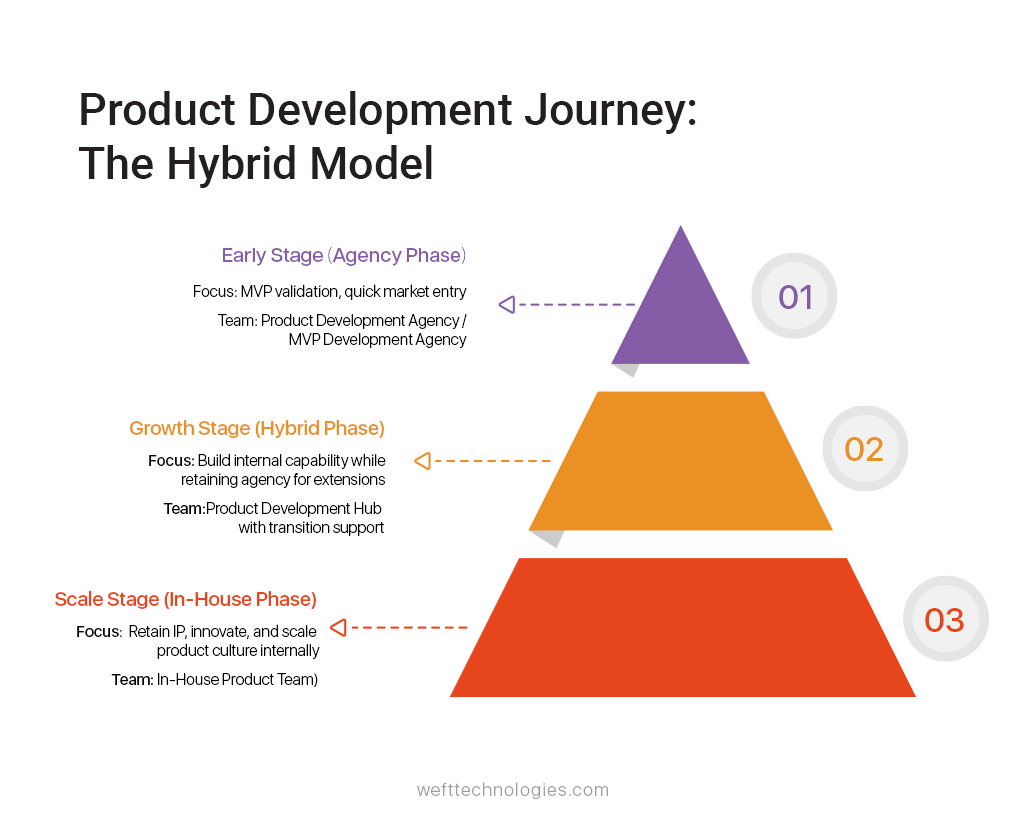
The best answer isn’t purely agency or purely in-house—it’s the hybrid model.
| Start with an agency to gain speed, get the MVP out, validate product-market fit, and then gradually build in-house capacity to take over and scale. |
This hybrid approach offers:
- The best of both worlds: fast execution + long-term internal ownership.
- You actually don’t have to commit to full in-house until you know the product direction.
- The agency builds the initial version, while the in-house team is the one that evolves, iterates, and owns the product.
- You can retain the agency for features, plug-in modules, or specialised work, and rely on your internal team for core architecture, backlog, and culture.
Conclusion: Making the Right Choice for Your Startup’s Stage and Vision
The decision between hiring a product agency vs building an in-house product team should not be made on account of one being “better” than the other. It should be thought out and worked out on the basis of what aligns best with your startup’s stage, vision, budget, and growth plan.
If you’re at the MVP stage, need speed, and have an uncertain future load, a product agency (outsourcing) is likely the right choice. If you’ve validated product-market fit, have funding, and are ready to scale, investing in an in-house product team is likely to pay dividends.

We are here to help you with growth
Contact Our ExpertsLatest Blogs
- From Prototype to Production: Building Custom AI Software for Long-Term ROI
- How to Achieve Product-Led Growth in 2026? The Right Strategies for a Successful Product
- How to Pivot a SaaS Startup Successfully: A Strategic, Data-Driven Guide for Founders
- A Complete Guide to Go-To-Market for Products and Services