
In today’s fast-moving digital economy, speed, agility, and continuous innovation are no longer optional.They are essential for business survival. Traditionally, building tailored enterprise software required months (or even years) of manual coding, extensive development teams, and massive capital expenditure. shift is occurring across the global tech ecosystem.
The convergence of low-code development platforms and artificial intelligence (AI) is fundamentally redefining how applications are designed, built, and deployed. By pairing visual development frameworks with intelligent, automated systems, organizations can bridge the gap between business strategy and technical execution faster than ever before.
In this comprehensive guide, we will explore how combining low-code platforms with AI in software development is transforming custom software development services, driving software development automation, and shaping the future of digital transformation.
The Paradigm Shift in Custom Software Development
For decades, Custom software development followed a predictable, code-heavy lifecycle: business analysts gathered requirements, developers wrote line after line of custom code, QA engineers tested for bugs, and DevOps engineers managed deployments. While this model delivers highly tailored software solutions, it often suffers from slow delivery cycles, high costs, and talent shortages.
Today’s market demands rapid adaptability. Businesses can no longer afford to wait 12 to 18 months for bespoke application development. This dynamic has catalyzed the rapid adoption of low-code application development alongside AI-powered software development.
Instead of replacing traditional software engineers, these modern tools empower developers and business stakeholders to collaborate seamlessly, automating low-value repetitive tasks while keeping human creativity and strategic thinking at the core.
Understanding Low-Code and AI: The Dynamic Duo
To appreciate how these technologies are reshaping the software landscape, it is important to understand what each brings to the table and why their combined synergy is so powerful.
What is Low-Code Development?
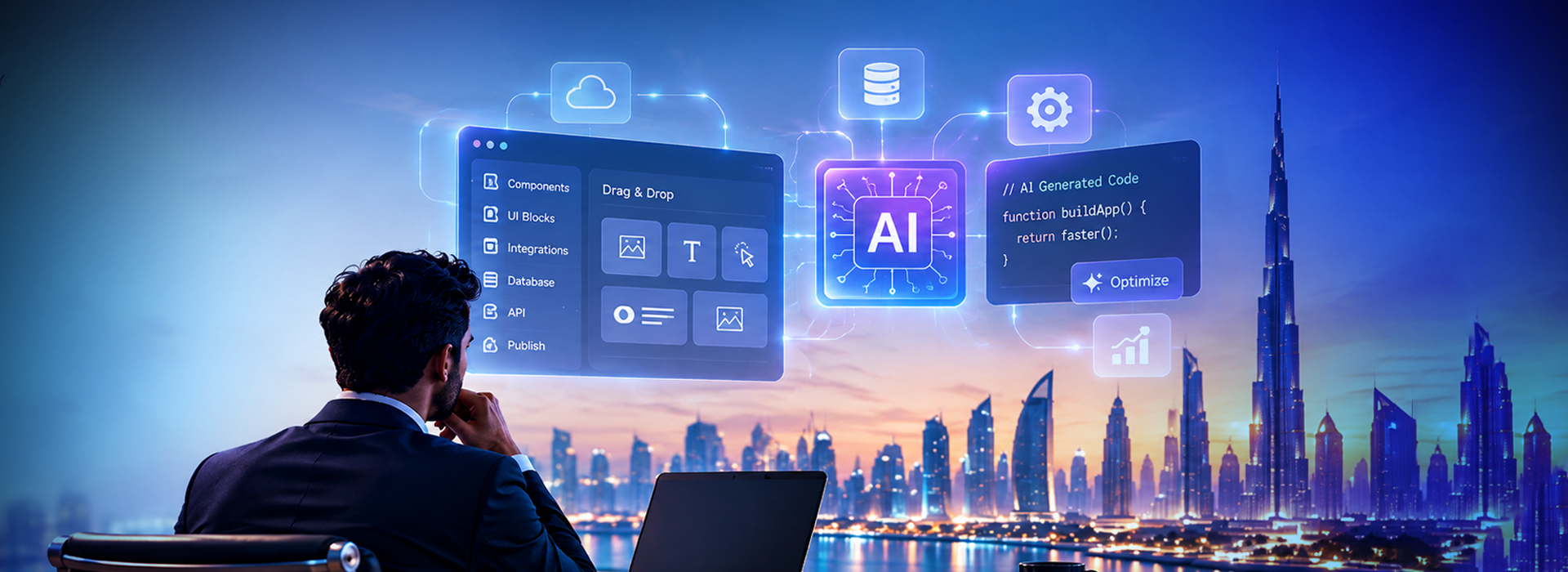
Low-code is a visual approach to software creation. Rather than writing thousands of lines of syntax, developers use drag-and-drop interfaces, pre-built components, visual workflow builders, and configurable data models.
- Speed to Market: Accelerates application creation by reducing manual boilerplate setup.
- Accessibility: Allows non-technical stakeholders (“citizen developers”) to co-create business applications under governance frameworks.
- Flexibility: Offers extension points where senior developers can inject custom hand-written code when complex logic is required.
What is AI in Software Development?
Artificial Intelligence(AI) specifically Generative AI, Large Language Models (LLMs), and Machine Learning algorithms adds cognitive capability to the software engineering workflow.
Key capabilities include:
- AI code generation: Translating natural language prompts directly into functional code snippets or entire module architectures.
- Intelligent Refactoring: Analyzing existing codebases to optimize performance and remove redundancies.
- Automated Debugging: Predicting bug occurrences and suggesting real-time fixes before code hits production.
The Power of Fusion: Low-Code + AI
While low-code provides the visual structure and speed, AI brings real-time intelligence and deep automation. Together, they transform traditional workflows into automated software development engines.
Instead of manually configuring a multi-step approval workflow in a low-code canvas, developers can simply describe the desired business process in plain English, allowing AI engines to generate the workflow, link database endpoints, and build responsive user interface components instantly.
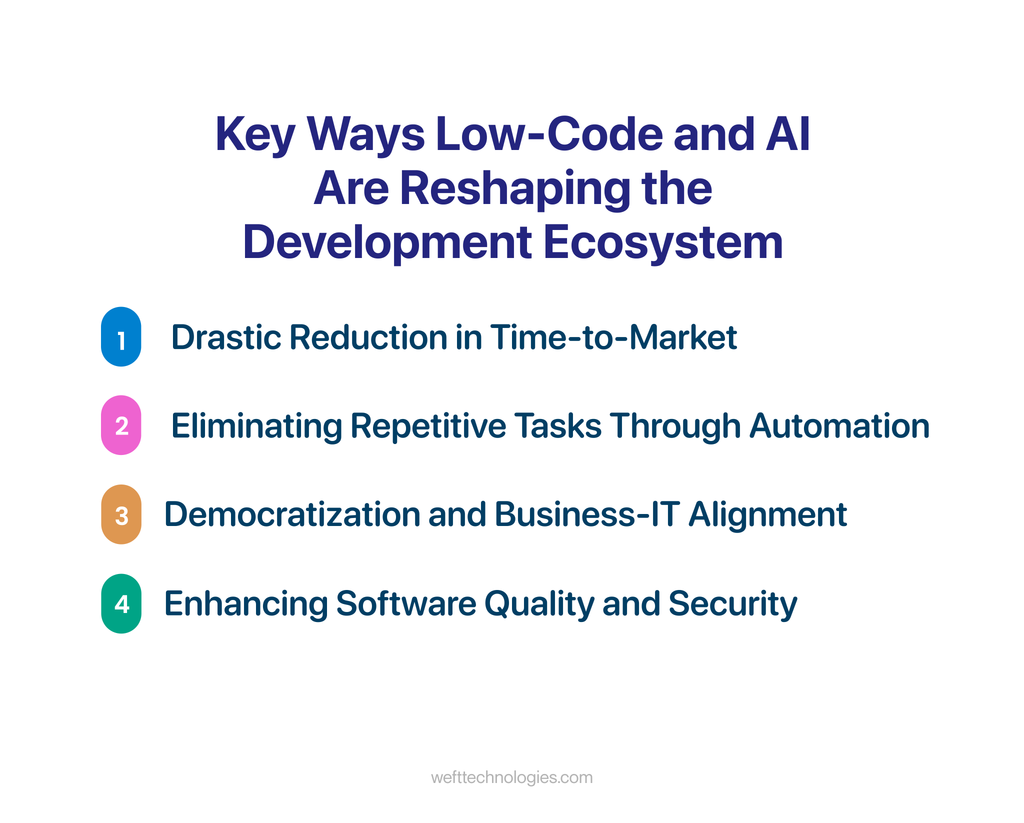
Key Ways Low-Code and AI Are Reshaping the Development Ecosystem
The combination of low-code and artificial intelligence is driving radical improvements across every phase of the software delivery lifecycle.
1. Drastic Reduction in Time-to-Market
In conventional development, setting up boilerplate code, user management, authentication, database schemas, and standard CRUD (Create, Read, Update, Delete) interfaces consumes significant developer hours.
With low-code software development and intelligent AI assistants:
- Instant Prototypes: Prototyping takes hours instead of weeks.
- Rapid Iteration: Product teams can build, test, and collect user feedback on working applications within days.
- Faster Deployment: Automated CI/CD integrations built into modern low-code platforms compress deployment timelines significantly.
2. Eliminating Repetitive Tasks Through Automation
A significant portion of a developer’s workday historically involved mundane tasks writing API wrappers, configuring basic UI components, generating mock data, or mapping schemas.
Through software development automation, AI models handle repetitive operational workloads:
- Automatically generating data integration schemas across complex API landscapes.
- Generating comprehensive unit and integration test suites automatically.
- Converting Figma designs or wireframe drawings directly into functional, responsive low-code UI elements.
This frees engineers to concentrate on complex architecture, security frameworks, proprietary algorithms, and high-value business logic.
3. Democratization and Business-IT Alignment
Historically, business teams communicated requirements to IT through lengthy document handoffs, leading to misaligned expectations, scope creep, and delayed projects.
Low-code platforms featuring conversational AI interfaces break down these silos:
- Citizen Developers: Business analysts, operations managers, and domain experts can design and test workflows directly within controlled governance boundaries.
- Real-time Co-Creation: IT teams and business heads collaborate on the same visual blueprint, eliminating communication barriers and ensuring final software aligns perfectly with business operational needs.
4. Enhancing Software Quality and Security
A common myth is that building software faster leads to compromised quality or security vulnerabilities. When leveraging enterprise-grade platforms guided by AI in software development, the opposite is frequently true:
- Built-in Governance: Leading platforms enforce enterprise security compliance, role-based access control (RBAC), and encryption standards out of the box.
- AI-Driven Vulnerability Scanning: AI algorithms scan application blueprints in real-time, detecting memory leaks, SQL injection vulnerabilities, and bad architectural patterns before deployment.
The Evolving Role of Custom Software Development Companies
As low-code platforms and AI tools proliferate, the role of a traditional custom software development company india or global engineering partner is undergoing a fundamental evolution. Modern IT service providers are shifting from pure code creation to strategic technological orchestration:
From “Coders” to “Solution Architects”
Businesses no longer hire software development services purely for manual line-by-line coding. They seek strategic partners who understand architectural design, system integrations, data governance, and AI integration.
Development partners now focus heavily on:
- Structuring complex enterprise microservices.
- Designing scalable multi-cloud architectures.
- Creating tailored AI prompts, fine-tuning LLMs, and ensuring robust data privacy mechanisms.
Bridging Low-Code Platforms with Complex Legacy Systems
While low-code platforms handle front-end interfaces and workflow automation effectively, enterprise environments rarely operate in isolation. They depend on complex legacy ERPs, mainframe databases, and proprietary custom tools.
A specialized custom software development company uses low-code and AI to build modern digital layer wrappers over legacy infrastructures, unlocking data trapped in outdated systems without demanding complete, high-risk system overhauls.
Real-World Enterprise Use Cases
The blend of low-code and AI in custom software development is already transforming operations across diverse industries:
| Industry | Application / Use Case | Key Business Benefit |
| Financial Services | AI-driven credit scoring engines linked to low-code loan origination portals | Processing time is reduced from weeks to minutes while maintaining compliance. |
| Healthcare | Patient management systems integrated with AI diagnostic assistants and automated scheduling workflows | Reduced administrative burden on medical staff and streamlined patient care. |
| Supply Chain & Logistics | Real-time shipment tracking platforms with predictive AI delay forecasting | Enhanced visibility, proactive disruption management, and lower operating costs. |
| Retail & E-Commerce | Hyper-personalized customer portals powered by dynamic AI recommendation models. | Higher conversion rates and rapid rollout of new digital storefront features. |
Key Challenges and Strategic Considerations
While combining low-code platforms with AI offers immense advantages, technology decision-makers must navigate several strategic challenges to maximize ROI:
1. Managing Technical Debt and Vendor Lock-In
Relying exclusively on proprietary low-code platforms can create long-term vendor lock-in. If an enterprise builds its core business logic inside a closed ecosystem, migrating off that platform later can prove costly.
- Mitigation Strategy: Choose open-architecture low-code platforms that support clean source-code export, standard REST/GraphQL APIs, and cloud-native standards.
2. Preventing “Shadow IT” and Ensuring Governance
When non-technical teams gain the power to build applications independently, organizations risk proliferating unmonitored applications, creating security compliance gaps, and fragmenting data assets.
- Mitigation Strategy: Establish a centralized Center of Excellence (CoE) to govern platform usage, enforce security standards, manage API access, and review citizen-developer projects prior to production deployment.
3. Data Privacy and AI Security
Using public generative AI tools for AI code generation can expose proprietary intellectual property or sensitive customer data to third-party models.
- Mitigation Strategy: Partner with verified Custom software development services like WEFT Technologies that deploy private, enterprise-grade AI models behind secure firewalls, ensuring code assets and datasets remain strictly protected.
The Road Ahead: What the Future Holds
Looking ahead, the fusion of low-code platforms and AI will deepen further, ushering in new paradigms for custom software engineering:
Autonomous Development Agents: Multi-agent AI systems will operate alongside developers within low-code environments independently building features, running unit tests, executing security audits, and submitting pull requests for human review.
Hyper-Personalized Software: Systems will adapt dynamically to individual user behaviors in real time, auto-generating user interfaces and optimizing workflow layouts tailored to individual productivity patterns.
Self-Healing Codebases: Applications built with integrated AI monitoring will automatically detect performance bottlenecks or error spikes, refactoring their underlying logic or adjusting infrastructure resource allocation autonomously without operational disruption.
Conclusion: Embracing the Future of Software Engineering
The rise of low-code platforms and artificial intelligence does not signal the end of traditional custom software development. Instead, it marks an exciting evolution toward faster, smarter, and more strategic application engineering.
By combining visual agility, AI-powered software development, and strategic human oversight, businesses can build flexible, cost-effective, and highly scalable digital solutions designed to withstand rapid market shifts.
To remain competitive in this modern digital landscape, forward-thinking leaders must embrace these modern paradigms, evaluate their technical ecosystems, and leverage skilled custom software development services to drive sustainable, long-term business growth.
If you are looking to accelerate your digital transformation and harness the full potential of modern development architectures, partnering with an experienced digital engineering firm can make all the difference. Discover how WEFT Technologies can help you build tailored, future-ready software solutions to elevate your business.