


If you’ve ever tried building a multi-tenant SaaS, you know it’s not just another technical project. It’s like building one product that feels personal to everyone using it. And that’s where most founders lose their sleep.
Every new customer wants something slightly different. Each one uses the same system, but in their own way. You start worrying about data isolation, performance, and security, all while trying to grow fast. But the truth is that building a multi-tenant SaaS doesn’t have to be impossible. You just need the right mindset, a bit of structure, and a solid foundation in SaaS development.
What is Multi-Tenancy?
Multi-tenancy sounds complex, doesn’t it? Let’s simplify the idea.
‘Multi-tenancy’ just means that resources are shared while providing separate experiences. Think of your SaaS product like an apartment building. Resources like plumbing, lifts, and power are shared. But every tenant has their own key, privacy, and space.
Doesn’t that simplify the concept considerably? All your customers share the same system. But their data and settings stay private.
That’s exactly how platforms like Shopify and Slack work. Thousands of users share the same codebase and infrastructure, but each store or workspace feels completely independent.
For any SaaS development company in India or abroad, understanding this balance between shared infrastructure and private experiences is key to building a scalable product.
Advantages of Multi-Tenant Architecture
Multi-tenancy isn’t just a technical setup; it’s a growth strategy. Here’s what it really gives you:
- Speed
- Scalability
- Efficiency
- Consistency
- Easier management
Challenges of Multi-Tenant Architecture
Multi-tenancy may sound like the smartest path forward but it also introduces new challenges. Here are the major challenges of multi-tenant SaaS that founders face:
- Data isolation and security risks
- Performance slows down when one tenant overuses resources
- Difficulties balancing customization with maintainability
- Hard to roll out updates
- Cost management challenges
- Harder debugging and issue tracking
Multi-Tenant vs Single-Tenant
When you’re just starting, single-tenant setups feel comfortable. Each customer gets their own environment that is clean, isolated, and predictable. But that comfort comes with limits. Every new customer means a new deployment, higher costs, and more maintenance.
Multi-tenancy flips this model. Instead of creating separate setups, you let everyone share the same system securely and efficiently. It’s like moving from running separate servers for each client to managing one powerful system that serves thousands.
The result? Easier updates, faster growth, and a cleaner roadmap.
Why Founders Choose Multi-Tenancy
When you’re building early, single-tenant setups feel safer. Each customer gets their own instance. Moreover, it is simple and easy to isolate. But as you grow, every new customer means more infrastructure and more maintenance. That’s why founders choose multi-tenancy. It allows them to scale fast, roll out updates instantly, and serve thousands of customers without rebuilding the wheel every time.
In effect, multi-tenancy helps to:
- Scale faster without separate deployments
- Update everyone at once
- Cost optimization in SaaS infrastructure and hosting
- Manage everything from one central system
Remember, to achieve SaaS scalability and performance, you need the right balance between architecture, automation, and control.
Types of Multi-Tenant Architectures
Shared Database, Shared Schema
Everyone uses the same database and tables, but each record is tagged with a tenant ID. Fast, cheap, and great for MVPs.
Shared Database, Separate Schemas
One database, but each tenant has its own schema. More control and better isolation.
Separate Databases
Each tenant gets a separate database. Strongest isolation but heavier to manage.
Choose your model based on your growth stage and customer needs, not just technical preference.
Early-stage? Go with shared schema – it’s fast and flexible.
Scaling enterprise clients? Move toward separate schemas or databases.
This is a common approach among companies offering SaaS development services, as it allows them to optimize resources while preparing for growth.
The Real Struggle
Building a multi-tenant SaaS isn’t about code. It’s about control. You need to make sure that:
- Tenant data stays isolated
- One customer’s usage doesn’t slow down another
- You can customize experiences without breaking your system
- And all of this has to work without doubling your effort
It’s easy to over-engineer or ignore future challenges entirely. Both paths will cost you later.
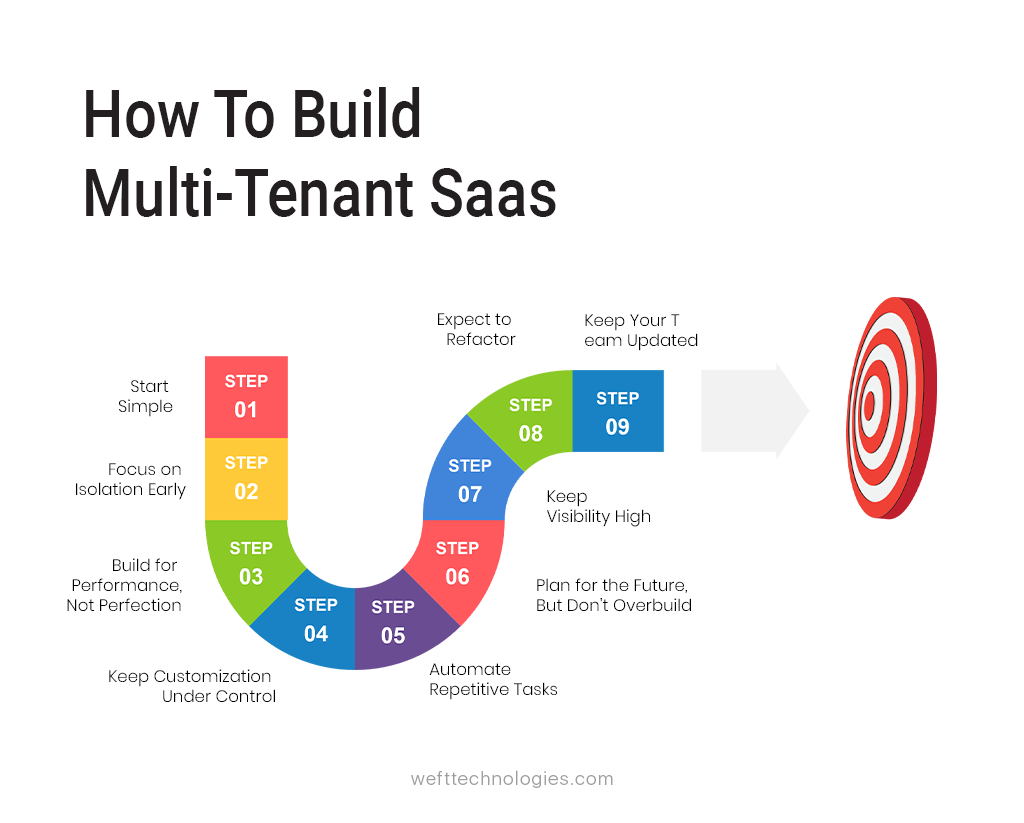
How To Build Multi-Tenant Saas
Step 1: Start Simple
You don’t need to design for ten thousand tenants from day one. Start with a setup that fits your current scale but can evolve later.
In the beginning, you can use a shared database with tenant IDs to separate data. It’s cheaper and faster to maintain. As you grow, move to separate schemas or databases for clients who need stronger isolation, just like how Shopify moved from shared setups to segmented data models as merchant demand increased.
Don’t build heavy. Build adaptability.
Step 2: Focus on Isolation Early
In multi-tenant SaaS architecture, data isolation is everything. One small mistake can damage your reputation. Make it non-negotiable to:
- Tag every record with a tenant ID
- Use strong access controls
- Encrypt sensitive data
- Test your isolation logic regularly
You can fix the speed later. But you can’t fix broken trust.
Step 3: Build for Performance, Not Perfection
Many founders confuse scalability with overbuilding. They end up designing for problems they don’t have yet. The smarter way is to focus on performance that scales, not perfection that slows you down.
Slack is a great example. Its early version wasn’t built for millions of users. But it was modular enough to evolve as the user base exploded.
Here are some key points to remember:
- Keep your architecture flexible
- Use proven frameworks
- And make sure every system can grow without a full rewrite
Step 4: Keep Customization Under Control
Every customer will eventually ask for “just one more thing.” If you start building every request into your product, you’ll lose control. Instead:
- Use feature flags to enable or disable features per tenant
- Store configurations in metadata, not code
- Offer customization through UI, not backend changes
That’s how Salesforce keeps one platform serving thousands of unique workflows without building a new product each time.
Step 5: Automate Repetitive Tasks
Manual work kills momentum. Automate everything repetitive, from tenant onboarding to provisioning and backups. Your goal should be simple – adding a new customer shouldn’t take more than a few clicks.
Platforms like Shopify and Notion grew fast because their infrastructure supported automated onboarding and updates. No manual setup. No messy handovers.
Remember, automation keeps your system consistent and strengthens your SaaS tenant management process.
Step 6: Plan for the Future, But Don’t Overbuild
Future-proofing sounds smart, but overbuilding too soon can hurt your speed. So, always build for your next milestone. Ask yourself these questions:
- What happens if I get 10x more users?
- Which part of my system breaks first?
- What can I delay until I reach that point?
Amazon followed this principle perfectly. In its early days, it was “just” an online bookstore. But its systems were built with modularity in mind, allowing it to expand into everything from cloud computing to groceries.
Build with vision, not paranoia.
Step 7: Keep Visibility High
As your SaaS grows, visibility becomes your lifeline. You need to know what’s happening across tenants, not just system-wide.
Set up monitoring to track:
- Performance per tenant
- Latency and uptime
- Resource usage and costs
When you can see which tenant is overloading the system or facing issues, you will be able to fix problems faster.
Good visibility doesn’t just save your product. It saves your time, too.
Step 8: Expect to Refactor
Every good SaaS architecture needs refactoring at some point. In fact, refactoring is a sign of growth. If you feel that something is starting to feel clunky or expensive, that is your signal to refactor. Regular refactoring keeps your scalable SaaS architecture healthy and adaptable.
Step 9: Keep Your Team Updated
A multi-tenant SaaS doesn’t just test your tech stack. It tests your communication. Your developers, product managers, and support teams should all understand how tenants are structured, how data flows, and where complexity lives. This level of communication and collaboration keeps your product stable as your customer base grows.
Components of a Good Multi-Tenant System
A strong multi-tenant system has a few non-negotiable components:
- Configurable Experience – Tenants can personalize without affecting others
- Scalable Infrastructure – Can grow without full rewrites
- Centralized Monitoring – Visibility across all tenants
- Automated Lifecycle Management – Smooth onboarding, provisioning, and updates
Key Things to Allow Per Tenant in Multi-Tenancy SaaS Applications
When designing for multiple tenants, think about what should vary and what should stay fixed. Allow tenants to:
- Set branding and UI preferences
- Manage users and access levels
- Choose features or pricing plans
- Configure notifications and workflows
Note – Keep your core logic, infrastructure, and data policies consistent.
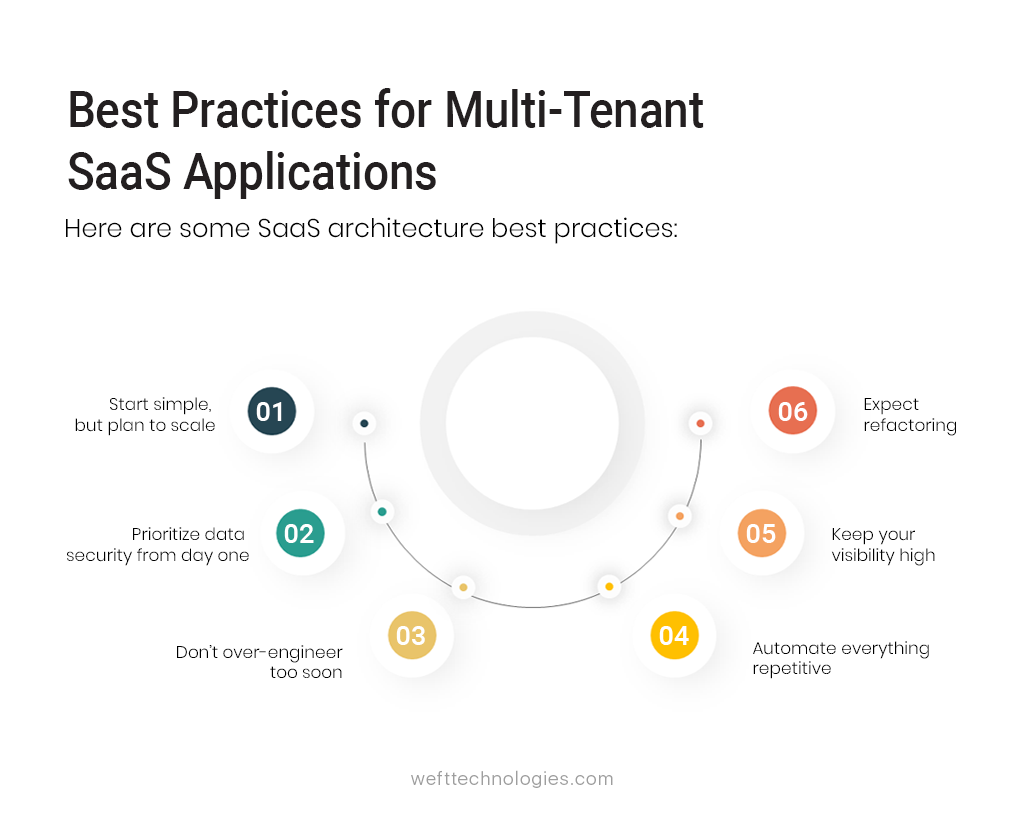
Best Practices for Multi-Tenant SaaS Applications
Here are some SaaS architecture best practices:
- Start simple, but plan to scale
- Prioritize data security from day one
- Don’t over-engineer too soon
- Automate everything repetitive
- Keep your visibility high
- Expect refactoring
Final Thoughts
At its core, multi-tenancy is about leverage. You don’t have to build for millions from day one.
You just have to make sure your system doesn’t collapse when you get there.
Remember, simplicity isn’t the opposite of scalability. It’s the foundation for it. Because the best SaaS architectures aren’t the most complex. They’re the ones that grow gracefully.

We are here to help you with growth
Contact Our ExpertsLatest Blogs
- From Prototype to Production: Building Custom AI Software for Long-Term ROI
- How to Achieve Product-Led Growth in 2026? The Right Strategies for a Successful Product
- How to Pivot a SaaS Startup Successfully: A Strategic, Data-Driven Guide for Founders
- A Complete Guide to Go-To-Market for Products and Services