


The startup landscape is evolving rapidly, and so is the mindset of investors. The days when an idea alone was enough to secure funding have changed, and now investors expect proof, traction, and a clear growth path. MVP development is a crucial strategy for startups that are longing to turn ideas into market-ready products. Launching a Minimum Viable Product, or MVP, is the best way to validate the idea, collect real user feedback, and iterate before launching a completed product. A strong MVP pitch is now essential for winning investors, as it shows not only the problem you are solving but also how your solution resonates with the market. Let’s see how to pitch your MVP to investors and raise funds in 2025.
Why MVP Development Matters for Startups
Time and resources are limited for startups, and that is where MVP, or Minimum Viable Product, comes in as a powerful strategy. If you are spending months or years on developing and launching a complete product with full features, launching an MVP with core features helps you collect genuine feedback from users. At this point, you can understand the efficacy of the product and where and what to improve. This approach helps you validate the acceptance of the product in the real market, and by gathering user feedback, you can refine it based on real-world data before making a large investment.
Key Benefits of MVP Development:
- Reduces cost and time-to-market.
- Proves demand before heavy investment.
- Builds investor confidence with early traction.
- Provides a foundation for future scalability.
- Prevents wasted effort on unnecessary features.
How to Validate Your MVP for Investors
Starting by defining clear success metrics and KPIs is the prime step you can take to validate your Minimum Viable Product, or MVP, for investors. Investors only focus on features that can solve their primary problem. So keep defining metrics such as user engagement, retention rates, conversion rates, and Net Promoter Score (NPS) as the primary step. Beta tests, customer interviews, and surveys are the best way to understand real user behavior, attitude towards the MVP, and pain points. Through these processes, you can collect both quantitative and qualitative feedback.
Also track key metrics like user interaction, retention, and churn to measure adoption and loyalty. Through analyzing user feedback and tracking metrics, you can identify where and what to improve. Based on all your analysis and understanding, shape your MVP to meet the investors’ expectations. Finally, present this validation to investors by showcasing data-driven proof, user testimonials, and clear evidence that your product addresses a real problem, showing the market demand and confidence in your ability and your MVP to scale and succeed.
What Investors Look for in an MVP and How Can You Pitch an MVP According to Their Demands
In 2025, investors are looking for more than just a working product; they want proof that your MVP has real potential. Here’s what they expect to see:
- Crystal-clear solution for the problem they face.
Investors expect your MVP to be the perfect solution that can solve their problems and challenges instantly. They also need to understand why your solution is exactly what the market needs. So, your MVP should address this pain point.
- Evidence of real traction
They need real results rather than unseen promises. Show signups, pilot users, waitlists, or user testimonials as the real evidence. This proves your MVP resonates with your target audience and validates its market value.
- A lean and efficient build
Investors value resourcefulness. So demonstrate a lean MVP that focuses only on core features. This shows smart prioritization, minimal waste, and a disciplined approach.
- A team capable of rapid adaptation
Investors look for people who are ready to learn and understand market trends, adapt to changes, listen to user needs, and strive to quickly fulfill their requirements. Demonstrating agility builds confidence in your ability to scale successfully.
- Early proof of product-market fit
They need to clarify that people are using and finding value in your product. Early validation significantly reduces investor risk and strengthens their confidence in backing your venture.
The Role of MVP in Fundraising
A well-crafted MVP is one of the strongest tools you can bring into a fundraising conversation. It turns your idea from a “what if” into a working proof of concept that investors can see, use, and measure. Instead of betting on assumptions, they get evidence that your product solves a real problem. Good MVPs turn abstract ideas into measurable proof, and that proof is what reduces investor risk and unlocks capital.
How an MVP helps your fundraising case
- A working MVP demonstrates that your idea works in the real world and that you can ship something tangible.
- Providing insights into metrics like user growth, engagement, or revenue gives measurable proof of momentum.
- A clear roadmap for how the MVP can evolve into a fully-featured product helps investors understand future growth potential.
- A tangible MVP makes your pitch more compelling, moving it from theoretical ideas to an evidence-backed narrative that resonates with investors.
- By showing that the product works in real-world conditions and users are engaging with it, an MVP lowers the perceived risk of investing in your startup.
- A functioning MVP can open doors for pilot projects, partnerships, or early collaborations, further validating the business model.
- Demonstrated traction and proof of concept can give startups more leverage to negotiate favorable terms with investors.
Key Elements of an MVP Pitch Deck
When pitching your MVP to investors, your deck should tell a simple, compelling story backed by evidence. Here are the must-have elements to include:
- Problem & Opportunity – You must clearly convey how your product is going to solve a real problem faced by investors. Make investors feel the urgency of the problem and get the clarity of the opportunity.
- Solution (Your MVP) – As the solution for their problem, present your MVP by highlighting its core features. Make them understand how it works.
- Market Size & Competition – The competition might be high, so you need to make it clear and crisp. Show what makes you unique in the market and why they should choose you. Break down TAM (total addressable market), SAM (serviceable available market), and your niche strategy.
- Business Model & Monetization – Explain the ways you can make the product profitable. The investors should get an idea of how to make money with the product (subscriptions, ads, SaaS, freemium, etc.) and why it is sustainable.
- Early Traction & Metrics – You can share previous data you have. The data can be sign-ups, engagement, pilot results, waitlists, or partnerships. No matter if the metric is small, it can make your pitch stronger.
- Technical Feasibility & Roadmap – Tell about the possibilities of scaling your products in the future by outlining your tech stack, scalability plans, and any strategic partnerships that add credibility.
- Funding Ask & Use of Funds – Be specific about how much you are raising, the milestones you will hit, and exactly how the money will be allocated.
- Founder Story & Team – End with the people. Highlight your expertise, adaptability, and why you are the right team to execute this vision.
Modern Fundraising Channels for Startups
When your MVP is ready, choosing the right fundraising channel matters just as much as the pitch itself. Here are the most effective options for MVP fundraising in 2025:
- Angel Investors / Angel Platforms: Use AngelList or local angel networks to find syndicates and leads that are best for early checks and mentorship.
- Accelerators: Platforms like YC, Techstars, etc. offer small investments, structured mentorship, and investor visibility through demo days. They are ideal for concentrated guidance and fast exposure.
- Equity Crowdfunding / Community Rounds: Platforms like Wefunder or Republic let you raise capital from many smaller investors while also building an engaged user base.
- Government Grants & Non-Dilutive Programs: Initiatives such as the Startup India Seed Fund help early ventures get backing without equity dilution, particularly useful for deep-tech or R&D-heavy projects.
- Friends & Family / Strategic Partners: The simplest and fastest way to secure early funding, but you need to be sure to document terms clearly to avoid future misunderstandings.
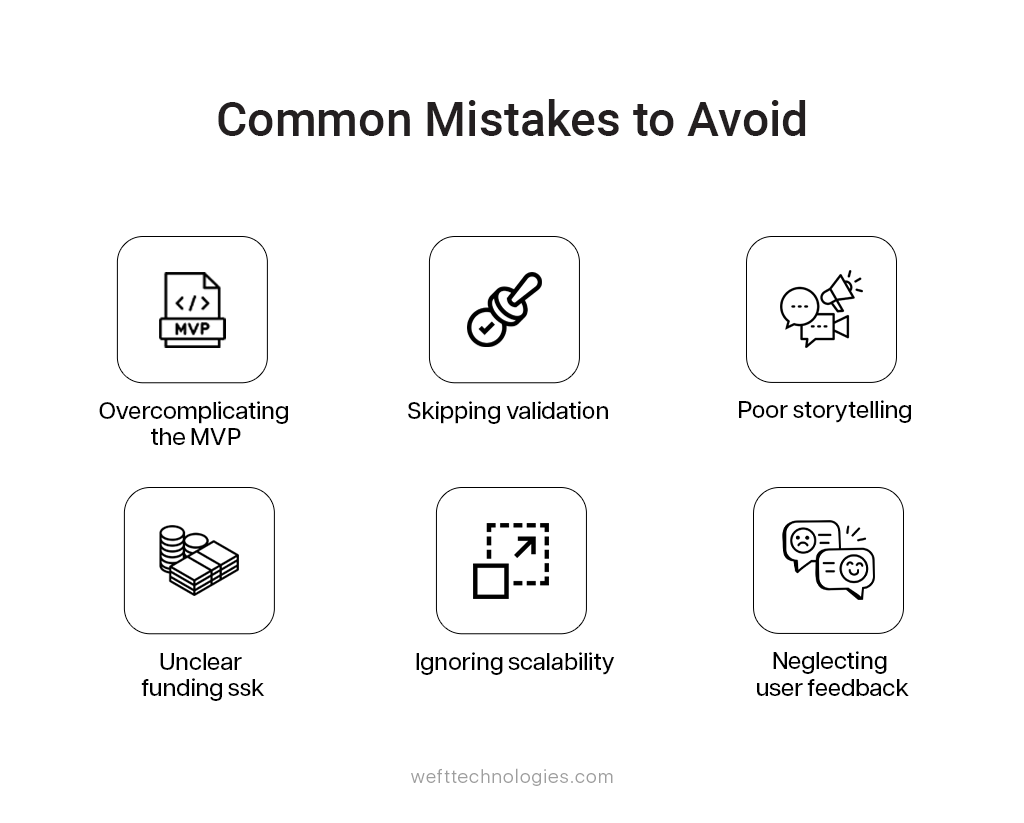
Common Mistakes to Avoid
When pitching your MVP, even small missteps can cost you investor interest. Here are the most common mistakes to avoid:
- Overcomplicating the MVP
Packing too many features into your MVP makes it confusing. Investors want to see one core problem solved really well, not a cluttered product. - Skipping validation
Pitching without real user feedback, signups, or pilot tests shows investors you’re guessing, not proving. Even small traction beats assumptions. - Poor storytelling
Numbers alone will not win investors. You need a clear story that connects the problem, your solution, and the opportunity ahead. - Unclear funding ssk
Be specific about how much funding you need, how you will use it, and what milestones it will achieve. - Ignoring scalability
An MVP should be lean, but still show potential to scale. If you don’t explain how the product grows beyond the first version, investors may see it as a dead end. - Not addressing competition
Saying “we don’t have competitors” is a red flag. Every idea has alternatives. Show why your MVP stands out and why users would pick you. - Overpromising results
Exaggerating the results can help you gain more investors, but when it comes to practical matters, if your product cannot meet the ambition, it can damage your credibility. - Neglecting user feedback
An MVP exists to learn from users. Ignoring feedback signals you’re not adaptable, something investors highly value.
Follow Up After the Pitch
Your MVP pitch to investors does not end when you leave the meeting. Follow-up is where many investor relationships are built. A strong, timely follow-up is the best thing you can do after pitching. Here’s how to do it right:
- Send a thank-you within 24-48 hours: Leaving a simple and professional thank-you email that acknowledges the time and interest of the investor can make an impact.
- Share your demo link: While sending a thank you email, you can attach your pitch deck or include a secure link to your demo. Because there is a chance for a revisit on materials by investors later.
- Reiterate key highlights
Briefly remind them of the key highlights of the products, the market potential, or the unique strength of your team to reinforce your value. - Keep them updated over time: Even if you get a “no” from the investor, do not lose hope. Share monthly or quarterly updates on traction, product improvements, or milestones.
- Focus on relationship-building: Stay professional, reliable, and open to feedback. Because investors want to see how you execute and adapt over time.
Whether you are working with a top MVP development company in India or refining your own prototype, focusing on lean, effective features, and a strong MVP pitch can be the difference between an idea that stays on paper and a product that succeeds in the real world. At Weft, we specialize in MVP development service by helping startups bring their vision to life, combining design, development, and market strategy to create MVPs that impress investors, validate ideas, and set the stage for sustainable growth.

We are here to help you with growth
Contact Our ExpertsLatest Blogs
- From Prototype to Production: Building Custom AI Software for Long-Term ROI
- How to Achieve Product-Led Growth in 2026? The Right Strategies for a Successful Product
- How to Pivot a SaaS Startup Successfully: A Strategic, Data-Driven Guide for Founders
- A Complete Guide to Go-To-Market for Products and Services