
Product discovery is the process of identifying real user problems, validating ideas, and defining what to build before development begins, and tech leaders have a crucial role in the process. Building software without a proper strategy is like sailing without a compass; you might move faster, but unsure whether you are heading in the right direction or not. Product discovery in development plays a big role in making the efforts of the team meaningful and impactful. This process bridges the gap between the vision of the business and the engineering execution. Instead of creating something, product discovery helps tech leaders to build products with purpose, capable of meeting user needs and business goals through proper coordination.
Here is a guide on product discovery for tech leaders.
What is Software Product Discovery?
Why do developers build a product? The simplest answer is to solve real user problems. So, ensuring the product’s capability to solve the problems is the key section. To achieve this, developers need to go through strategic processes that involve identifying user problems and the business context of the product. This process of identifying what, why, and for whom to build before development is called software product discovery. It reduces the risk of time wasting and resource loss, thus it is considered a critical first step in building successful, user-centered software.
When it comes to software product discovery, it is a continuous cycle of research, analysis, validation, and ideation that bridges product management and engineering. This process gives clarity to the team members on what should be achieved by the product and how it is to be delivered by being useful to the people. It turns assumptions into actions, bringing value to the team as well as the users.
Why Product Discovery Matters
Without planning, all effort will be in vain. Here comes the importance of product discovery in software development. Product discovery is a process where teams collaborate with each other to build software products as solutions for real user problems, along with analyzing the market demands and trends for the product. This ensures that the team builds solutions that are highly useful for the targeted audience by aligning with business goals.
It is a systematic process, which is a powerful step before developing the whole product without an idea, because this great process helps you identify and validate problems before you get into the development, to minimize the risk of errors and wastage of time. It also prevents the team from developing something that is underused or irrelevant, so that you will be able to deliver only valuable features. From continuous user research and hypothesis testing to cross-functional collaboration, software product discovery is a long process through many steps, enabling teams to prioritize and work accordingly and effectively. Transform your assumptions into valued results with this simple process.
Benefits of Product Discovery
- Prevention of time wastage, unwanted tasks, and unnecessary usage of resources.
- Improving customer satisfaction by building products that are aligned with real user needs.
- Creating understanding and proper communication among team members.
- A better way to prioritize tasks and complete them accordingly speeds up development.
- Increases business confidence with evidence-backed insights.
- Creating reassurance in stakeholders about the product direction.
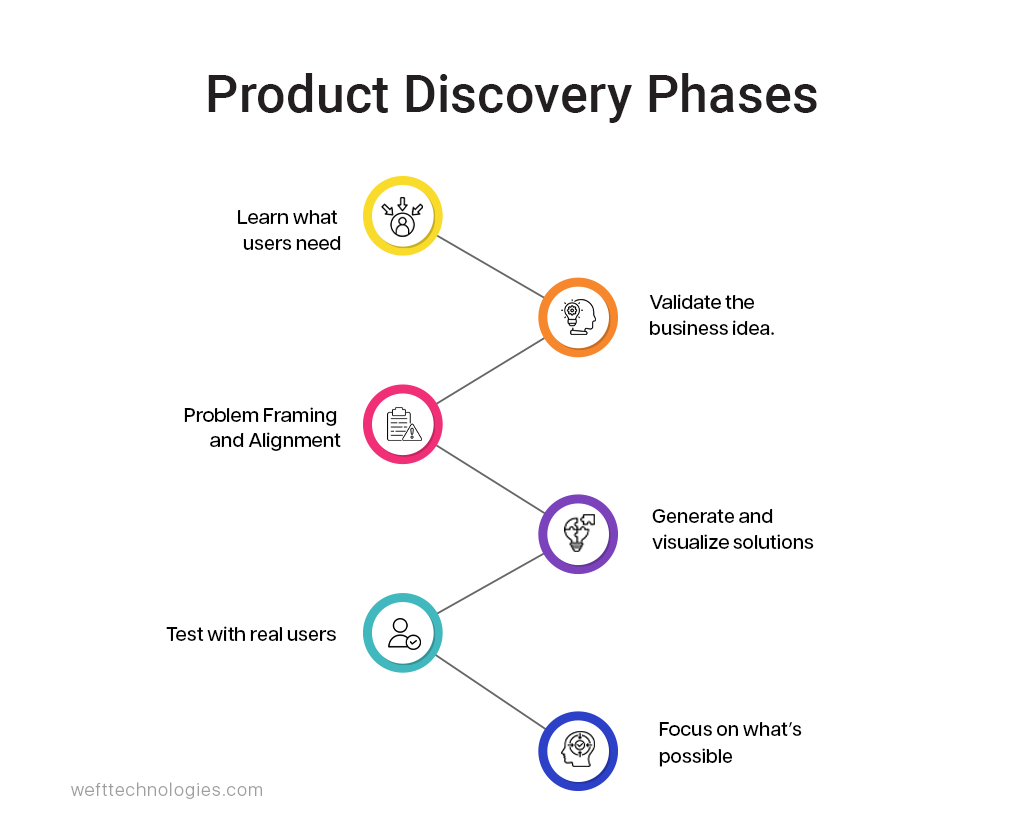
Main Stages of the Product Discovery Phase
- Understanding User Needs
Understand user needs by conducting interviews, surveys, and behavior analysis to get their behaviors, motivations, and pain points.
- Verifying Business and Market Assumptions
Evaluate the business possibility of the product that you need to develop to solve the real user problems according to the market demands, competition, the product’s potential ROI, etc., before investing in development.
- Problem Framing and Alignment
The next step is to define the “why” behind developing such a product, which simply means analyzing the core problem of the user you want to solve, along with ensuring alignment between business, design, and engineering teams
- Ideation and Prototyping
After you get the pain points, then enter into generating multiple ideas of product development and visualize them through sketches or wireframes, and finally create early prototypes to explore different approaches quickly before development.
- Validation and Testing
Use MVPs, mockups, or user tests to validate the effectiveness of the proposed product on the targeted users by gathering data on usability and desirability.
- Prioritization and Feasibility Assessment
Identify which features deliver the highest value with the least complexity. Assess technical feasibility, potential integrations, and resource constraints early to plan a realistic roadmap.
Product Discovery vs. Traditional Development
Product discovery is an evidence-first, iterative process focused on understanding users, validating hypotheses, and testing solutions (prototypes/MVPs) before committing large engineering effort, while traditional development, which is often embodied by waterfall-style approaches, follows a linear, plan-driven sequence that assumes requirements can be fully specified upfront and emphasizes detailed documentation and delivery predictability.
| Aspect | Product Discovery (Iterative) | Traditional Development (Linear) |
| Main Goal | Focuses on finding what’s worth building by understanding users and testing ideas. | Focuses on building what’s already defined and delivering it on time and within budget. |
| When It Happens | Starts early and continues throughout the product lifecycle as teams keep learning. | Happens mostly at the beginning — once planned, the team moves straight into development. |
| Feedback Loops | Quick and ongoing — teams test prototypes, MVPs, and ideas frequently. | Slow — feedback usually comes only after launch or major project milestones. |
| Dealing with Uncertainty | Embraces uncertainty by running small experiments to learn and adjust. | Assumes requirements are clear and fixed; changes later are difficult and expensive. |
| Team Involvement | Cross-functional — product managers, designers, and engineers collaborate throughout. | Involves stakeholders mostly at the start, then teams work in silos. |
| Documentation Style | Light and focused on learning — includes hypotheses, insights, and experiment notes. | Detailed and process-heavy — includes requirement documents and full design specs. |
| Speed to Market | Faster for validated ideas — teams release small, tested features quickly. | Predictable for planned projects, but slower to respond to change or feedback. |
| Cost Management | Early costs go into testing, but saves money by avoiding building the wrong product. | Costs are predictable if the plan doesn’t change — but rework can be expensive. |
| Best Fit For | New products, innovative ideas, or uncertain markets where learning is crucial. | Stable products or projects with fixed requirements and low uncertainty. |
Key Contributors in the Product Discovery Phase
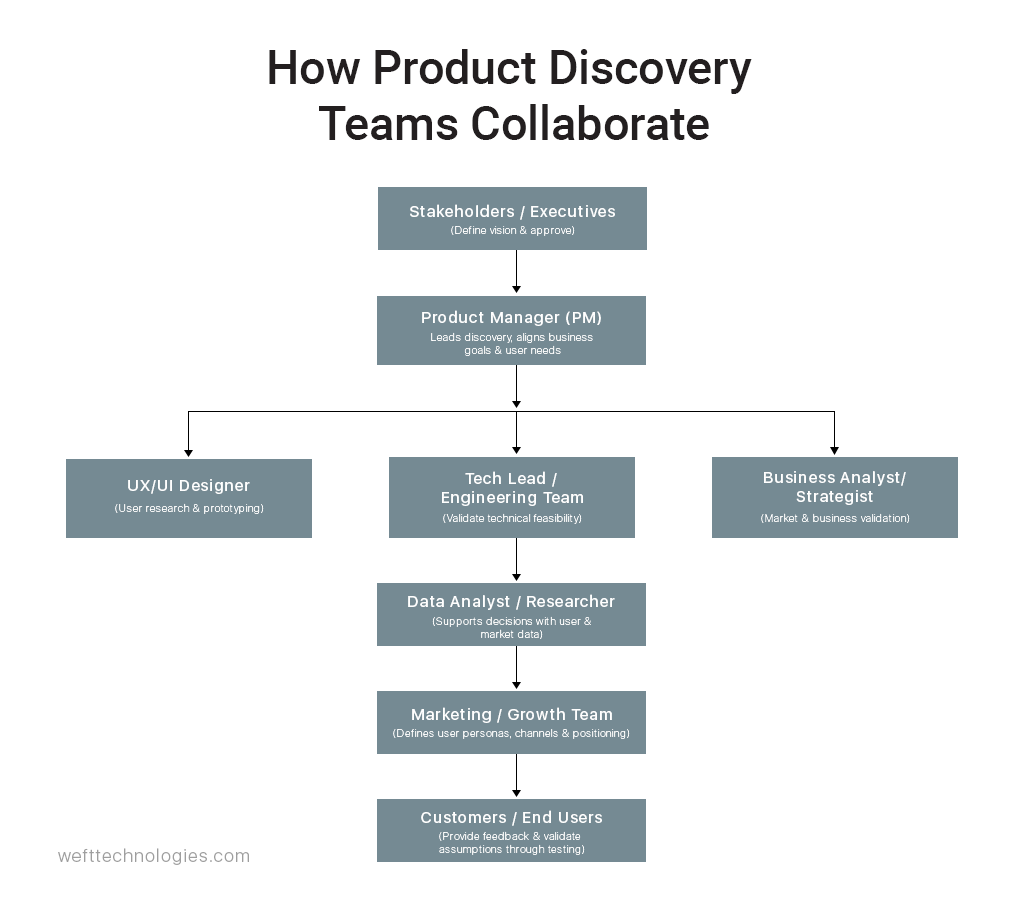
Product discovery is not an individual task, it is a collective process that consists of various contributors and team members. It is a combination of strategy, empathy, feasibility, and validation through effective teamwork. The key contributors to product discovery in software development are:
- Product Manager– The strategic lead of the discovery process who decides what to build and why it matters.
- UX/UI Designer– Creating user-friendly experiences to meet the user needs based on user behaviour.
- Tech Lead / Engineering Team– Validates technical feasibility and explores possible solutions early.
- Business Analyst / Strategist– The one who analyzes market trends and business possibilities of the product.
- Data Analyst / Researcher– Provides insights from user data, trends, and metrics that support the product’s market opportunity.
- Stakeholders / Executives– The representatives of business interests who approve priorities to meet long-term organizational goals.
- Marketing or Growth Team– The people behind bringing the product to the right audience through different channels.
- Customers / End Users– The most critical contributors who share real feedback and validate solutions.
Tools and Techniques for Effective Product Discovery
Product discovery is a specialized process that needs to go through many techniques using proper tools in order to bring out the most effective product outcome. From user feedback to communication among the team members, tools for product discovery are inevitable. Let’s take a look at the best techniques and tools for agile product development.
- User Research
Conduct user research using feedback collection tools to gather qualitative and quantitative data and opinions from users regarding real pain points, their problems, and the way of solution they expect.
Here are some tools that can help you collect user feedback
- Lookback & UserTesting for interviews
- Google Forms, Typeform, & SurveyMonkey for surveys
- Maze for structured task-based testing.
- Synthesis & Framing
Organize research into testable problems and hypotheses. This focuses discovery efforts and makes experiments measurable.
Techniques & tools for synthesis:
- Affinity mapping & clustering using Miro, FigJam.
- Hypothesis mapping / one-page discovery briefs
- Persona & journey mapping with UXPressia, Smaply, and Experience Fellow.
- Ideation & Prioritization
Produce multiple solution ideas and choose the highest-impact bets.
Tools that make the process simple are
- Miro, in-person whiteboards for co-creation workshops.
- Miro, Jira, and Trello for story mapping.
- Airfocus, Productboard for prioritization frameworks.
- Prototyping & Rapid Validation
This helps you build lightweight artifacts to validate desirability and usability, which is a useful technique in clarifying the scope for MVP development and discovery.
Techniques & tools:
- Balsamiq and Sketch to test flows.
- Figma, Adobe XD, InVision, Proto.io, & Marvel for high-fidelity prototypes.
- Analytics & Experimentation
Data reveals what users actually do versus what they say, and therefore use tools to analyze behavioral data to validate hypotheses and refine MVP scope.
Techniques & tools:
- Amplitude, Mixpanel, Heap, & PostHog for product analytics.
- Google Analytics, Hotjar, Crazy Egg for Web analytics & heatmaps.
- FullStory, Hotjar for session replay.
- Optimizely, LaunchDarkly for A/B testing & feature flags.
6. Collaboration and Communication
Effective communication among team members is vital in product discovery. Here are some tools for better collaboration:
- Miro & FigJam as Digital whiteboards & workshop tools.
- Product management & discovery platforms such as Productboard, Aha!, Roadmunk.
- Jira, Asana, Trello Project & agile tracking.
Common Challenges and Solutions in Product Discovery
Product discovery in software development is essential, as this strategic process helps developers build products by understanding user needs and market demands. Before building a product, the team goes through various processes. Besides, they have to overcome many challenges. Challenges are always a part of product discovery phases, and you need to overcome them wisely. Here are some commonly faced challenges in MVP development and discovery, and simple tips to overcome them.
- Unclear problem statements
If teams don’t agree on the problem, they will pursue mismatched solutions and waste cycles. This often shows up as long spec documents that reflect opinions, not testable hypotheses.
How to fix it: Use hypothesis framing that keeps discovery experiments focused and measurable.
- Skipping validation
Teams that skip testing build by opinion or internal preference, often producing features that users ignore.
How to fix it: Run small, fast experiments such as prototype tests, guerrilla usability tests, or short MVPs. Make user testing a required step before significant engineering investment.
- Lack of stakeholder alignment
When stakeholders are not aligned, priorities may change, timelines slip, and discovery outcomes get disordered, resulting in wasted time.
How to fix it: Use a mix of stakeholder mapping, regular check-ins, and shared metrics.
- Poor documentation and knowledge loss
Discovery insights can be lost or scattered, and new team members repeat the same work. Poor documentation makes decisions opaque to stakeholders.
How to fix it: Maintain a discovery brief and a lightweight wiki that captures hypotheses, experiments run, results, and decisions. Keep records short, templated, and searchable.
- No time for discovery and work under pressure
Teams often feel forced to prioritize delivery sprints over discovery activities, treating research as a luxury, leading to brittle roadmaps and reactive fixes.
How to fix it: Embed continuous discovery practices into day-to-day work. Best practices are run discovery in parallel with delivery, assign rotating discovery ownership, and protect a percentage of team capacity for experiments.
- Involving too many or too few people in discovery
Too many participants slow down decisions, and too few create bias and limit perspectives. Both extremes reduce discovery quality.
How to fix it: Keep discovery teams small, cross-functional, and empowered with product, design, and a maximum of two engineers. Pull in stakeholders only for specific checkpoints. Limit meeting sizes and use async updates to keep broader groups informed.
- Failing to balance problem vs. solution focus
Teams can spend discovery time refining a single solution rather than exploring multiple approaches to the core problem. This narrows learning and can blindside teams to better options.
How to fix it: Validate the problem exists and is worth solving, then explore several solution ideas before committing. Authoritative voices in product leadership emphasize spending the majority of the discovery effort on understanding and testing the problem space.
Best Practices for Integrating Discovery into Development
- Cross-functional collaboration: Bring every team member together early and conduct an open discussion, hear different perspectives, and create a product strategy by concluding the opinions.
- Adopt agile and lean principles: Experiment, test, adapt, and continue, because agile keeps teams flexible, and lean thinking can create real value.
- Encourage continuous learning and iteration: Collect regular feedback and analyze its results, and be flexible to change accordingly.
- Use data and evidence to drive decisions: Back every product decision with research, analytics, and testing. Data-driven discovery reduces guesswork and strengthens confidence in the roadmap.
- Balance discovery and delivery: Run discovery alongside development, and test new ideas while building validated ones. This balance ensures continuous innovation without slowing delivery.
- Prioritize user value over features: Focus on solving meaningful problems, not just adding features. Each discovery insight should translate into clear user value and measurable business outcomes.
Role of Tech Leaders in Product Discovery
- Promote a mindset of learning, experimentation, and user focus.
- Encourage teams to explore problems before jumping into solutions.
- Allocate time and resources accordingly for each task to each person based on the roles and responsibilities to avoid extra work and work pressure.
- Bring all members together and create an environment where every opinion is valued and considered to bring the best outcome.
- Encourage each member to take part in product discovery, especially engineers in research, validation, identifying technical constraints, solving them, etc.
- Guide teams in assessing execution possibilities of ideas using existing systems or architecture.
- Leaders establish frameworks for discovery — such as hypothesis templates, success metrics, and validation checkpoints — to keep efforts structured and measurable.
- They align discovery outcomes with organizational strategy, ensuring validated insights translate into actionable roadmap decisions.
- Great leaders track the impact of discovery, such as reduced rework or faster delivery, and help replicate successful practices across teams.
BOTTOM LINE
The role of product discovery in software development is pivotal, and it is the foundation of software development. It is the primary step that requires opinions from all team members, analysis, iteration, and validation to generate the best user-friendly, purposeful product. With better collaboration and effective teamwork, tech leaders can make the journey of product discovery effortless.
As one of the trusted software development companies in India, Weft Technologies understands this fact and blends strategies and engineering excellence to enable business growth by bringing the most beneficial product to the market that can leave a mark in both the market and users’ hearts. Collaborate with us today.

We are here to help you with growth
Contact Our ExpertsLatest Blogs
- From Prototype to Production: Building Custom AI Software for Long-Term ROI
- How to Achieve Product-Led Growth in 2026? The Right Strategies for a Successful Product
- How to Pivot a SaaS Startup Successfully: A Strategic, Data-Driven Guide for Founders
- A Complete Guide to Go-To-Market for Products and Services