

In the not-so-distant past, the user journey in digital marketing was built on the grounds of a tidy funnel:
keyword search → click → conversion.
It was that simple. But not anymore.
The sweeping tide of digital transformation in marketing, fueled by AI, automation, and ever-evolving algorithms, has been observed to have rewritten the rules of engagement. What once relied on intuition alone now thrives on a far more solid element- intelligence, and what once followed trends now predicts them.
Search is no longer based on what users type; it’s about what they mean by each message or directive. Each query is considered a clue, and AI has learned to follow the trail.
This shift marks the rise of intent-based marketing, which is the new language of connection, wherein digital marketing services interpret context, behaviour, and need, rather than simply matching keywords like traditional search consoles.
This roughly means that marketing is evolving slowly from reactive to intuitive, anticipating what users are seeking before they even articulate it in full. It’s basically a shift from queries to conversations.
McKinsey & Company roughly reports that more than 70% of consumers expect brands to deliver more personalized interactions that are well aligned with their demands and expectations, and more importantly, they are very likely to switch providers if they don’t get what they intend for.
This expectation root from a sum-total of an era of AI-powered search experiences and user-centric search, that is basically systems that understand us, anticipate our needs, and respond in real-time.
Let’s talk more about it.
How AI is Transforming Digital Experiences?
If you think that Artificial intelligence is still a tool in the marketing toolkit, you are wrong. We are about to turn our pages to 2026, and at this point, AI could be safely called the engine of transformation. AI in digital transformation now bridges data, user behaviour, and brand intent to craft experiences that feel natural, relevant, and immediate. Besides, brands are entering “a promising new era of personalization” driven by AI and generative AI.
For digital marketing services, this means two things:
- Scalability of personalization: AI enables tailored messages, experiences, and recommendations at volumes previously impossible.
- Predictive versus reactive: Rather than waiting for users to search, we anticipate their need and deliver the answer before they even ask. This symbolizes the birth of predictive marketing and predictive analytics in digital marketing.
Decoding Personalized and Predictive Search
What Is Personalized Search?
Personalized search mainly refers to what the user sees based on their history, location, preferences, and sometimes even momentary context. This could vary highly on the grounds of several factors, including where they are residing. To be clearer, a user residing in London City Center might see different results than someone living in the suburbs of Bangalore, even for the very same query. This is the essence of data-driven personalization in search.
By leveraging behavioural data, device context, and previous interactions, personalized search results move the user journey away from one-size-fits-all toward “just for me”.
For example, when a user searches for anything specific, like “running shoes,” they are likely to see a selection based on their prior purchases, local availability, etc. Now, this is personalization in action. It goes in line with the broader trend in AI-driven digital marketing: personalization is not a bonus, but a ‘must.’
What is Predictive Search?
Prediction of the future might sound quite mystical, but in marketing, it’s real and measureable. Predictive search anticipates user intent-even prior to them actually typing a query. Behind the scenes, the system analyzes micro-signals, such as past searches, behavior across channels, and real-time context to offer suggestions, autocomplete, or even proactively surface the right results.
For instance, when you land on an e-commerce site and the search bar suggests “running shoes for rainy season”, your result is again the sum total of several factors, including previous searches. Let’s say you’ve been actively browsing for indoor fitness gear for a while now, and as the weather forecast changed, the algorithm assumes that you would soon be in need of related items like the one in question, hence it’s predictive work..
Personalized and predictive search represent the twin pillars of modern search ecosystems: customize what you see, and anticipate what you will seek.
Inside the Machine: The Technology Powering Predictive Intelligence
- Personalized and predictive search relies on several key technologies, some of which include:
- Machine Learning and Deep Learning: These are models that learn from past user behavior and ultimately improve over time.
- NLP: Systems that understand user queries beyond keywords-with the help of multiple other factors such as capturing tone, context, sentiment, etc.
- Real-time Data Processing and Big Data: Collection and treatment of omnichannel behavioral data-web, mobile, app, and offline-with minimum latency.
- Predictive Analytics Frameworks: Algorithms computing the probabilities of next-step behaviors, drop-offs, or conversions.
This technology stack powers a paradigm shift from classical SEO to AI-powered search experiences, driving search journeys that are adaptive, intelligent, and genuinely user-centric.
How to Build a Truly User-Centric Search Ecosystem
The difference between algorithm-first and human-first search is subtle, but very significant. Brands that build search systems around users’ needs, intent, and behaviour rather than just keywords or algorithms are seen to excel over the other.
User-centric search means:
- Mapping user behaviour across devices and channels (web, mobile, app, voice)
- Understanding micro-moments (small intent triggers: “learn”, “buy now”, “compare”)
- Designing for frictionless experiences: fewer clicks, fewer distractions, faster fulfilment
- Crafting a search personalization strategy that adapts to context and evolves with behaviour.
For example, a travel site may show flight search results based on your previous trips, preferred airlines, real-time price alerts, and the device used, apart from your previous searches. That’s when you say user-centric search in action.
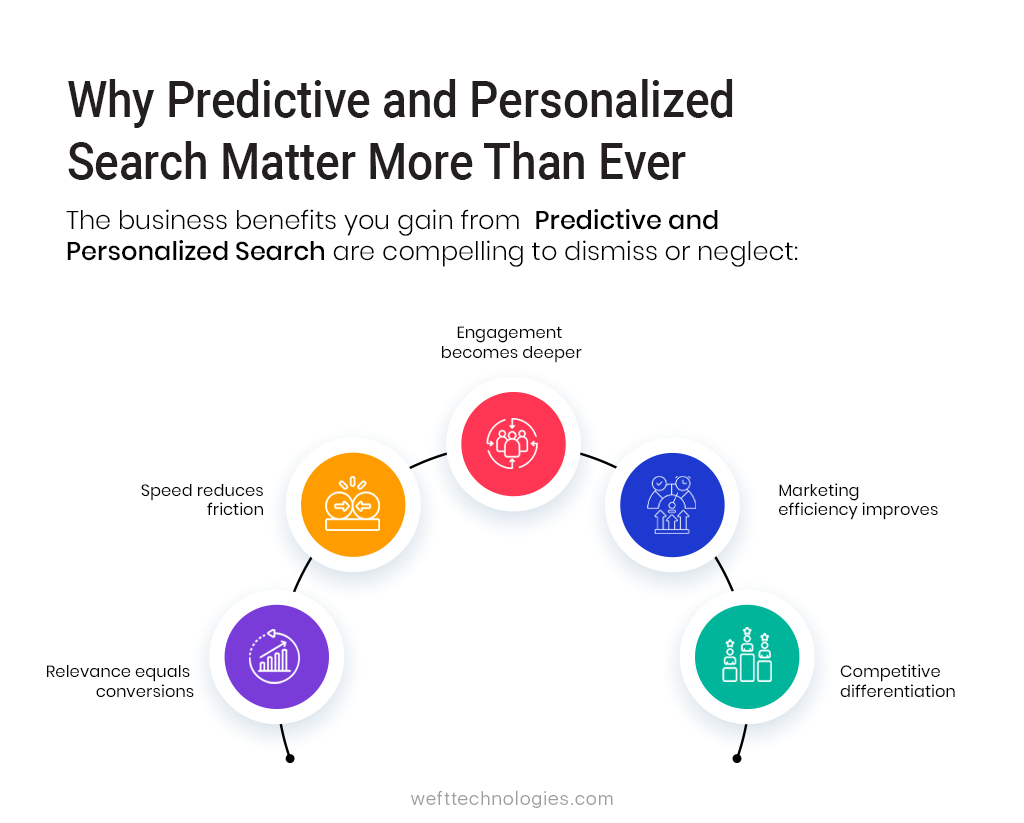
Why Predictive and Personalized Search Matter More Than Ever
The business benefits you gain from Predictive and Personalized Search are compelling to dismiss or neglect:
- Relevance equals conversions: Users who feel understood engage more deeply—conversion rates improve, bounce rates drop.
- Speed reduces friction: Predictive search reduces time to answer, delivering value faster and keeping users engaged.
- Engagement becomes deeper: Tailored interactions increase user satisfaction and loyalty—an outcome of effective AI-driven customer engagement.
- Marketing efficiency improves: With accurate intent detection, data-driven digital marketing becomes less scatter-gun and more surgical.
- Competitive differentiation: Brands employing personalized and predictive search outperform those stuck in legacy models of keyword optimization.
It is widely observed that companies getting personalization right can outperform competitors significantly, while those who don’t risk losing customers. In short, personalised and predictive search are core components of any modern digital marketing services model in the context of digital transformation.
The Power of Hyper-Personalization: Because “One Size Fits None”
Once upon a time, personalization meant using a first name in an email. Fast-forward to today — AI knows your viewing habits, your purchase cycles, and even your emotional states. This is hyper-personalization — a level of targeting where the system predicts your next move.
AI dynamically adjusts content, recommendations, and interfaces based on live behavior. If you linger on a product page, scroll faster on certain colors, or pause longer on upbeat music, the algorithm learns and predicts your searches.
Netflix is a textbook example. The thumbnail you see for the movie you sat to watch might be entirely different from somebody else’s thumbnail, because it is particularly designed to appeal to your visual taste and browsing history.
Spotify also goes a step further with mood playlists, suggesting what the emotive tone of your listening might be and then compiling tracks to fit.
Predictive analytics in digital marketing — an intelligent loop of data collection, analysis, and response is the system behind all these methodologies. AI reads cues like location, timing, browsing history, and even micro-gestures to create experiences that feel human.
AI as the New Salesperson: Guiding You Before You Even Ask
Today’s AI isn’t just sitting quietly in the background. On the other hand, it’s becoming the digital world’s most intuitive salesperson.
Predictive marketing relies on both behavioral and contextual data in order to map user journeys that unfold in real time. Instead of showing random suggestions, AI actually studies intent: it understands what a user might want based on what they are doing now and what similar users did next.
Suppose you buy a new running shoe online. Well, the platform doesn’t stop there; instead, it predicts what’s next: insoles, socks, a fitness tracker, even a brand of energy bars with which to fuel your runs. This is AI-powered customer engagement that converts every click into a story anticipating, not interrupting, your needs.
The same intelligence drives content platforms. Streaming apps preload genres you haven’t yet asked for, and AI assistants nudge you toward topics you’ll soon be curious about. When done right, these nudges don’t feel manipulative, as some fear rather more like understanding.
That’s the art of data-driven personalization: knowing when to suggest, and when to stay silent.
The Hidden Hurdles: Challenges in the Age of Intelligent Search
- Privacy & data ethics: The more user data that’s collected to power personalization, the more concern it raises. Brands must balance relevance with transparency and trust.
- Data silos and quality: Personalized search requires clean, integrated data. Success is barred by legacy systems and fragmented data sources.
- Algorithmic bias/exclusion: Advanced models inadvertently might furtheredor exclude segments, reducing fairness.
- Over-personalization risk: Too much personalisation is creepy; context counts. Yet, the line separating helpfulness from intrusion is extremely thin.
- Scaling complexity: Building predictive and personalized search at scale requires robust infrastructure, cross-functional teams, and continuous iteration.
These challenges mean that technology development is not going to be enough; organizational change, ethics governance, and strategic vision are equally essential.
The Ethics of Knowing Too Much: When AI Gets a Little Too Friendly
But let’s pause here — because when AI begins predicting our desires with near-psychic precision, a natural question arises: how much is too much?
Today, Algorithms can know us better than our closest friends. They understand our triggers, moods, and vulnerabilities. This brings into light one very crucial and raging debate in AI-driven digital marketing: where should personalization end and privacy begin? The obvious answer would be to regulate a balance between the two-enough personalization to delight, but not enough to disturb.
And how do we get there? By building transparent systems that show users why they see what they see, by offering choice over data collection, and by creating AI models that learn ethically — not invasively.
How to Implement Predictive Personalisation at Scale
For brands ready to embrace this transformation, here’s a strategic roadmap:
Step 1: Build a clean, unified data foundation
Integrate first-party data across channels (web, app, CRM), adopt a Customer Data Platform (CDP) approach, and ensure consent and data governance.
Step 2: Define intent-based segments and moment-based triggers
Move beyond demographic segmentation—map behaviour, context, micro-intent (e.g., “planning vacation”, “comparing features”).
Step 3: Select an AI framework for personalization + prediction
Deploy machine learning models that can predict next actions, and personalise search results or recommendations accordingly.
Step 4: Design search and UX interfaces around user behaviour
Ensure your search experience is frictionless, user-centric, and adaptive. Personalisation should feel natural—not forced.
Step 5: Measure the right metrics
Traditional KPIs (click-through, bounce rate) may no longer reflect value. Measure engagement, intent fulfilment, conversion latency, and user satisfaction.
Step 6: Iterate, optimise, and scale
Use feedback loops, real-time analytics, A/B testing of predictive logic, and ethical review to refine.
By following this structured approach, digital marketing services can implement predictive marketing and search personalisation strategy, turning search from a cost centre into a growth engine.
The Future Is Already Personal: What’s Next for Predictive Search?
We are just beginning to scratch the surface of what’s possible. Emerging trends indicate that in the future, search will be truly adaptive and deeply embedded.
Voice, Visual, and Multimodal Search: Beyond text, users will search via voice, image, gesture, and expect personalized responses accordingly.
Generative AI + recommendations: Predictive systems will not only suggest results but generate content tailored to the user in real time.
Emotional and contextual search: Systems will include mood, environment-smart-home and wearables-time of day, and micro-intent into returning results that feel almost human.
Hyper-personalized embedded experiences: Search will become invisible-embedded in apps, devices, and home assistants.
Humanising the Future of Search
In the rush toward technology, it’s easy to forget that at the heart of personalized and predictive search lies something deeply human: intent, desire, curiosity. The most advanced systems will not simply answer queries—they will understand us.
The shift is from “search results” to “search relationships”. When a user feels recognized, celebrated, and anticipated, the brand-user connection moves from transactional to transformational. AI tools can help you personalise user journeys and deliver more memorable customer experiences.”
In this sense, digital transformation in marketing can re-imagine how brands engage with people across journeys, contexts, and lifetimes.
Final Thoughts
The era of static keyword-based search is over. In its place emerges personalized and predictive search—where brands anticipate needs, deliver relevance, and craft intelligible, human-centric journeys.
For those offering digital marketing services, this shift is both a challenge and an opportunity. The companies that embrace AI-driven digital marketing, and build truly user-centric search experiences will lead the next wave of the future of digital marketing.

We are here to help you with growth
Contact Our ExpertsLatest Blogs
- From Prototype to Production: Building Custom AI Software for Long-Term ROI
- How to Achieve Product-Led Growth in 2026? The Right Strategies for a Successful Product
- How to Pivot a SaaS Startup Successfully: A Strategic, Data-Driven Guide for Founders
- A Complete Guide to Go-To-Market for Products and Services