


Digital transformation has gradually moved from being an overused buzzword in corporate corners to becoming a natural and essential part of how today’s businesses grow, adapt, and stay relevant in the highly competitive and contentious environment.
Yet, several of these transformation initiatives hardly deliver any meaningful impact. What is more astounding is that it is not because of a technology deficit per se, but essentially because the digital product at the core of the business and its digital product development efforts are planned and built without clear alignment to broader business goals.
This blog, therefore, explores how organizations are aligning product strategy with business goals.
Why Does Digital Transformation Fail When Done Without Proper Product Alignment?
Despite heavy investment and persistent efforts put in, many companies still struggle to achieve real, measurable outcomes through means of digital transformation. The problem is never really any lack of technology, talent, or ambition.
More often, transformation efforts fail because digital product development happens separately and is detached from the company’s overall business strategy. While leadership sets bold transformation goals, product teams focus on simply shipping features, both moving forward, but rarely in sync.
This dissociation creates a substantial gap between vision and execution.
When digital product roadmaps are molded by short-term delivery pressures and things likewise instead of long-term transformation goals, organizations often end up with well-built products that never really add value to the business or revenue in a broader perspective.
Alignment is essentially what closes this gap!
When a digital product roadmap strategy is intentionally aligned with the broader business transformation strategy, it significantly adds to the business growth.
How you may wonder!
Well, this may enable teams to gain clarity, leaders to gain visibility, and outcomes to become measurable and repeatable. This alignment, thus, leads to faster decisions, smarter prioritization, and better use of digital transformation services.
Furthermore, if you want to get a picture of why exactly the alignment matters, or how to achieve it, or how digital product development hub enable sustainable transformation, you are up for a treat.
We are discussing it all in detail.
What Digital Transformation Really Means
Digital transformation is an often misunderstood term. It is almost always referred to as the adoption of new tools, platforms, or automation technologies to merely digitize your business. While these elements are necessary, they are far from what is sufficient or what is necessary.
Digital transformation mainly represents a strategic rethinking of how organizations essentially create, deliver, and scale value using their digital capabilities.
Therefore, a true transformation always tends to decision-making models, operating structures, and customer relationships, rather than just systems.
Core Pillars of Digital Transformation
The digital transformation journey typically varies across industries. However, we can undoubtedly say that most successful initiatives are built on a common set of pillars:
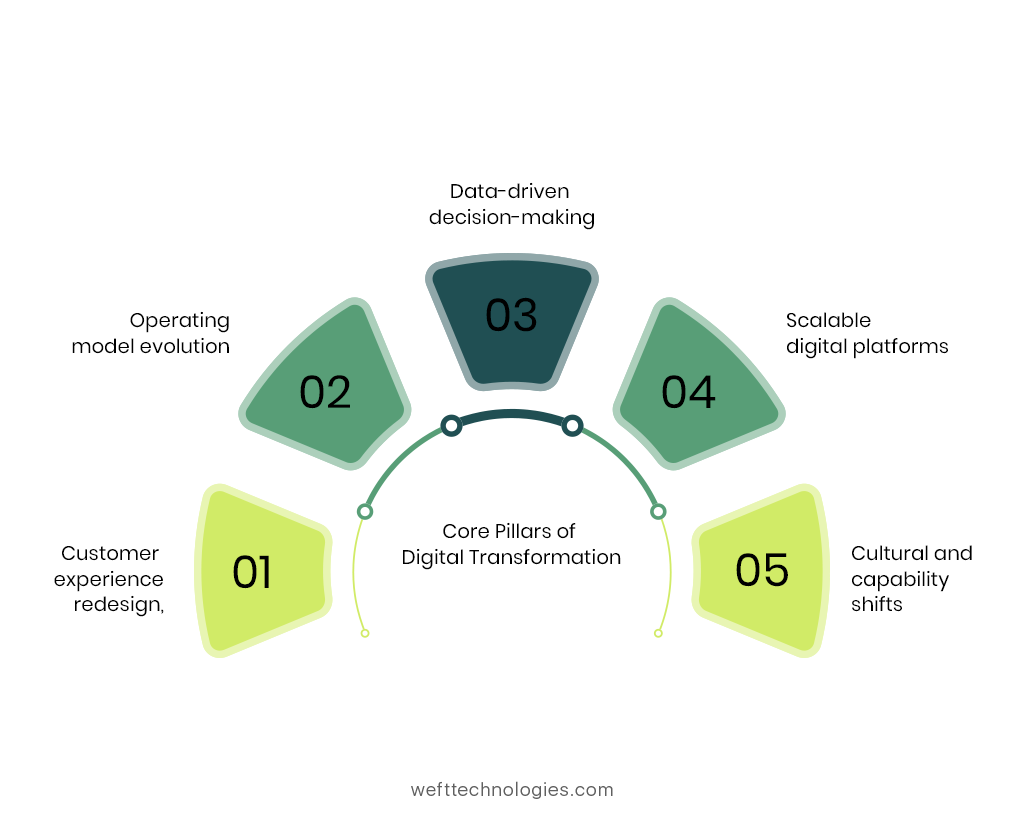
- Customer experience redesign, where mainly digital touchpoints are reimagined around real user needs rather than just adding to the internal processes.
- Operating model evolution, shifting from siloed, project-based execution to integrated, product-led ways of working.
- Data-driven decision-making enables leaders and teams to prioritize tasks based on clear-cut data and evidence rather than mere intuition.
- Scalable digital platforms, designed to support growth, integration, and future innovations that are to take over the transformation journey.
- Cultural and capability shifts, ensuring teams can sustain transformation over a longer period of time and under various cultural shifts that may likely happen.
Across all these pillars, digital products primarily serve as the primary execution layer—the tangible means through which transformation ambitions materialize and prosper.
The Role of Digital Products in Business Transformation
Digital products are said to be situated at the intersection of strategy, technology, and user experience. Abstract goals such as “becoming customer-centric” or “improving operational efficiency” only gain meaning or momentum when translated into products that customers are wowed by.
Within a transformation context, digital products mainly function as:
- Revenue drivers, opening new channels, markets, or business models.
- Experience differentiators, shaping how customers perceive and engage with the brand.
- Process optimizers, streamlining internal workflows and reducing friction.
- Data generators, creating feedback loops that inform continuous improvement.
To manage this difficulty, many organizations are seeking and moving toward a digital product development hub or a centralized product hub. And these hubs, in turn, bring a plethora of things together, including strategy, design, engineering, data, and growth functions to the table with the help of their expertise and analysis. And what’s more, this enables cohesive decision-making and faster alignment with transformation goals.
Thus, it is safe to say that transformation does not happen overnight or simply through one-time launches. It unfolds slowly and incrementally, through continuous product evolution guided by a clear and aligned strategy and roadmap.
What Is a Digital Product Roadmap—and Why It Matters Strategically
A digital product roadmap is not a delivery schedule or a backlog of features. It is a strategic artifact that communicates how product development will advance business priorities over time. At its best, it acts as a shared narrative connecting leadership intent with execution reality.
A well-defined roadmap mainly aligns:
- Business objectives, ensuring every initiative supports transformation goals.
- User needs, grounding decisions in real-world problems and behaviors.
- Technology investments, balancing speed with scalability and sustainability.
- Delivery timelines, providing transparency without sacrificing adaptability.
Roadmaps are seen to fail when they become overloaded with features, driven by internal opinions, or disconnected from the broader digital transformation roadmap. It is sad that many organizations usually optimize for delivery speed rather than focusing on strategic impact and, in conclusion, mistake activity for actual progress.
This is why the digital product roadmap strategy must be seen and treated as a leadership responsibility. It requires cross-functional ownership, strategic clarity, and continuous validation rather than providing mere product management expertise.
The Cost of Misalignment: What happens when Product Strategy and Transformation Drift Apart
Misalignment between product strategy and transformation goals creates compounding risks that grow over time:
- Wasted Investment in Low-Impact Features
Digital product development consumes significant resources. When initiatives are not tied to transformation outcomes, organizations invest heavily in features that fail to move key business metrics. - Fragmented User Experiences Across Digital Touchpoints
Products evolve independently, leading to inconsistent journeys across channels. This fragmentation erodes trust, satisfaction, and long-term customer value. - Technology Sprawl and Architectural Debt
Without a unifying roadmap, teams make isolated technology decisions. The result is a fragmented architecture that slows innovation and increases maintenance costs. - Delayed Transformation Outcomes
Leaders struggle to see tangible ROI, causing skepticism and loss of momentum. Transformation initiatives stall before reaching scale. - Internal Silos Between Strategy, Product, and Engineering Teams
Teams may execute efficiently within their domains, but misaligned priorities lead to collective inefficiency at the organizational level. - Inability to Scale or Adapt to Market Change
Rigid, misaligned roadmaps limit an organization’s ability to respond to evolving customer needs or competitive pressures.
Core Principles of Product Roadmap Alignment With Business Goals
Effective product roadmap alignment rests on several foundational principles:
- Transformation Goals Must Precede Product Decisions
Every roadmap initiative should trace directly back to a defined business transformation objective. - User Value and Business Value Must Move Together
Alignment occurs when solving user problems simultaneously advances growth, efficiency, or differentiation. - Roadmaps Should Be Outcome-Driven, Not Feature-Driven
Success is measured by impact—such as adoption, efficiency, or revenue—not by the number of features shipped. - Technology Choices Should Enable Long-Term Agility
Modular, API-first architectures allow products to evolve alongside transformation priorities. - Cross-Functional Ownership Is Non-Negotiable
Strategy, product, design, engineering, and data teams must jointly own roadmap decisions. - Roadmaps Must Be Adaptive, Not Fixed
Continuous learning and iteration ensure alignment remains intact as conditions change.
How to Align Your Digital Product Roadmap With Transformation Strategy: A Step-by-Step Framework
Step 1: Clarify the Business Transformation Strategy
Begin by defining the long-term vision and identifying strategic themes such as growth, efficiency, experience, or even resilience.
Step 2: Translate Strategy Into Product-Level Outcomes
Convert high-level goals into measurable product outcomes. For example, “operational efficiency” could be easily translated into reduced onboarding time or lower support costs.
Step 3: Map User Needs to Transformation Objectives
Leverage customer journeys, pain points, and behavioral data to ensure that every roadmap theme has the capability to solve a real user problem.
Step 4: Prioritize Initiatives Using Strategic Value Scoring
Assess initiatives based on business impact, user value, transformation relevance, and technical feasibility more than anything else.
Step 5: Align Technology Architecture With Roadmap Horizon
Balance short-term delivery needs with long-term scalability. Consider the role of platforms, data, and AI early in the process of planning and building.
Step 6: Establish Governance and Continuous Alignment Loops
Conduct regular roadmap reviews, track KPIs, and maintain leadership visibility to sustain alignment.
Operating Models That Enable Product-Led Transformation
Product-led transformation requires operating models designed for alignment. Traditional project-based delivery focuses on outputs, while product-based teams focus on outcomes.
A centralized product development hub enables:
- Faster decision-making through shared context
- Reduced handoffs across functions
- Stronger alignment with transformation goals
When assisted with the right digital transformation services—governance, tooling, etc., these models are said to significantly improve execution quality and speed.
Measuring Success: KPIs That Signal True Alignment
Meaningful alignment is reflected in measurable outcomes. Let’s take a look:
- Business outcome metrics, such as revenue growth or cost reduction
- Product adoption and engagement indicators
- Time-to-value and experimentation velocity
- Technology, health, and scalability metrics
- Cross-team predictability and alignment indicators
- Customer experience and retention signals
Together, these KPIs reveal whether the roadmap is advancing transformation or merely sustaining activity.
Common Pitfalls to Avoid in Product Roadmap Alignment
- Treating transformation as a one-time roadmap exercise
- Over-engineering before validating strategic value
- Ignoring organizational readiness and culture
- Failing to communicate the roadmap rationale clearly
- Confusing delivery velocity with transformation progress
The Strategic Advantage of Alignment: Faster, Smarter Transformation
When product strategy is considerably aligned with business goals, digital transformation moves forward with much speed and lucidity. This way, teams may spend less time guessing priorities and more time could be invested in planning and building the actual product.
As a result, execution becomes a lot faster than it could be otherwise, investments deliver far better returns than expected, and unnecessary risks are reduced or dealt with even before they show up.
This alignment helps organizations make smarter decisions at each and every stage. Product teams understand why a feature is needed, leaders gain visibility into progress and impact, and, therefore, resources are utilized more effectively.
Each product update essentially builds on previous learning, creating long-term value instead of isolated improvements here and there.
Final Thoughts
Digital transformation succeeds only when vision is translated smoothly into execution through a well-aligned digital strategy. A strong digital transformation strategy can never be pointed as a one-time plan—it’s in fact a living blueprint that guides teams, supports leadership decisions, and evolves as the business and market change with time and season.
The real challenge, therefore, isn’t choosing between strategy and delivery, but ensuring their progress happens in sync. When a digital product roadmap is treated as a strategic asset—rather than a static plan—organizations can build adaptive, resilient products that evolve with the business and create sustained transformation impact on their business.

We are here to help you with growth
Contact Our ExpertsLatest Blogs
- The Marketing Funnel Doesn’t End at Your Website Anymore
- Brand Visibility in the Age of AI Search: A Practical Guide for Businesses
- Digital Product Development in 2026: Strategies for Building Products That Actually Succeed
- The AI App Explosion: Why Low-Cost Development Won’t Fix a Broken Business Strategy