


A few years ago, Artificial Intelligence was seen as a competitive advantage. Today, it’s quickly becoming a baseline expectation.
Startups and unicorns that are integrating Machine Learning (ML) and AI into their workflows are no longer experimenting, they are outpacing entire industries.
The numbers tell a compelling story. The global AI market is projected to reach $184 billion in 2024 and grow exponentially to $826.7 billion by 2030. At the same time, 84% of executives believe innovation is the key to growth.
If innovation is essential and AI is driving innovation, can businesses really afford not to be AI-first?
The answer is clear; AI-first is not the future. It’s the present.
Let’s dive deep into the AI-First approach in business.
What Is an AI-First Approach in Business?
An AI-first approach means using Artidicial Intelligence or AI as the default, foundational technology for solving problems, creating products, optimizing operations, and designing your business, products, and decision-making processes. In an AI-first approach, AI is at the core, not as an add-on.
AI-First vs Traditional Approach
Here’s a table that shows the difference at a glance
| Traditional Model | AI-First Business Model |
| Decisions based on past data | Decisions driven by predictive intelligence |
| Manual workflows | Automated, AI-powered processes |
| Reactive problem-solving | Proactive, real-time optimization |
| Static product features | Continuously learning, evolving products |
The table clearly conveys the core idea of the AI-first approach. In a traditional setup, AI is used occasionally. In an AI-first strategy, AI becomes the foundation of how your business operates. This shift defines the modern AI-first business model, where intelligence is embedded into every layer of operations.
Why AI-First Is Essential
Let’s look at the reality businesses are dealing with today.
Customers expect faster responses, more personalized experiences, and seamless interactions. At the same time, companies are flooded with massive amounts of data, facing intense competition, and expected to innovate at an unprecedented speed.
In such an environment, relying on traditional methods isn’t just inefficient, it’s risky. It’s like trying to navigate a fast-moving highway with an outdated map.
AI Brings the Change
Businesses that have embraced AI are moving ahead at a completely different pace. They’re launching products faster, making decisions backed by real-time insights, and delivering experiences that feel tailored to each customer.
Meanwhile, companies that delay this shift are starting to feel the gap. Product launches take longer, operations become harder to manage, and competitors begin to pull ahead. Over time, this gap widens.
This is why adopting an AI-first digital transformation strategy is no longer a strategic choice, it’s a necessity. Because the longer a business waits, the harder it becomes to catch up, turning that delay into a kind of technical debt that keeps growing.
The Core Pillars of an AI-First Business
To truly embrace an AI-first approach, businesses must build around these five pillars:
1. Data as a Strategic Asset
2. AI-Driven Decision Making
3. AI in Digital Product Development
4. Continuous Learning Systems
5. Automation at Scale
1. Data as a Strategic Asset
AI thrives on data. Businesses must ensure their data is clean, structured, and accessible. Without quality data, even the best AI models fail.
2. AI-Driven Decision Making
From forecasting demand to identifying risks, AI enables:
- Faster insights
- Better accuracy
- Real-time adaptability
3. AI in Digital Product Development
Modern products are more evolving than static. With AI in digital product development, businesses can:
- Build smarter features
- Personalize user experiences
- Continuously improve performance
4. Continuous Learning Systems
AI systems improve over time. This means:
- Products get smarter with usage
- Decisions become more refined
5. Automation at Scale
Automation is not just about saving time, it is about scaling intelligently. From workflows to customer interactions, AI enables end-to-end efficiency.
AI in Digital Product Development: What’s Changing?
The traditional product development cycle is long, expensive, and often uncertain. But with an AI-first product development process, everything changes.
Traditional vs AI-First Product Development
| Traditional Development | AI-First Development |
| Weeks/months of research | Real-time data-driven insights |
| Manual prototyping | AI-generated prototypes |
| Delayed feedback loops | Instant feedback analysis |
| Fixed product roadmap | Adaptive, evolving roadmap |
Key Transformation in Digital Product Development with AI
- Predicting Product–Market Fit with Confidence
One of the biggest reasons startups fail isn’t a lack of ideas, it’s building something the market doesn’t need.
With AI, businesses can move from guesswork to clarity. By analyzing customer behavior, identifying demand patterns, and validating ideas early, AI helps ensure that products are aligned with real market needs.
This results in less risk, better decisions, and products that actually resonate with users.
- Faster Innovation & Reduced Time to Market
Traditional product development is time-consuming; prototyping, testing, and iterations can take weeks or even months.
AI dramatically accelerates this process. Prototypes can be generated in hours, testing becomes automated, and iteration cycles become significantly shorter.
The result is faster innovation, quicker launches, and a strong competitive edge.
- Turning Customer Feedback into Actionable Insights
Collecting feedback is easy, understanding it is the challenge.
AI goes beyond basic surveys and emails by analyzing large volumes of unstructured data from multiple sources like social media, reviews, and forums. It transforms this data into structured, meaningful insights. So that businesses can understand them and act on them with precision.
Real-World Applications of AI-First Strategy
AI is already transforming industries in practical and impactful ways:
- E-commerce: AI enables personalized product recommendations and dynamic pricing to enhance customer experience and maximize sales.
- Fintech: AI helps detect fraudulent activities and perform real-time risk analysis to improve financial security and decision-making.
- Healthcare: AI supports predictive diagnostics and analyzes patient data to enable faster, more accurate medical decisions.
- Logistics: AI optimizes delivery routes and forecasts demand to improve efficiency and reduce operational costs.
These examples show how AI-powered business solutions are driving measurable results.
Key Benefits of an AI-First Approach
- Faster operations through automation, which reduces turnaround time and results in quicker service delivery
- Better decision-making with real-time data for more accurate strategies and fewer costly mistakes
- Improved customer experience with personalization for higher engagement and improved customer retention
- Scalable systems that grow with your business without a proportional increase in costs
- Reduced operational costs and errors, generating higher profit margins
- Faster product development and innovation, thus a quicker time to market and a competitive advantage.
- Ability to handle large volumes of data efficiently to drive smart business outcomes.
Challenges in Becoming AI-First
- Lack of AI expertise makes implementation difficult
- Data silos prevent effective use of information
- Integration challenges with existing systems
- Unclear starting point for adopting AI
- High initial uncertainty around ROI and outcomes
This is why many businesses struggle to transition, even when they understand the importance of becoming AI-first.
How to Start Your AI-First Journey
Adopting an AI-first approach doesn’t have to be overwhelming. By following a structured, step-by-step path, businesses can gradually integrate AI into their operations and scale with confidence. Here’s a simple roadmap to get started.
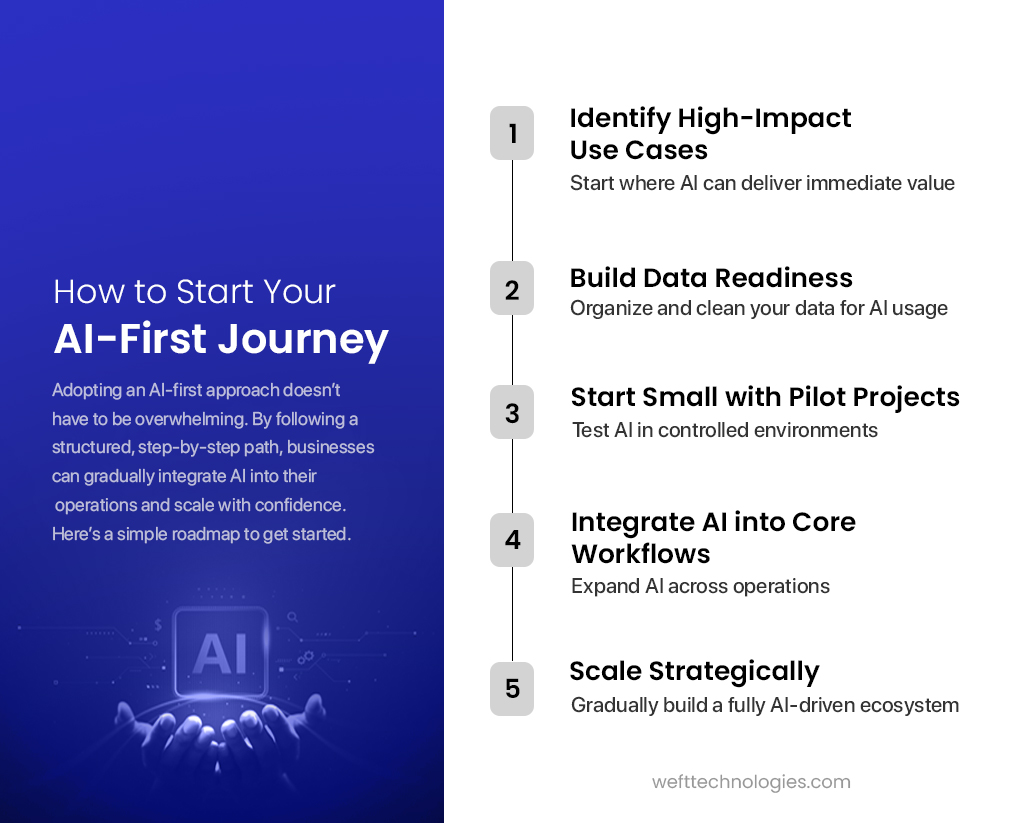
1. Identify High-Impact Use Cases
Start where AI can deliver immediate value.
2. Build Data Readiness
Organize and clean your data for AI usage.
3. Start Small with Pilot Projects
Test AI in controlled environments.
4. Integrate AI into Core Workflows
Expand AI across operations.
5. Scale Strategically
Gradually build a fully AI-driven ecosystem.
The Role of an AI-First Digital Product Studio
Transitioning to AI-first requires expertise rather than tools. An AI-first digital product studio acts as a strategic partner by:
- Designing AI-driven products
- Building scalable solutions
- Integrating AI across business processes
- Continuously optimizing performance
It also functions as a digital product development hub, managing everything from ideation to deployment.
Partnering with the right team for AI-first product development can ensure faster time to market, access to specialized knowledge, reduced implementation risk, and better ROI.
Build AI-First Products with Weft Technologies
To truly unlock the potential of AI, businesses need more than just tools, they need the right partner.
Weft Technologies stands as a leading AI-first digital product studio and digital product hub, helping businesses design, develop, and scale AI-powered solutions.
With a strong focus on innovation and performance, Weft enables organizations to:
- Build intelligent digital products
- Accelerate product development
- Transform operations with AI
- Stay ahead in a competitive landscape
The Future Belongs to AI-First Businesses
The shift is already happening.
AI is becoming the foundation of modern business growth.
Companies that embrace an AI-first strategy today will define tomorrow’s market leaders. Those who delay risk becoming irrelevant.
The question is no longer “Should we adopt AI?” It’s “How fast can we become AI-first?”
If you’re looking to transform your ideas into intelligent, scalable digital products, Weft Technologies is your ideal partner.
Start your AI-first journey today and build for the future that’s already here.