


The technology landscape is shifting beneath our feet. For years, launching a Software as a Service (SaaS) and Minimum Viable Product (MVP) followed a highly rigid, predictable playbook: draft extensive wireframes, secure seed funding (or deplete your savings), hire an expensive development team or agency, and wait months to see your product come to life.
Then came Vibe Coding.
Vibe coding means using AI to build products incredibly fast. Instead of writing code line by line, founders can focus on the big picture, how the business works, and how users experience the app.But while it helps you launch quickly, it is not a magic fix. If you are not careful, you can easily end up with a messy, broken codebase that is hard to fix later.
This comprehensive Vibe Coding Guide explores how early-stage SaaS Startup Founders can leverage AI-powered MVP development to build and validate their software at lightning speed without compromising their core product direction.
What is Vibe Coding in a Startup Context?
At its core, vibe coding is the practice of shifting from writing code line by line to directing code through natural language prompts. Using advanced AI coding tools for startups, a founder provides high-level instructions, context, and feedback, while the underlying Large Language Models (LLMs) handle the heavy lifting of execution to accelerate everything from prototyping to backend scaffolding.
For Early-Stage Entrepreneurs, this approach is completely changing how software is built. You no longer need a massive engineering budget or a fully staffed engineering team just to test a market hypothesis. Instead, you can describe the overall “vibe,” the specific workflow, and the desired features, allowing AI to generate highly functional prototypes in hours rather than weeks.
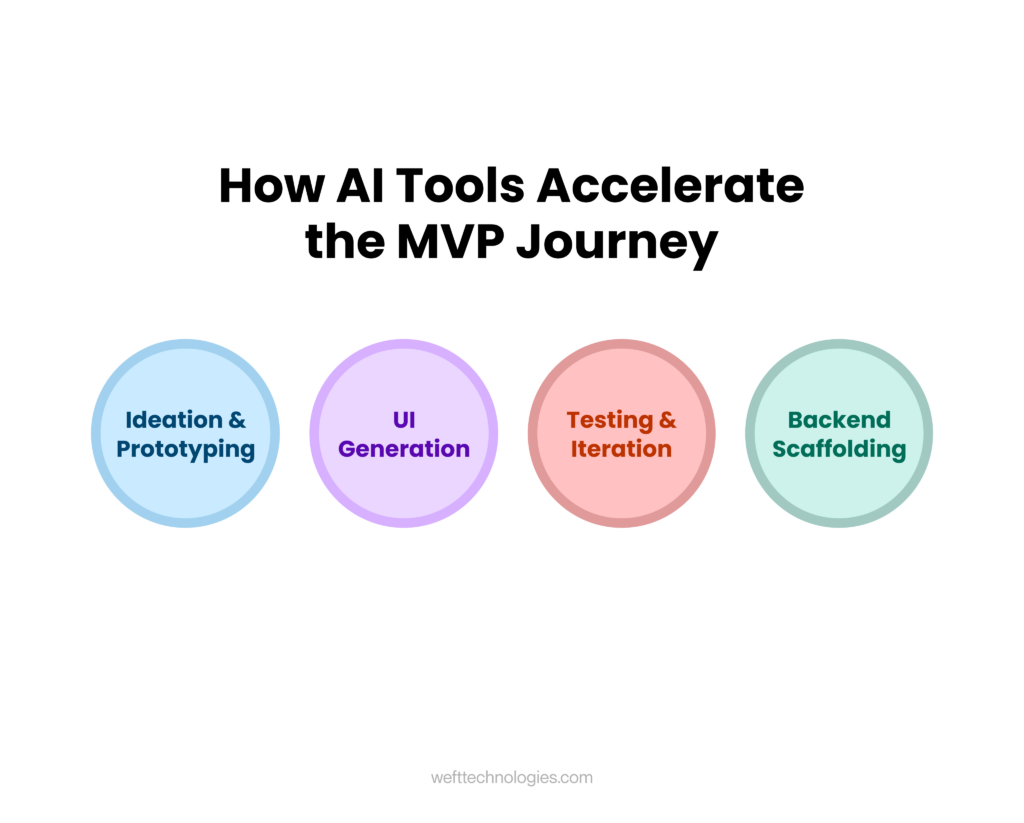
How AI Tools Accelerate the MVP Journey
Choosing to Build MVP with AI optimizes the entire product development lifecycle, turning what used to be a months long process into a highly iterative loop:
Ideation & Prototyping: When you have a new idea, it can be tough to explain exactly how it should look and feel. This process helps you instantly turn those abstract concepts into interactive, working mockups. By building a quick visual model right at the beginning, you can map out and tweak the entire user journey. This makes it easy to see what works and what doesn’t before you spend time and money on actual development.
UI Generation: Instead of getting bogged down in writing endless lines of style sheets, this allows you to quickly spin up modern frontend interfaces and clean user dashboards. By using popular, pre-built frameworks like Tailwind CSS, you can rapidly create responsive design components that automatically look great on any screen size,whether it is a mobile phone, tablet, or desktop.
Backend Scaffolding: Setting up the invisible architecture of an app usually takes a lot of tedious manual work. With this approach, you can automatically generate all your boilerplate code, database structures, and secure API endpoints. Instead of coding everything from scratch, you can set up the entire foundational system using simple, conversational language.
Testing & Iteration: Building an app is only half the battle; you also need to make sure it doesn’t break. This step uses AI to automatically write unit tests, track down hidden bugs, and fix runtime errors on the fly. It allows you to rapidly push out new feature updates and improvements based on immediate feedback from your real users.
The Pros and Cons of Vibe Coding
Before diving headfirst into AI Startup Development, it is vital to balance the incredible speed advantages against the realistic infrastructure challenges.
The Benefits
- Drastically Reduced Costs: Cut down on the heavy upfront capital traditionally required to build an initial product, lowering the barrier to entry.
- Faster Time to Market: Launch your product in days or weeks, allowing you to capture market interest and secure early users before competitors notice.
- Lean MVP Building: Test real user demand with a functional, high-fidelity application before making a permanent financial commitment.
- Empowering Non-Technical Founders: Allows Non-Technical Founders and agile SaaS Product Managers to actively participate in building, testing, and tweaking the product without needing a computer science degree.
The Challenges
- Scalability Limitations & Technical Debt: AI is exceptionally good at building what works right now, but it often lacks long-term architectural foresight, creating potential scalability bottlenecks down the line.
- Security Concerns: AI-generated code can occasionally introduce security oversights, unpatched legacy packages, or poorly optimized database queries if left unvetted.
- Overdependence on AI: Relying entirely on automated tools without understanding how the architectural pieces fit together can leave founders completely stranded when a complex bug inevitably breaks the system.
MVP Development Best Practices for Founders
To make startup product validation with AI work for your business long-term, you must ground the AI’s speed with human strategy. Use these essential MVP Development Tips to guide your workflow:
1. Validate the User Problem First
Do not build a beautiful solution in search of a problem. Before typing a single prompt into an AI tool, talk to your target audience. Ensure the pain point you are solving is severe enough that users are actively looking and willing to pay for a solution.
2. Keep the MVP Drastically Focused
The absolute ease of AI generation makes feature creep incredibly tempting. Resist the urge to add “just one more cool feature” simply because the AI can write it in thirty seconds. Keep your Vibe Coding for SaaS MVP project hyper-focused strictly on your core value proposition.
3. Combine AI Speed with Human Oversight
Think of AI as an incredibly fast, infinitely patient junior developer. It still needs a senior architect- you to review its work, direct its path, and maintain structural control. Never push code blindly to production; verify the fundamental logic.
4. Document Your Code Early
AI can write thousands of lines of code in seconds, but it rarely documents why it chose a specific implementation. Make it a habit to instruct your AI tools to generate clean documentation, internal comments, and explicit API schemas as it builds. Your future engineering team will thank you.
5. Plan for Future Scalability
Know the limits of your stack. Build with clean, modular components so that when the time comes to transition your lean prototype into a production-grade enterprise application, your code can be easily refactored rather than entirely scrapped.
Real-World Scenario: The 48-Hour SaaS Launch
Consider the real-world example of Base44, a platform acquired by Wix for $80 million precisely because its “vibe coding” infrastructure allows users to build complex software through pure conversation.
Using this exact platform, a non-technical entrepreneur documented a weekend workflow that completely bypasses traditional development agencies.
On Friday night, using Base44’s natural language “Discuss Mode,” the creator mapped out the architecture for a B2B client portal without writing a single line of code. By Saturday, they used plain-English prompts to instantly scaffold a polished frontend dashboard while the platform automatically provisioned a secure backend database. Over the next 24 hours, the creator used the integrated AI to implement role-based user authentication, wire up functional Stripe subscription payments, and instantly debug system errors simply by pasting terminal logs back into the prompt box.
Within 48 hours of conception, the founder pushed a fully functional, full-stack MVP live to a public URL. By letting AI handle 100% of the manual engineering, the creator secured their first paying customers and scaled the application to $10,000 in monthly recurring revenue—all before a traditional dev shop would have even finished the initial project discovery phase.
When to Vibe, and When to Engineer
Understanding where the boundaries lie is crucial for long-term MVP development for founders.
| Phase / Requirement | Vibe Coding (AI-Driven) | Traditional Engineering (Human-Led) |
| Early Ideation & Prototyping | Perfect for rapid visual mockups. | Too slow and expensive for pure experimentation. |
| Core Feature Validation | Great for testing user workflows quickly. | Better saved for after market validation is proven. |
| Data Privacy & Compliance | Risks compliance gaps if unmonitored. | Necessary for GDPR, HIPAA, and strict security. |
| Massive Infrastructure Scaling | Can lead to unoptimized technical debt. | Required for high-performance, enterprise scale. |
Final Thoughts
The most successful tech entrepreneurs do not choose one approach over the other; they strategically combine both. Partnering with an experienced MVP Development company or an established AI MVP Development partner can help you bridge this gap seamlessly.
Whether you collaborate with a dedicated MVP Development company in India to manage your long-term software architecture or scale your engineering team locally, the roadmap remains clear: use the unparalleled speed of vibe coding to survive the volatile early stages of a startup, achieve rapid validation, and win your first cohort of paying customers. Once you have undeniable market proof, bring in robust, traditional engineering practices to solidify, secure, and scale your product into a dominant market force.
Vibe responsibly, validate quickly, and build smart.