


AI, or Artificial Intelligence, is everywhere today. Every second company claims to be “AI-first.” Yet, despite this surge, a large number of AI-driven products fail to deliver real business impact.
But why? Because AI is easy. Building a real AI product is hard.
Simply integrating AI models or APIs does not guarantee success. What businesses often miss is strong product thinking, scalable systems, and continuous learning mechanisms. This is where an AI-first digital product studio plays a critical role, bridging the gap between experimentation and real-world product success.
In this blog, we’ll break down why most AI products fail, what actually works, and how businesses can move from AI hype to building scalable, intelligent, and high-performing products.
The AI-First Approach: Where Businesses Go Wrong
The term “AI-first” has quickly become a buzzword across industries. Many companies are adopting AI with the assumption that adding intelligence automatically creates value. But in reality, most AI implementations are superficial. It creates a false sense of progress. Businesses rush to adopt AI tools or integrate machine learning features without rethinking how their product actually works at a deeper level. As a result, AI becomes an add-on rather than a core driver of value.
Common Mistakes Businesses Make in AI Adoption
- Treating AI as a feature, not a core system
- Relying heavily on third-party APIs without control or customization
- Ignoring data quality and pipelines
- Skipping user experience design for AI interactions
- Launching without feedback loops or continuous learning systems
Without proper AI adoption, products that look innovative but fail to scale, adapt, or deliver consistent value. Rather than using just AI tools, AI-first is more about building products that think, learn, and evolve.
Why Most AI Products Fail
The growing needs of AI products do not define the success of the system. Studies show that a surprising number of AI initiatives fail to deliver real business value, and a majority of enterprise AI and GenAI projects struggle to achieve measurable ROI. The technology is getting advanced day by day, and today’s AI models are more powerful than ever. The real issue lies in how AI products are built, integrated, and executed.
Understanding these failure points is essential if you want to move from experimentation to real impact in AI product development.
Let’s look into the major reason why most AI products fail:
The “Solution-First” Trap
Many businesses’ focus shifts to attractive demos instead of solving the real problems of users. They start with AI instead of the problem. They build features just because competitors are doing it, not to fulfill the user needs. Therefore, products often lack product-market fit, thus AI becomes a marketing label, not a functional solution. It results in low real-world usage of products.
Lack of System Thinking
Without proper architecture, even the best models fail in production. AI products are complex systems that require strong architecture. Many are built like LLM wrappers with no unique value, and AI is added as a plugin instead of being built into the core. So, accuracy drops, and model shift happens. Without systems thinking, even powerful AI models fail in production.
Weak Data Foundations
Data is often fragmented, unstructured, or outdated. AI is only as good as the data it learns from. Poor data pipelines lead to inaccurate, unreliable outputs. Significant effort is required to make data AI-ready.
No Continuous Learning or Feedback Loops
Businesses that think AI systems are like traditional software have the maximum chance to fail because AI systems must evolve continuously, unlike traditional systems. Many AI products become static after launch. Companies refuse to learn and evolve from user behaviour to advance the product for better outcomes. Data drift declines product performance over time.
Over-Reliance on Third-Party APIs
Products built entirely on APIs struggle to scale and stand out. External APIs are useful in boosting the development process. Still, they have limitations such as limited control over performance and customization. So, overrelying on third-party APIs offers no long-term competitive advantage or differentiation. but increases dependency risks such as pricing, availability, and policy changes.
Poor Human-AI Interaction & Lack of Trust
If users do not trust or understand the AI, they refuse to use it, no matter how advanced it is. You may have built fully automated systems, but if they are implemented without human control, they reduce confidence in use and transparency in decision-making. Poor integration into existing workflows leads to low adoption.
High Costs with Unclear ROI
Without a clear ROI, AI projects quickly become unsustainable. AI product development is expensive and often underestimated. It will be costly for computing and infrastructure, especially for scaling and growing. Budget spent on tools instead of core product value creates a high cost for development. It creates difficulty in measuring real business impact.
AI-First vs Traditional Product Development
To truly understand the gap, it is important to compare how AI-first products should be built versus traditional approaches.
| Aspect | Traditional Product Development | AI-First Product Development |
| Core Logic | Rule-based systems | Data-driven intelligence |
| Updates | Manual releases | Continuous learning |
| User Experience | Static flows | Adaptive & personalized |
| Scalability | Feature-based | Intelligence-based |
| Decision Making | Predefined rules | Predictive & autonomous |
The key difference between traditional product development and AI-first product development is that AI-first products are not built, they are trained and continuously improved. Therefore, unless the business initiates to evolve and improve the product according to the user requirements and expectations, the product seldom becomes successful. Businesses need a proper AI implementation strategy to scale the product and make it successful to bring ROI.
How to Build Real & Successful AI Products
Businesses should understand the fact that adding AI features alone does not guarantee success. So then, how to build a successful AI-first digital product?
The answer is simple yet powerful, build AI products with the right foundation, systems thinking, and long-term strategy. Beyond being intelligent, successful AI products are scalable, adaptable, user-centered, and continuously improving.
The companies winning with AI today are not simply using powerful models. They are building products designed to evolve with users, data, and business needs.
Here’s what actually works in modern AI-powered product development:
1. Build AI as a System, Not a Feature
One of the biggest mistakes businesses make is treating AI like a small add-on. In reality, AI needs to be part of the product’s core architecture. Real AI products are designed around intelligence from the beginning, not patched in later.
Successful AI-first products integrate:
- Data pipelines
- Decision-making logic
- Learning systems
- Automation workflows
- directly into the foundation of the product.
2. Invest in Strong Data Pipelines
AI performance depends entirely on data quality. Better data creates better intelligence. Without structured and reliable data, even advanced models produce inconsistent results. Businesses that treat data as a strategic asset build more accurate and dependable AI products.
Strong AI systems require:
- Clean and organized datasets
- Real-time data processing
- Scalable storage infrastructure
- Continuous data monitoring
3. Create Continuous Feedback Loops
AI products should evolve after launch. A continuous learning process helps products become smarter, more personalized, and more effective over time.
The best AI systems learn from:
- User interactions
- System performance
- Real-world outcomes and feedback
4. Design Human-AI Workflows
AI works best when it enhances human capability, not when it removes humans entirely. Instead of building “autopilot” systems, successful companies create AI copilots, decision-support systems, human-review systems, transparent AI interactions, etc., to build trust, improve usability, and ensure users remain in control when needed.
5. Focus on Scalability from Day One
A scalable AI architecture ensures the product can grow without losing speed, accuracy, or reliability. Scaling AI requires much more than scaling software.
Businesses need to think about:
- Infrastructure costs
- Model performance at scale
- Data growth
- Security and compliance
- Continuous optimization
6. Choose a Reliable AI-First Digital Product Studio
Using AI tools is easy today. Building a truly intelligent product is much harder. This is why businesses increasingly work with an AI-first digital product hub or AI software development company that understands both technology and product strategy.
Because in the end, successful AI products are not built around hype, they are built around systems that continuously create value.
The Role of an AI-First Digital Product Studio
Businesses may have access to AI tools, talented developers, or even good ideas, but still struggle to turn them into scalable, high-performing products. That is because building real AI products is not just a technical challenge; it requires coordinated execution across multiple disciplines.
This is where an AI-first digital product studio plays a critical role.
Unlike traditional teams that treat AI as an add-on, an AI-first digital product development company approaches AI product development as a complete system, bringing together strategy, design, engineering, and data into one unified process. It acts as a digital product hub where every layer of the product is built to support intelligence, adaptability, and long-term growth.
Why Businesses Need an AI-First Approach
Modern AI products demand more than isolated expertise. They require a combination of:
- Product strategy to solve real business problems
- Data engineering to power accurate and reliable AI
- AI/ML expertise to build intelligent systems
- UX design to make AI usable and trustworthy
- Scalable architecture to support growth and performance
Without this alignment, even well-funded AI initiatives fail to deliver results.
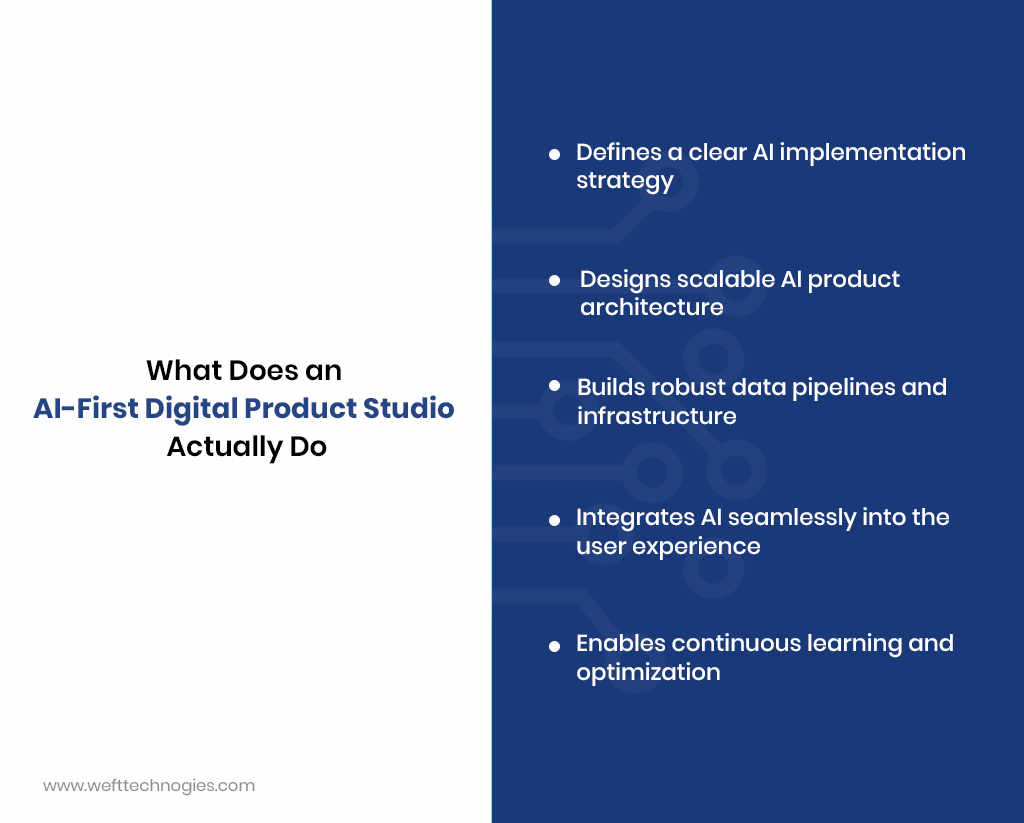
What an AI-First Digital Product Studio Actually Does
A strong digital product development hub doesn’t just build features, it builds intelligent systems that evolve. Here’s how:
- Defines a clear AI implementation strategy: Aligns AI capabilities with business goals, ensuring the product solves real problems, not just showcases technology.
- Designs scalable AI product architecture: Creates a strong technical foundation that supports performance, flexibility, and long-term scalability.
- Builds robust data pipelines and infrastructure: Ensures clean, structured, and continuously flowing data to power accurate AI outcomes.
- Integrates AI seamlessly into the user experience: Designs human-centered interfaces where AI feels intuitive, transparent, and trustworthy.
- Enables continuous learning and optimization: Implements feedback loops so the product improves based on real-world usage and evolving data.
How to Scale AI Products Successfully
Scaling AI products is fundamentally different from scaling traditional software. It is all about managing evolving models, growing data, and maintaining consistent performance in real-world conditions. Without the right approach, even a well-built AI product can break, drift, or become too expensive to sustain.
To scale AI successfully, businesses need to think beyond deployment and focus on long-term performance, adaptability, and control. Here are the ways to scale AI products successfully:
- Build modular AI systems for flexibility
Design your AI architecture in a modular way so models, data pipelines, and components can be updated or replaced without disrupting the entire system. - Monitor model performance in real time
Continuously track accuracy, latency, and output quality to detect model drift or failures before they impact users. - Maintain data quality at scale
As data grows, ensure it remains clean, relevant, and well-structured, because poor data at scale leads to poor decisions. - Optimize infrastructure and compute costs
AI workloads can become expensive quickly; efficient model usage, caching, and smart resource allocation are essential for sustainable growth. - Ensure ethical and transparent AI usage
Build trust by making AI decisions explainable, reducing bias, and maintaining compliance with evolving regulations. - Create strong feedback and retraining loops
Scaling AI means enabling systems to learn continuously from user interactions and real-world outcomes.
From AI Hype to Real Business Impact
Many businesses are stuck in the “AI hype cycle”, experimenting but not achieving results. The companies that succeed are not the ones using the most AI, but the ones using AI the smartest way.
To move forward:
- Shift focus from tools to systems
- Prioritize execution over experimentation
- Invest in long-term product thinking
- Collaborate with experts in AI-powered product development
Partner with Weft Technologies: The AI-First Digital Product Studio in India
When it comes to building scalable, intelligent AI products, choosing the right partner is critical. Weft Technologies, a leading AI-first digital product studio in India, helps businesses move beyond experimentation and build AI-driven products that deliver real impact.
As a trusted AI software development company and digital product development hub, Weft combines strategy, design, and engineering to create products that are not just functional but also continuously learning and evolving.
Why Partner with Weft Technologies?
- End-to-end AI product development, from idea validation to scalable deployment
- Strong AI implementation strategy aligned with real business goals
- Robust data pipelines & architecture for reliable, high-performing AI systems
- User-centric AI design that builds trust and improves adoption
- Continuous optimization using real-world data and feedback loops
Most AI products fail not because of technology limitations, but because of poor product thinking, weak systems, and a lack of continuous improvement. To build successful AI-driven solutions, businesses must move beyond surface-level implementation and focus on creating intelligent, adaptive, and scalable products.
Partnering with an AI-first digital product company makes all the difference. At Weft Technologies, we act as a strategic digital product development hub, helping businesses design, build, and scale high-performing AI-powered products. From defining the right AI implementation strategy to delivering custom AI product development, we ensure your product doesn’t just launch, but evolves and succeeds.
Ready to build a truly intelligent AI product? Contact Weft Technologies today and turn your AI vision into a scalable reality.