


AI coding tools have made it possible to build websites, apps, and prototypes in hours instead of weeks. With a simple prompt, entrepreneurs can generate code, design interfaces, and even launch basic applications. This trend, often called vibe coding, is changing how businesses approach digital product development.
But while AI can help build a quick prototype, can it create a secure, scalable product ready for real customers? For startups planning an MVP, the bigger question is not whether AI can write code, but whether it can build a successful business product.
Understanding the difference between vibe coding and professional product engineering can help founders choose the right approach for their growth stage and avoid costly mistakes later.
What is Vibe Coding?
Vibe coding is a modern software development approach where you simply explain to AI how the software will be in plain language rather than writing code line-by-line. By describing what you want, AI tools generate much of the code automatically. Instead of writing every line manually, developers or even non-technical founders can use AI to rapidly create applications, websites, and prototypes. AI generates code according to your prompt.
Popular vibe coding tools include:
- GitHub Copilot
- Cursor AI
- Replit AI
- Lovable
- Bolt.new
- Claude Code
- ChatGPT
Vibe coding has become popular because it reduces development time and lowers the barrier to entry for entrepreneurs.
Benefits of Vibe Coding
Vibe coding is gaining popularity because it helps businesses and developers build applications quickly and with less effort. Here are some of its key benefits:
- Faster Prototyping: AI can generate code quickly, helping startups turn ideas into working prototypes in a short time.
- Lower Initial Costs: Businesses can reduce early development expenses by using AI for basic coding and testing.
- Ideal for Validating Ideas: Startups can build a minimum viable product (MVP) and gather user feedback before making larger investments.
- Accessible for Non-Technical Founders: AI coding tools allow entrepreneurs with limited programming knowledge to create and test digital products.
- Speeds Up Repetitive Tasks: Developers can automate routine coding, debugging, and documentation, allowing them to focus on more complex work.
What Is Product Engineering?
Product engineering is the end-to-end process of planning, designing, developing, testing, deploying, and continuously improving a digital product. Unlike vibe coding, which focuses on quickly generating code, product engineering takes a strategic approach to building products that are scalable, secure, and ready for long-term business growth.
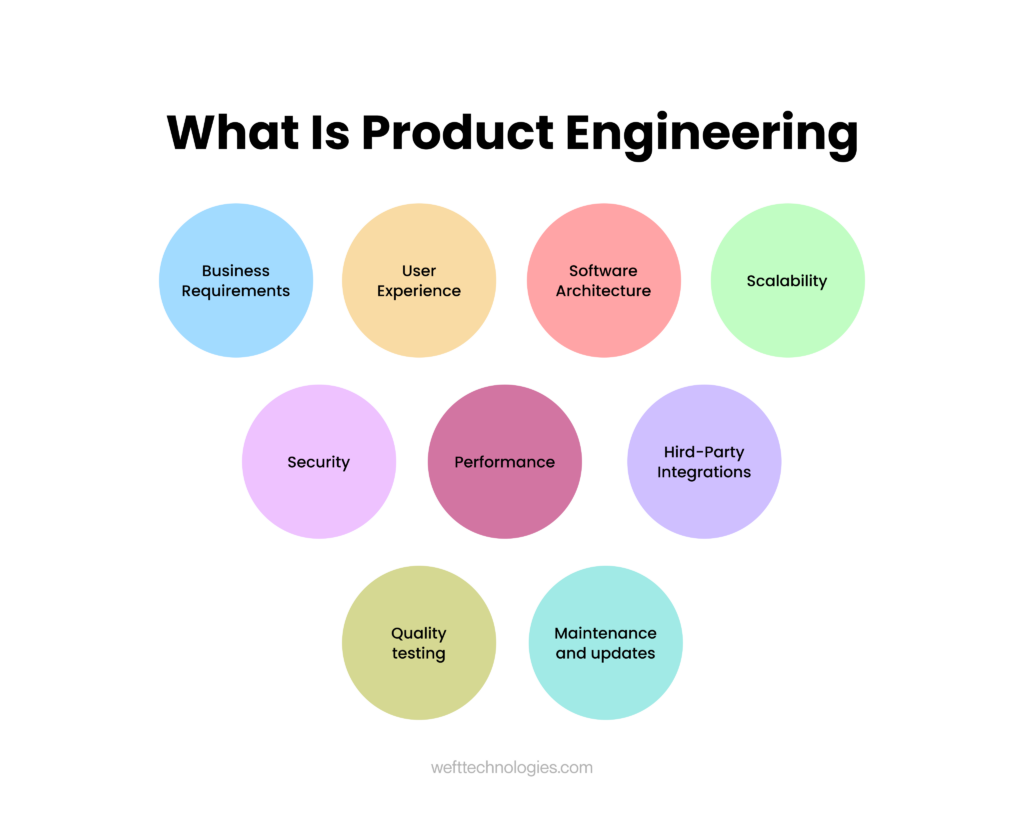
A product engineering process typically covers:
- Business requirements: Understanding user needs and business goals.
- User experience (UX): Creating intuitive and engaging customer journeys.
- Software architecture: Building a strong technical foundation for future growth.
- Scalability: Ensuring the product can handle increasing users and data.
- Security: Protecting sensitive information and reducing cyber risks.
- Performance: Delivering fast and reliable user experiences.
- Third-party integrations: Connecting with payment gateways, CRMs, APIs, and other business tools.
- Quality testing: Identifying and fixing issues before launch.
- Maintenance and updates: Continuously improving the product as business needs evolve.
A digital product studio brings together product strategists, designers, developers, and engineers to manage every stage of digital product development. This collaborative approach helps businesses build high-quality products that not only launch successfully but also adapt and scale with changing market demands.
Vibe Coding vs Product Engineering
Let’s take a quick look at the basic differences between vibe coding and product engineering:
| Factor | Vibe Coding | Product Engineering |
| Development speed | Very fast | Structured |
| Initial cost | Low | Higher upfront |
| Scalability | Limited | High |
| Security | Basic | Enterprise-grade |
| Architecture | AI-generated | Strategically designed |
| Testing | Minimal | Comprehensive |
| Maintenance | Difficult over time | Long-term support |
| Best for | MVPs and prototypes | Production products |
When Is AI Enough?
AI-assisted development and vibe coding can be a great choice for startups and businesses in the early stages of product development. It helps turn ideas into working solutions quickly and at a lower cost.
Vibe coding is ideal for:
Idea Validation– AI can help build quick prototypes to test whether a business idea solves a real customer problem.
Startup MVPs– A basic version of a product can be developed faster to gather user feedback and validate market demand.
Internal Business Tools– Simple dashboards, workflow automation tools, and employee portals can often be built efficiently with AI assistance.
Landing Pages and Marketing Sites– AI tools can quickly create websites and landing pages for product launches and marketing campaigns.
Task Automation– AI is useful for developing scripts and small applications that automate repetitive business processes.
For startups with limited budgets and simple requirements, AI-assisted development can significantly reduce the time and cost of experimenting with new ideas.
When Do You Need Product Engineering?
As a product grows, so do its technical and business requirements. While AI can accelerate development, professional product engineering becomes essential for building reliable and scalable digital products.
You need product engineering when your product requires:
Scalability– A strong architecture ensures the application can support a growing number of users and increasing data without performance issues.
Security– Professional engineering helps protect customer data, manage user access, and meet industry compliance standards.
Complex Integrations– Modern products often need to connect with payment gateways, CRMs, ERPs, AI services, and other third-party platforms.
Better User Experience– A well-designed product provides smooth navigation, intuitive interfaces, and higher customer satisfaction.
Reliable Performance– Professional development ensures fast loading times, minimal downtime, and a stable user experience.
Long-Term Growth– A scalable product architecture makes it easier to add new features, expand into new markets, and support future business needs.
If your goal is to build a product that can grow with your business, attract customers, and deliver long-term value, product engineering is the smarter investment.
The Hidden Risks of Relying Only on AI
AI-powered development has made it easier and faster to build digital products. However, relying entirely on AI or vibe coding without proper engineering oversight can create challenges as a product grows. Understanding these limitations can help businesses make smarter technology decisions.
- Technical Debt
AI often prioritizes speed over long-term maintainability. While the code may work initially, it can become difficult to update, debug, or scale as new features are added.
- Security Risks
AI-generated code may overlook security best practices and introduce vulnerabilities. Without proper reviews, businesses could face data breaches, compliance issues, and increased cybersecurity risks.
- Weak Architecture
AI can generate functional applications, but it may not design a robust system architecture. As user numbers and business requirements grow, poorly structured applications can struggle with performance and scalability.
- Inconsistent Code Quality
Different AI tools and prompts can produce varying coding styles and standards. This inconsistency can make collaboration, maintenance, and future development more complex.
- Limited Business Understanding
AI can interpret instructions but cannot fully understand business goals, customer expectations, or market strategies. It may build what is requested but not necessarily what the business truly needs.
- Integration Challenges
Modern digital products often rely on multiple third-party services such as payment gateways, CRMs, ERPs, and cloud platforms. AI-generated solutions may not handle these complex integrations effectively without expert planning.
- Higher Long-Term Costs
While AI can reduce initial development expenses, fixing architectural issues, security gaps, or performance problems later can be costly and time-consuming.
- Lack of Strategic Product Thinking
Successful digital products require more than working code. Decisions about user experience, feature prioritization, scalability, and future growth require human expertise and strategic planning.
AI is an excellent tool for accelerating development and validating ideas, but it works best when combined with professional product engineering. A balanced approach helps businesses innovate quickly while building secure, scalable, and future-ready digital products.
AI and Product Engineering Work Better Together
The future of digital product development is not about choosing between AI and human expertise, it is about combining the strengths of both. AI can accelerate development by handling repetitive and time-consuming tasks, while product engineering ensures that the final product is secure, scalable, user-friendly, and aligned with business goals.
Modern digital product teams use AI to:
- Generate boilerplate code
- Speed up testing and debugging
- Create technical documentation
- Automate repetitive development tasks
- Improve developer productivity
At the same time, engineers focus on:
- Product architecture
- Security and compliance
- Business and product strategy
- User experience and design
- Performance optimization
- Quality assurance and testing
By working together, AI and product engineering enable businesses to build products faster without compromising quality. AI helps reduce development time and costs, while experienced engineers provide the strategic thinking and technical expertise needed to solve complex challenges.
This hybrid approach is becoming the standard for modern digital product development. As AI technology continues to evolve, it will serve as a powerful tool that enhances human capabilities rather than replacing them. Businesses that combine AI-driven efficiency with professional product engineering will be better positioned to innovate, adapt to changing market demands, and build future-ready digital products that can scale with their growth.
How to Choose the Right Approach
The best choice depends on your business goals.
Choose Vibe Coding If:
- You have an early-stage idea.
- You need rapid validation.
- Budget is limited.
- You want a simple prototype.
Choose Product Engineering If:
- You’re launching a commercial product.
- Customer data is involved.
- Scalability matters.
- Complex integrations are needed.
- Long-term growth is the goal.
Choose Both If:
Most startups benefit from using AI for rapid development while relying on a professional team for architecture and product engineering.
Why a Digital Product Studio Offers More Value
Building a successful digital product takes more than writing code. From validating an idea to launching and scaling a product, businesses need a combination of strategy, design, engineering, and ongoing support. This is where a digital product studio adds value.
Unlike managing multiple freelancers or separate service providers, a digital product studio offers an integrated approach to digital product development. It brings together experts from different domains to collaborate throughout the product lifecycle, ensuring faster development, better quality, and solutions that align with business goals. This streamlined approach helps reduce risks, improve time-to-market, and create products that are built for long-term growth.
A digital product studio brings together:
- Product strategy
- Market research
- UX/UI design
- MVP planning
- Software engineering
- AI integration
- DevOps
- QA testing
- Product scaling
This approach reduces risk and improves time-to-market.
How an MVP Development Company Can Help
Many startups fail because they either overbuild or underbuild their first product.
An experienced MVP development company helps businesses:
- Validate ideas faster
- Prioritize essential features
- Build scalable architecture
- Reduce development costs
- Prepare for future growth
A strong MVP launch strategy balances speed with long-term sustainability.
Build Smarter Digital Products with Weft Technologies
AI has transformed how businesses build software, but successful products still require digital transformation strategy, engineering expertise, and a clear understanding of user needs.
At Weft Technologies, we combine AI-assisted development with structured product engineering to help businesses launch, scale, and innovate with confidence. As a trusted MVP Development Company in India and digital product studio, we support startups and enterprises through every stage of the product journey, from idea validation and MVP development to full-scale digital product development.
Whether you’re experimenting with vibe coding, planning a startup MVP, building apps with AI, or building a complex business platform, our team helps you choose the right approach for your goals, budget, and long-term growth.
Ready to turn your idea into a scalable digital product? Partner with Weft Technologies, the right startup technology partner, to build future-ready solutions that grow with your business.