

Technology shifts faster, and so does product development. For years, MVP development, or Minimum Viable Product development, has been the foundation of modern product strategy. Startups and enterprises alike have relied on Minimum Viable Products (MVPs) to launch quickly, validate ideas, and minimize risk. It’s a proven approach, build fast and learn faster.
But today, users no longer expect just functional products, they expect intelligent, personalized, and adaptive experiences. Static applications struggle to meet market dynamics.
This shift has led to the rise of a new concept: Minimum Viable Agentic Product (MVAP). Unlike traditional MVPs, MVAPs are built with AI-driven capabilities, allowing products to learn from users, make decisions, and continuously improve over time.
More than adding AI features to existing products, MVAP lets us reimagine the product architecture to be inherently intelligent and self-improving. Let’s talk in detail about this shift from MVPs to MVAPs.
What is MVP in Modern Product Development?
A Minimum Viable Product (MVP) is the simplest version of a product built with just enough features to solve a core problem and test it with real users. Instead of investing heavily upfront, startups use MVP development to launch quickly, gather feedback, and understand whether their idea actually works in the market. This is why many businesses rely on MVP development services or partner with an experienced MVP development company to build efficiently, reduce risk, and move faster.
The core goal of an MVP is simple: validate the idea early, learn from users, and make smarter decisions before scaling the product.
Where MVPs Fall Short in the AI-Driven World
While MVPs are effective for quick validation, they start to show limitations in today’s fast-moving, AI-driven product landscape. Modern users expect products to be smarter, faster, and more responsive, and traditional MVPs often struggle to keep up.
The limitations of MVP in this AI-driven world are:
- Static and rule-based: Most MVPs operate on predefined logic, which means they can only perform what they are explicitly built to do.
- No real-time learning: They don’t learn from user behavior or improve automatically over time.
- Depend on manual updates: Every improvement or feature enhancement requires developer intervention, slowing down progress.
- Limited personalization: MVPs typically offer the same experience to all users, lacking dynamic, personalized interactions.
- Slower response to market changes: Adapting to new trends or user needs takes time, making it harder to stay competitive.
A Minimum Viable Agentic Product (MVAP) is the next evolution of MVP in modern AI product development. It is the most basic version of a product that not only solves a core problem but also has built-in intelligence to learn, adapt, and act on its own.
The term “agentic” refers to systems that can make decisions, take actions, and improve over time with minimal human intervention. Unlike traditional MVPs that are static, an MVAP behaves more like a smart assistant by understanding context, responding dynamically, and keeping getting better with usage.
In simple terms MVAP is a combination of MVP, intelligence, and adaptability.
Core Pillars of MVAP
To truly understand MVAPs, it helps to break them down into three core capabilities:
- Independent Decision-Making:
MVAPs can analyze situations and take actions without constant human input, reducing manual effort and improving efficiency. - Continuous Learning:
These products learn from user interactions and data over time, allowing them to improve performance and deliver more accurate outcomes. - Adaptive Responses:
MVAPs can adjust their behavior in real time based on changing user needs, contexts, or environments, creating a more personalized and responsive experience.
Together, these pillars transform a basic product into an intelligent system that does more than function but actively evolves.
MVP vs MVAP: What Really Changes?
To understand the real impact of moving from MVP to MVAP, it’s important to look at how the approach to product building fundamentally changes. The comparison below highlights the key differences that make this shift both technological and strategic.
| Aspect | MVP | MVAP |
| Product Behavior | Static, feature-driven | Dynamic, context-aware |
| Intelligence | Rule-based logic | AI-driven decision-making |
| User Experience | Generic, one-size-fits-all | Personalized and adaptive |
| Data Usage | Limited, for validation | Continuous learning from user behavior |
| Updates | Manual releases | Automated, self-improving |
| Scalability | Functional scaling | Intelligent, autonomous scaling |
| User Interaction | Reactive (user-driven) | Proactive (system-driven) |
How MVAP Transforms Product Development
MVAP is all about rethinking how products are built and evolve. Instead of just validating an idea, MVAPs focus on delivering continuous value by evolving with user needs and data from day one. This makes them a powerful approach in AI-driven product development, especially for businesses aiming to build scalable and future-ready products.
Here’s how it transforms development:
- AI-assisted development: AI helps generate user stories, automate testing, and accelerate coding.
- Continuous product evolution: The product improves after launch without waiting for new releases.
- Data-driven decision-making: Real-time insights guide product improvements.
- From software to systems: Products become intelligent ecosystems, not just tools.
This approach significantly reduces the gap between user expectations and product experience.
How to Evolve from MVP to MVAP: Step-by-Step Guide
Transitioning from an MVP to an MVAP is about making it smarter, more responsive, and capable of learning on its own. Here’s a step-by-step, simple, and practical path to follow to build MVAP from MVP. This evolution helps transform a basic product into an intelligent, self-improving system that delivers ongoing value to users.
Step 1: Build a Strong MVP Foundation
Start with a clear problem and validate your idea using a lean MVP development approach, ensuring there is real user demand before adding intelligence. This step-by-step evolution helps transform a basic product into an intelligent, self-improving system that delivers ongoing value to users.
Step 2: Identify Agentic Opportunities
Look for areas where AI can reduce manual effort, automate repetitive tasks, or improve user decision-making.
Step 3: Integrate AI Capabilities
Introduce practical AI features, such as recommendations, predictive insights, automation, and conversational interfaces, to enhance functionality.
Step 4: Enable Learning with Data
Allow the product to learn from user behavior and interactions, so it can continuously improve performance and relevance over time.
Step 5: Introduce Autonomous Actions
Move from assistance to action by enabling the system to make decisions, trigger alerts, or complete tasks independently when appropriate.
Step 6: Continuously Optimize
Use feedback loops, analytics, and performance metrics to refine the system, ensuring it becomes smarter and more valuable with every iteration.
Real-World Use Cases of MVAP
By combining AI-driven product development with autonomous decision-making and continuous learning, these use cases show how products move beyond basic functionality to deliver ongoing value.
- AI-Powered Financial Assistants: Making financial management more proactive and personalized by analyzing user behavior, suggesting savings plans, and even automating transactions.
- Smart Healthcare Agents: Agentic systems in healthcare can monitor patient data in real time, detect anomalies early, and assist in diagnosis or triage.
- AI-Based DevOps Copilots: Used in software development, these tools can automatically detect issues in code, analyze root causes, and even fix problems in CI/CD pipelines.
- Predictive Maintenance in Manufacturing: AI agents connected to machines can predict failures before they happen, schedule maintenance, and even trigger part replacements.
- Autonomous Marketing & E-commerce Engines: These systems learn from user interactions to personalize journeys, recommend products, and adjust pricing dynamically.
- Logistics & Route Optimization Agents: AI-powered logistics systems continuously analyze traffic, weather, and delivery constraints to optimize routes in real time.
Business Benefits of Moving to MVAP
- Faster time to market with smarter, AI-assisted development
- Delivers more value to users through personalized experiences
- Reduces manual effort by automating decisions and workflows
- Improves product performance through continuous learning
- Helps businesses adapt quickly to changing market needs
- Increases user engagement with intelligent, responsive features
- Enables better decision-making using real-time data insights
- Scales efficiently without increasing operational complexity
- Creates a strong competitive advantage with AI-driven capabilities
- Drives long-term growth with self-improving product systems
Challenges in MVAP Development
- Defining the right level of AI autonomy without losing control
- Ensuring data quality and availability for accurate learning
- Managing privacy, security, and compliance requirements
- Handling unpredictable AI behavior and reducing errors
- Building user trust in automated decision-making systems
- Integrating AI smoothly into existing product architecture
- Balancing performance with computational and infrastructure costs
- Continuously monitoring and improving AI models over time
- Aligning cross-functional teams (product, data, engineering)
- Avoiding overcomplication by adding AI where it’s not needed
Best Practices for Building MVAPs
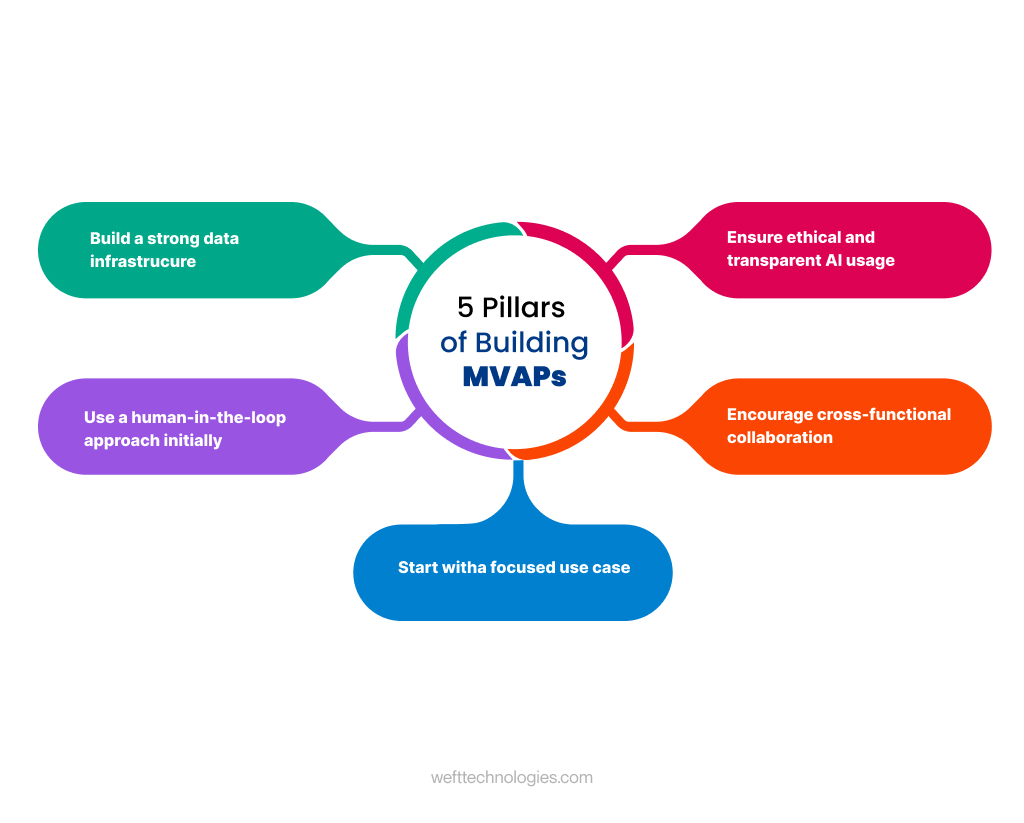
Get to know the 5 pillars of successful building MVAPs:
- Start with a focused use case- Begin with a clear, high-impact problem where AI can add real value.
- Use human-in-the-loop- Keep human oversight early to ensure control, accuracy, and trust in AI decisions.
- Build a strong data foundation- Reliable, structured data is what makes continuous learning possible.
- Ensure ethical AI usage- Design systems that are transparent, fair, and explainable to users.
- Encourage cross-functional collaboration- MVAPs require product, AI, and engineering teams to work as one unit.
5 Pillars of Building MVAPs
- Start with a focused use case
- Use a human-in-the-loop approach initially
- Build a strong data infrastructure
- Ensure ethical and transparent AI usage
- Encourage cross-functional collaboration
The Future of AI Product Development
The future of AI product development is shifting from static, feature-based products to intelligent, autonomous systems that continuously learn and evolve. Instead of relying on periodic updates or version releases, modern products are being designed to adapt in real time based on user behavior, data, and changing environments. AI is becoming the core foundation of how products are built, experienced, and scaled. This shift is redefining how businesses create value, moving from simply delivering features to delivering ongoing, personalized outcomes. MVAP (Minimum Viable Agentic Product) represents a natural evolution, where products are designed to think, act, and improve on their own.
Key shifts taking place will be the following:
- AI will be deeply embedded into every stage of product development
- Products will continuously evolve instead of relying on manual updates
- User experiences will become highly personalized and context-aware
- Decision-making will increasingly be automated within the product
- Competitive advantage will come from intelligence, not just functionality
Choosing the Right MVP Development Company: Things to Consider
Transitioning from MVP to MVAP is a strategic shift. A reliable partner should go beyond basic development and understand the bigger picture. Look for a team that brings expertise in:
- Product strategy: Aligning your idea with real user needs and business goals
- AI integration: Identifying where and how intelligence can add real value
- Scalable architecture: Building systems that can handle growth and continuous learning
- User experience: Designing intuitive, human-centered interactions even in AI-driven products
Working with an MVP development company in India offers practical advantages without compromising quality. That’s what you receive from Weft Technologies.
Build Intelligent Products with Weft Technologies
At Weft Technologies, we help businesses move beyond traditional MVPs and step into the future of AI-driven product development. As an experienced MVP development company in India, our focus is on building solutions that can evolve, learn, and scale with your business.
Our approach combines:
- Strategic MVP development services to validate ideas quickly and effectively
- AI integration and automation to make products smarter from the start
- Scalable, future-ready architectures that support continuous growth
- Ongoing product optimization driven by real user data and insights
How Weft Helps You
- Identify high-impact AI opportunities within your product
- Build and validate MVPs quickly and efficiently with expert-led MVP development services
- Seamlessly transform your MVP into an intelligent MVAP
- Deliver scalable, adaptive digital products built for long-term success
The journey from MVP to MVAP marks a fundamental shift in how products are built and experienced. If you’re ready to build future-ready products, partnering with the right experts can make all the difference.
Connect with Weft Technologies to turn your MVP into an intelligent, AI-driven product that grows with your users and your business.

We are here to help you with growth
Contact Our ExpertsLatest Blogs
- The Marketing Funnel Doesn’t End at Your Website Anymore
- Brand Visibility in the Age of AI Search: A Practical Guide for Businesses
- Digital Product Development in 2026: Strategies for Building Products That Actually Succeed
- The AI App Explosion: Why Low-Cost Development Won’t Fix a Broken Business Strategy