

Businesses today often use different software for sales, accounting, customer management, operations, HR, inventory, and reporting. While each tool may solve a specific problem, managing several disconnected systems can create new challenges. Data gets scattered, teams repeat the same work, and important information becomes harder to track.
This is where Custom software development can make a difference. Instead of adjusting business processes to fit ready-made tools, companies can build software around the way they actually work. End-to-end custom software development brings different processes, teams, and data into a connected system that can grow with the business.
For startups, growing companies, and enterprises, the goal is not simply to have another software platform. It is to create a reliable digital system that improves everyday operations and supports long-term business growth.
What Is End-to-End Custom Software Development?
End-to-end custom software development means creating a software solution specifically for a business, from the initial idea and requirements to development, deployment, integration, and ongoing support.
Unlike off-the-shelf software, which provides the same features to a large number of businesses, custom software is designed around specific workflows and requirements.
For example, a logistics company may need one platform that connects order management, fleet operations, shipment tracking, billing, and customer notifications. Rather than using separate applications for each function, a custom solution can connect these processes within one system.
Tailored software solutions align software functionality with specific business processes and requirements, helping businesses build systems that fit the way they actually work.
The result is a system that works more naturally with the organisation instead of forcing employees to change established workflows simply to accommodate software limitations.
Why Businesses Are Moving Beyond Ready-Made Software
Ready-made applications can be useful, especially for common business requirements. However, problems can appear when a company grows or develops more specialised processes.
A business may end up using one application for accounting, another for CRM, separate tools for project management, spreadsheets for reporting, and email or messaging platforms for coordination.
This can lead to:
- Repeated data entry: Employees may have to enter the same information into multiple systems.
- Disconnected data: Important information remains spread across different platforms.
- Integration challenges: Systems may not communicate properly with each other.
- Limited flexibility: Businesses have to work within the features provided by the software vendor.
- Multiple subscriptions: Several software licences can increase recurring costs.
- Vendor dependency: Changes to pricing, features, or policies can affect the business.
- Manual reporting: Teams may spend significant time collecting information from different sources.
Custom software addresses these issues by allowing businesses to build a connected digital environment around their actual requirements.
Key Benefits of End-to-End Custom Software Solutions
The value of custom software goes beyond having unique features. A well-planned solution can improve how different parts of a business work together.
1. Bring Different Business Processes Into One System
One of the biggest advantages is connecting processes that are normally managed through separate applications. Sales can pass customer information to operations. Operations can share updates with finance. Management can access data from different departments through a central dashboard. This reduces unnecessary movement of information between systems and gives teams a more consistent view of business activities. Custom business software has integration capability that connects multiple business processes through a unified digital system
2. Improve Operational Efficiency
Manual tasks can consume a considerable amount of employee time. Data entry, approvals, report preparation, status updates, and document handling are common examples.
Custom software can automate repetitive steps and create workflows based on how the organisation operates.
For example, when a sales order is approved, the system could automatically notify the operations team, update inventory information, generate the required documentation, and make the transaction available to the finance team.
The objective is simple: reduce unnecessary manual work so employees can focus on tasks that require their attention and expertise.
3. Create a Single Source of Business Data
When information is stored across several platforms, finding the correct version of a record can become difficult.
A centralised custom application can bring important business information together. Employees can work with the same data while authorised managers can access reports and dashboards based on real-time system information.
This can support better decision-making because business leaders spend less time collecting data and more time understanding it.
4. Reduce Unnecessary Software and Vendor Costs
Using several applications does not automatically mean higher costs, but businesses can accumulate expenses as they add more tools, users, integrations, and subscriptions.
A custom platform may consolidate multiple business functions into one solution.
This does not mean custom software is always cheaper from day one. Development requires an initial investment in planning, design, engineering, testing, and deployment. The business case should therefore consider the total cost of ownership, including subscriptions, integrations, maintenance, employee time, and future expansion.
5. Improve Customer and Employee Experience
Software affects more than internal operations. It also influences how customers interact with a business.
A connected system can help employees access customer information faster, provide accurate updates, reduce delays, and respond to requests more efficiently.
At the same time, employees benefit from simpler workflows and fewer repetitive tasks.
Good custom application development should therefore consider both sides of the experience: what the business needs and what its users need.
6. Integrate With Existing Business Systems
Businesses rarely start from zero. They may already have accounting platforms, CRMs, payment gateways, ERP systems, cloud services, or specialised applications. A custom solution can be designed to work with these systems through APIs and other integration methods. This allows companies to improve their technology environment without necessarily replacing every existing application.
This is particularly important for custom software development and integration services, where the goal is to make different technologies work together as part of a larger business ecosystem.
7. Scale With Business Growth
A system that works for a small team may not be suitable when the company expands into new locations, adds more employees, serves more customers, or introduces new products. Custom software can be designed with future requirements in mind. Scalable software solutions support increasing users, transactions, integrations, and business requirements over time. Businesses can add modules, users, integrations, workflows, or reporting capabilities as their needs change.
8. Improve Control Over Security and Access
Different departments do not need access to the same information. A finance employee, sales executive, warehouse manager, and senior executive may require different levels of access. Custom software can implement role-based permissions and workflows according to business requirements. Security should also be considered throughout the development lifecycle, including secure architecture, authentication, access control, testing, monitoring, and regular updates. For businesses handling customer, financial, employee, or operational information, this level of control can be especially important.
Custom Software vs Multiple Off-the-Shelf Tools
The right choice depends on the business. Off-the-shelf software can be practical when requirements are standard, and the available features meet those needs.
Custom development becomes more relevant when the business has specialised workflows, complex integrations, or requirements that existing tools cannot handle effectively.
| Business requirement | Multiple ready-made tools | Custom software |
| Standard business processes | Often suitable | Can be built if needed |
| Highly specialised workflows | May require workarounds | Designed around the workflow |
| Data across multiple departments | May remain fragmented | Can be centralised |
| Integrations | Depends on available APIs/connectors | Can be planned into the architecture |
| Business-specific features | Limited by vendor | Built to specific requirements |
| Future expansion | Depends on product roadmap | Architecture can support planned growth |
The decision should therefore be based on business requirements, expected growth, integration needs, security, and long-term costs rather than simply comparing development prices.
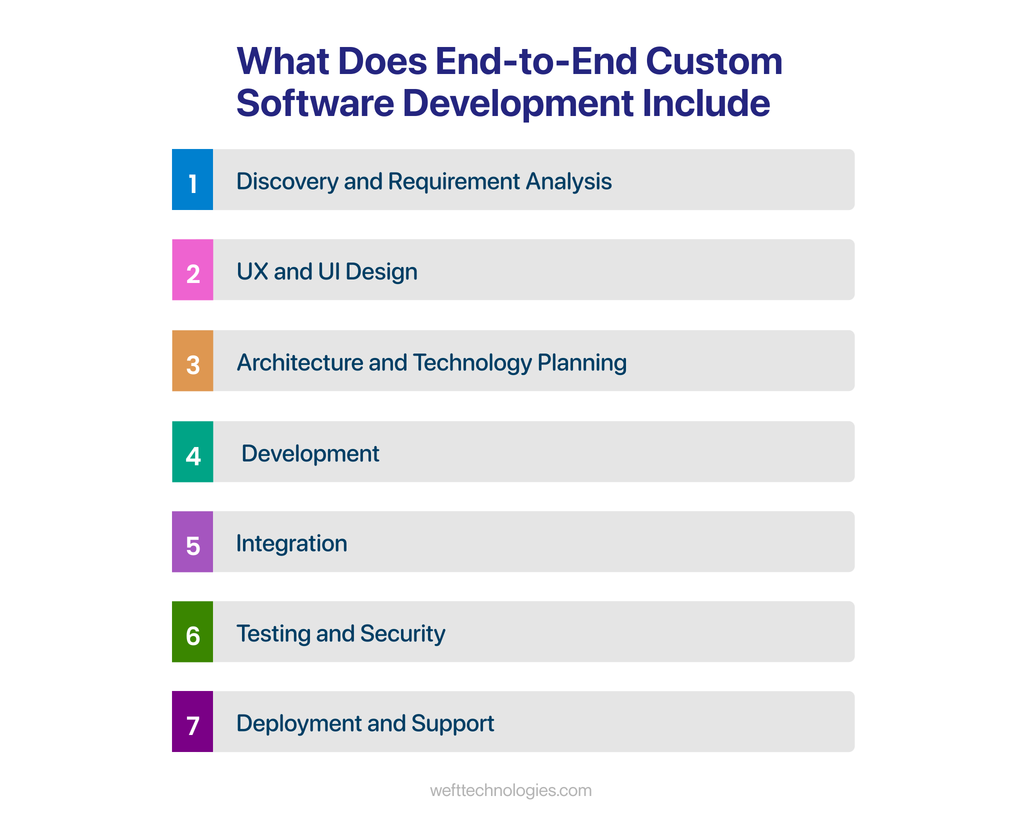
What Does End-to-End Custom Software Development Include?
A successful solution involves more than writing code. A complete development process usually includes several stages.
1. Discovery and Requirement Analysis- The development team first understands the business, users, existing systems, challenges, and goals. This helps define what the software actually needs to solve.
2. UX and UI Design- The interface and workflows are designed around the people who will use the system. Simple navigation and clear processes can improve adoption and reduce training requirements.
3. Architecture and Technology Planning- The team selects the appropriate architecture, technologies, databases, cloud infrastructure, and integration approach based on the product’s requirements.
4. Development- Developers build the required features and business logic while following appropriate coding and engineering practices.
5. Integration- The software is connected with existing platforms such as ERP systems, CRMs, payment gateways, communication tools, analytics platforms, or third-party APIs.
6. Testing and Security- Functional testing, performance testing, usability testing, integration testing, and security checks help identify issues before deployment.
7. Deployment and Support- Once the application is ready, it is deployed to the required environment. Ongoing monitoring, maintenance, updates, and improvements help keep the system reliable as business needs evolve.
This complete approach is what makes end-to-end custom software development services different from simply hiring a team to build a few software features.
When Should a Business Consider Custom Software?
Custom software may be worth considering when:
- Existing applications require too many manual workarounds.
- Different departments use disconnected systems.
- Employees repeatedly enter or transfer the same data.
- Business processes are unique or highly specialised.
- Integrating current applications has become difficult.
- Management lacks a clear view of important business data.
- The company is expanding into new markets or locations.
- Existing software cannot support planned growth.
- Security, access control, or compliance requirements are becoming more complex.
For example, a growing manufacturer may need software connecting procurement, production, inventory, quality checks, sales, and finance. A standard application may cover some of these areas, but a tailored platform can connect them according to the company’s specific workflow.
How to Choose the Right Custom Software Development Partner
The development partner you choose can have a major impact on the outcome. Look beyond coding capabilities and consider the complete development approach.
- Look for business understanding: A good partner should take time to understand your business problem before recommending technology.
- Check end-to-end capabilities: Look for experience across research, UX/UI, development, testing, cloud, security, integrations, deployment, and ongoing support.
- Consider scalability: The solution should support your current requirements while leaving room for future changes.
- Review integration experience: If your business already uses multiple platforms, make sure the development team understands APIs, third-party integrations, data migration, and system interoperability.
- Ask about post-launch support: Software is not finished when it goes live. Updates, monitoring, maintenance, security improvements, and new features may be required as the business evolves.
An experienced custom software development company in India can support businesses with these requirements by combining technical expertise with an understanding of business processes. For companies working across regions, it is also important to evaluate communication, delivery processes, time zones, and support arrangements before selecting a partner.
Build Business-Specific Software With Weft Technologies
Every business has its own processes, customers, challenges, and growth plans. Software should support those differences rather than force every organisation into the same workflow.
Weft Technologies provides custom software development services designed around business requirements. From discovery and UX/UI design to development, integrations, cloud, QA, deployment, and ongoing improvements, our teams can support the complete product lifecycle.
Investing in custom software is not simply about getting software with more features. It is about creating a digital system that fits the way your business operates. When planned properly, an end-to-end solution can connect departments, reduce repetitive work, centralise information, simplify integrations, improve user experiences, and provide the flexibility needed for future growth.
For businesses that have outgrown disconnected tools or standard software, custom software solutions for businesses can provide a more connected and adaptable foundation for the next stage of growth. Whether you need a new business application, an integrated enterprise platform, or a scalable solution to replace disconnected tools, Weft focuses on building technology that solves real operational problems.
Looking to connect your business processes through a tailored digital solution? Contact Weft Technologies to discuss your requirements and explore an end-to-end custom software development approach for your business.