

In 2026, building something people actually want and keep using takes more than a development team and good intentions; it takes research, design thinking, engineering discipline, some smart use of AI, and a willingness to keep improving after launch instead of treating it as done. At Weft Technologies, we act as a digital product hub for founders and enterprise teams who need more than a group of coders taking orders. They want someone who understands the whole journey, from the first “does anyone actually want this” conversation to scaling something that’s already working, backed by real digital product development services rather than a loose collection of freelancers.
This blog walks through what that journey looks like right now and, honestly, what tends to separate the products that stick around from the ones that quietly disappear a few months after launch.
What Is Digital Product Development, Exactly?
Digital product development is the process of taking an idea, which can be a web app, a mobile app, a SaaS platform, or whatever, and turning it into something real through research, design, engineering, and ongoing refinement. Where it differs from plain old software product development is timing. Software development usually starts once someone already knows what they’re building. Product development starts a step earlier, asking whether the thing should be built at all and why.
That gap sounds small on paper, but it’s the reason so many well-built apps still fail. You can hire great engineers, ship clean code, and still end up with a product nobody opens twice, because the assumptions underneath it were never tested. A proper digital product development hub treats research, design, and engineering as one connected effort instead of three teams passing a file back and forth, which is really what end-to-end product development is supposed to mean in the first place. That’s the whole point of the lifecycle we’ll get into below.
It’s also worth mentioning that this isn’t a one-size-fits-all process. A startup validating its first idea and an enterprise modernizing a decade-old system are working through very different versions of the same product development process, and a good partner should be able to flex between the two, offering digital product consulting for the strategy side and hands-on engineering for the build.
Why Digital Transformation Makes This Non-Negotiable
None of this happens in a vacuum. Digital transformation has pushed nearly every company, big or small, to treat digital products as core to how they make money rather than a side experiment. Customers expect fast, personalized digital experiences without thinking twice about it, and internal teams expect the same from the tools they use every day. That expectation alone is why enterprise product development budgets keep climbing, and why founders can’t afford to treat their first build as a throwaway experiment either.
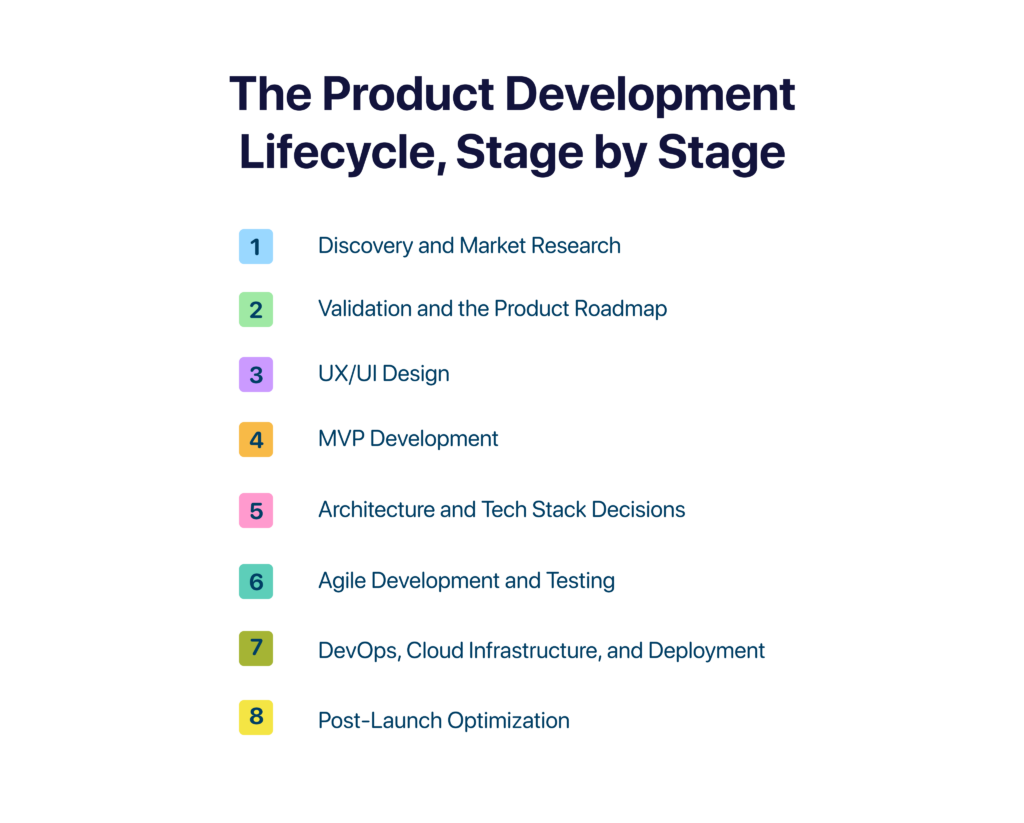
The Product Development Lifecycle, Stage by Stage
A stage-by-stage product development lifecycle at a glance:
Discovery and Market Research
Good products start with understanding a problem, not jumping to a solution. This means competitor research, user research through real conversations with the people who’ll actually use the product, and figuring out what’s genuinely frustrating them instead of guessing. Skip this step and you usually end up building features nobody asked for and wondering why adoption is flat.
Validation and the Product Roadmap
Before any production code gets written, the idea needs a reality check, through surveys, a simple landing page, a clickable prototype, or whatever fits. Product validation is really just a way of reducing the odds you’re about to spend months building something the market shrugs at. Once there’s some evidence behind the idea, the product roadmap can prioritize what actually matters instead of what’s loudest in the room.
UX/UI Design
Design isn’t the coat of paint at the end, it’s often the first thing that decides whether someone trusts your product enough to keep using it. Users make that call within seconds. UX/UI work in 2026 leans hard on accessibility, mobile-first layouts, and just cutting out friction wherever it shows up.
MVP Development
A good MVP is a focused build that tests whether the core idea actually holds up, using real usage data instead of internal opinions. Founders and enterprise teams alike use this stage to learn fast before committing serious budget to a full build.
Architecture and Tech Stack Decisions
This is where the harder engineering calls get made, and which frameworks will hold up as things scale instead of forcing a rebuild eighteen months in. This stage often calls for custom software product development rather than off-the-shelf tooling, especially when the product needs to fit a very specific workflow. Getting scalable software architecture right early on saves a painful amount of rework later.
Agile Development and Testing
Agile breaks the build into short, testable chunks so teams can adjust as they learn, instead of discovering problems six months in. Continuous testing, automated where it makes sense, catches issues while they’re still cheap to fix rather than after launch when they’re anything but.
DevOps, Cloud Infrastructure, and Deployment
Enterprise-grade product development leans on solid DevOps: CI/CD pipelines, cloud-native infrastructure, and systems built to scale without a ground-up rewrite. This matters even more for SaaS product development, where uptime and scale aren’t optional extras, they’re the product. Security and compliance belong here too, built in from the start, not patched on right before launch when someone remembers.
Post-Launch Optimization
Launch day isn’t the finish line, it’s closer to the starting gun. After release, teams watch how people actually use the product, gather feedback, and keep iterating. The strongest products treat every release as a hypothesis worth testing, not a final answer carved in stone.
Where AI Actually Fits In
AI has moved from “nice add-on” to something baked into how digital products get planned and built in the first place. A few places this shows up in real work:
Research moves faster, since AI tools can sort through user feedback and market data in a fraction of the time manual analysis used to take. Prototyping speeds up too, with AI-assisted design tools shortening the wireframing and iteration cycle. Teams increasingly lean on predictive models to spot churn risk or guess at what feature will actually move the needle next. And a lot of 2026 products don’t stop at using AI behind the scenes, they ship AI-powered features directly, from recommendations to automation to natural-language interfaces, as part of the core value.
None of this replaces a product team’s judgment. It just means fewer decisions get made on gut feeling alone.
Where Things Usually Go Wrong
No product journey is friction-free, and the same handful of mistakes tend to show up again and again:
- Building around internal assumptions instead of what user research actually shows
- Underestimating architecture complexity until growth forces an expensive rebuild
- Treating design as a final polish step rather than something that shapes the whole build
- Weak handoffs between design, engineering, and DevOps teams that quietly waste weeks
- Leaving security and compliance for “later,” especially risky in regulated industries
What Tends to Work
A few practices show up consistently across the products that actually succeed:
Start with the problem, not the platform. Validate demand before locking in a tech stack. Build for change, since modular, cloud-native architecture makes future pivots far less painful than a rigid one. Treat AI as part of the infrastructure rather than a bolt-on feature request. Keep design and engineering talking to each other constantly, because disconnected teams tend to ship disconnected products. Keep measuring after launch instead of assuming the job is done, and let real data steer the roadmap. And plan for security and compliance early, particularly for SaaS or enterprise products handling sensitive data.
Choosing the Right Development Partner
Not every vendor that says “we build software” actually operates as a true digital product hub. A few things worth checking before signing anything:
- Real experience across the full product development lifecycle, not just execution on a spec someone else wrote
- A team willing to push back on a weak idea instead of just building whatever’s asked, the kind of digital product consulting that questions the plan before committing engineering hours to it
- Clear, honest communication and timelines that don’t fall apart at the first delay
- Genuine depth in scalable architecture and cloud infrastructure, not just buzzwords on a website
- A track record with businesses roughly your size and complexity, whether that’s a lean startup or full enterprise product development
This is where Weft Technologies comes in. We offer digital product development services covering discovery, user research, design, engineering, AI integration, and long-term support under one roof, so founders and enterprise leaders aren’t juggling five different vendors just to get one product built properly. Whether it’s custom software product development for a niche workflow or SaaS product development built to scale from day one, the approach stays the same: understand the problem first, then build.
Building a successful digital product in 2026 isn’t really about moving fast for its own sake. It’s about moving deliberately through discovery, validation, design, and engineering with AI and DevOps supporting the process instead of driving it blindly. The companies treating product development as one connected system, rather than a string of disconnected phases, are the ones ending up with products that actually last.
If you’re planning your next product and want a partner who thinks past just writing code, Weft Technologies would be glad to help, from the first research conversation through to long-term scale.