


The mobile app market is expanding at a rapid pace. Building a feature-rich, high-performing app historically required months of dedicated engineering, large cross-functional teams, and substantial capital outlay. Today, the integration of Generative AI in mobile app development is reshaping operational dynamics.
From rapid prototyping and automated code completion to automated UI design and automated bug fixing, modern engineering teams leverage Generative AI in mobile app development to deliver products to market faster and more economically than ever before.However this low barrier to entry has created a situation where now the market is flooded with AI-built Applications.
Whether you are a startup founder building your product, understanding how to pair AI-powered mobile app development speed with strategic product planning is critical. To build a successful application in today’s crowded market, you must focus not just on how quickly you can build, but on what you are building and what users care about.
The Illusion of the Low-Cost AI Advantage
For decades, the primary hurdle in software product development was technical execution: Can we afford to build this? Do we have the engineering bandwidth?
AI-powered mobile app development has effectively inverted this dynamic. Today, writing boilerplate code, configuring APIs, and setting up database schemas can be executed in minutes using generative coding assistants.
However, lowering development expenses creates a psychological illusion. When an AI app development pipeline allows you to launch an MVP for $20,000 instead of $80,000, it is tempting to skip critical business discovery phases.
The harsh reality of the 2026 app economy is clear: User attention is scarcer than ever. An app store filled with thousands of AI-generated utilities means users have zero tolerance for products that fail to solve immediate, specific pain points.
Why Cost-Effective AI Apps Still Fail
Even if an app developed by Generative AI cuts your code production effort by 50%, a flawed product strategy will still undermine your launch. Here is where cheap AI apps fall short:
1. The “Copycat” Software Trap
When software creation becomes effortless, market copycats proliferate. Founders use generative tools to clone existing popular apps without offering a unique value proposition.
- The Strategic Flaw: Competing against established incumbents on their home turf without product differentiation.
- The Result: High customer acquisition costs (CAC) that quickly erase any savings achieved in upfront mobile app development.
2. Neglecting User Experience (UX) and Brand Identity
AI tools for mobile app development can instantly spit out UI layouts, but they lack human empathy and brand understanding.
- The Strategic Flaw: Relying on generic, template-driven AI layouts without testing real user journeys.
- The Result: High user drop-off rates, poor app store ratings, and zero user retention after day one.
3. Flawed Monetization and Unit Economics
Saving money during the initial build does not guarantee long-term financial health.
- The Strategic Flaw: Building features without clear monetization loops, churn reduction models, or lifetime value (LTV) projections.
- The Result: An app that generates user traffic but drains cash flow through recurring server, vector database, and LLM API costs.
4. Hidden Technical Debt and Security Blind Spots
Unaudited, AI-generated code often contains unseen performance bottlenecks, security vulnerabilities, and messy dependency trees.
- The Strategic Flaw: Treating AI code output as production-ready without enterprise code audits.
- The Result: Critical system crashes, data compliance fines and expensive post-launch rewrite cycles
Strategy -driven VS Blind Execution : A phase by phase comparison
| Lifecycle phase | Strategy -Driven | Blind AI execution |
| Ideation & Discovery | Uses AI to synthesize competitor reviews and market gaps, then validates demand with real users. | Prompts AI to generate feature lists based on trends; skips deep customer interviews. |
| UI/UX Prototyping | Uses AI-assisted app development for rapid layout drafting, followed by human UX refinement and user testing. | Accepts initial AI-rendered wireframes; ignores brand voice and nuanced accessibility. |
| Development & Architecture | Senior engineers guide Generative AI models to build clean, modular cross-platform architecture. | Generates raw code blocks with minimal oversight; risks security and scalability. |
| Quality Assurance (QA) | Combines automated AI regression testing with thorough human exploratory and security testing. | Relies solely on automated scripts; misses contextual user journey bugs. |
| Post-Launch & Scaling | Continuously optimizes features based on real analytics, user feedback, and sustainable unit economics. | Struggles with high churn and unexpected API usage bills. |
The Real Cost Breakdown: Where Savings Actually Belong
When planned correctly, leveraging AI in mobile app development offers substantial financial benefits. However, smart product teams do not simply pocket those savings, they reallocate them into areas that drive long-term adoption.
Notice that the strategic build isn’t just about achieving the lowest possible AI mobile app development cost. It’s about taking the savings generated by Generative AI in coding and reinvesting them into market validation, product strategy, and user acquisition.
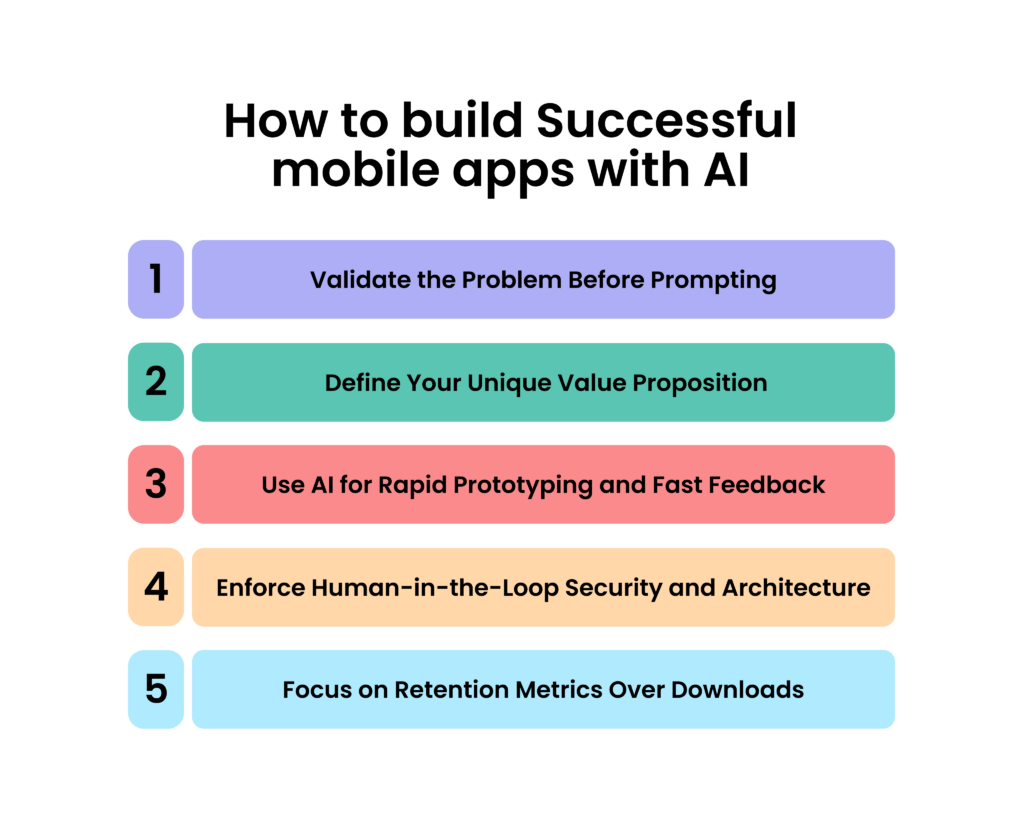
Beyond the code: How to build Successful mobile apps with AI
To avoid getting lost in a flooded market, follow this actionable, strategy-first blueprint when using AI app development tools:
1. Validate the Problem Before Prompting
Never ask AI to build an app simply because a technology exists. Conduct interviews, survey target communities, and analyze competitor complaints in app store reviews to identify acute, unsolved problems.
2. Define Your Unique Value Proposition
Determine your core differentiator:
- Are you providing a 10x faster workflow?
- Are you offering a hyper-personalized experience that competitors lack?
- Is your pricing model fundamentally fairer?
If your UVP can be easily replicated in an afternoon prompt by a competitor, your strategy needs deeper defensibility.
3. Use AI for Rapid Prototyping and Fast Feedback
Deploy AI tools for mobile app development to create clickable prototypes within days. Put these early designs directly into the hands of target users to gather immediate usability feedback before writing backend infrastructure.
4. Enforce Human-in-the-Loop Security and Architecture
Ensure every AI-generated code component is audited by an experienced software architect. Pay strict attention to API key management, data encryption, and cross-platform framework compliance
5. Focus on Retention Metrics Over Downloads
Track Day-1, Day-7, and Day-30 retention rates. A lean app with 1,000 highly engaged, paying users is far more valuable than a low-cost AI app with 50,000 downloads and a 99% bounce rate.
Why You Need a Strategic Partner, Not Just AI Prompts
While modern tools allow anyone to generate code snippets, executing a complete, enterprise-grade digital product requires multidimensional expertise. This is where partnering with a professional mobile app development company becomes an invaluable advantage.
A seasoned engineering partner bridges the gap between raw AI speed and long-term business viability:
- Strategic Product Alignment: Experienced engineers help refine your feature roadmap to ensure you don’t over-engineer unnecessary features.
- Enterprise Security & Compliance: Protecting proprietary data and user privacy requires human accountability, clear compliance frameworks, and thorough code audits.
- Optimized Cost Efficiency: Working with a top-tier mobile app development company in india enables businesses to maximize ROI. By pairing competitive global developer talent with advanced AI-powered mobile app development workflows, you achieve high-quality builds at a fraction of traditional costs.
Final Thoughts: Strategy Is Your Ultimate Defensible Advantage
In an era where Generative AI allows anyone to build an app in a weekend, technical execution alone is no longer a durable competitive moat. Lowering your build costs is a massive operational win, but a cheaper production cost will never rescue a product that nobody wants.
To build an app that lasts:
- Use AI-powered mobile app development to move fast and spend smart.
- Reinvest your savings into deep market validation, world-class UI/UX design, and strategic user acquisition.
- Partner with technical experts who understand how to balance rapid automation with enterprise security and scalable engineering.
Ready to build an AI-driven app backed by a winning market strategy? Don’t just build faster, build smarter. Partner with our team of expert developers and product strategists to create a secure, high-performing mobile app that stands out in today’s competitive market. Contact us today for a free technical consultation to discuss your vision!