


Bringing a new product idea to life is exciting, but moving straight into development without research is one of the biggest reasons MVPs fail. Here comes the importance of market research for MVP development, which helps you understand your right audience, validate demand, study competitors, and identify what features actually matter. Instead of guessing, you learn what people are willing to use and pay for through effective market research. That’s where lean startup market research comes in.
Before you get into the full development of an MVP (minimum viable product), a simplified version of your product designed to test your idea with real users, read this guide for a practical, step-by-step process to research your idea, choose the right tools, validate your concept, and reduce risk long before launch.
What Is Market Research in MVP Development?
Market research in MVP development is the process of understanding your target users, their problems, market needs, competitors, and the real demand for your product before you invest in full-scale development. This process helps you validate the core product idea and define essential features to solve the users’ problems. Clear market research before developing a Minimum Viable Product, or MVP, guides you on the right and quickest path, instead of guessing market needs and building many random features.
In the MVP context, market research guides what features to build first, who you are building for, and whether the product is worth pursuing at all. By collecting evidence through market trends’ analysis, you can validate whether your idea solves a meaningful problem so that you can build a useful MVP. This process reduces risk, prevents wasted development costs, and ensures your MVP is built around real user needs, not assumptions.
Why Market Research Matters Before MVP Development
- Helps you clearly understand the right target audience and real problem users face.
- It shows whether there is enough demand for your idea.
- Gives a clear understanding of what competitors are already doing and where gaps exist.
- It helps you price your product realistically.
- It increases the chances of attracting investors and early users.
Benefits of Market Research in MVP Context
Market research is a reality check instead of guessing user needs and before you start building on assumptions. It can help you in many ways, and some of them are:
1. Find the right audience
Who your product is really for is crucial, and gather the details through clear market research, leading you to build the useful product for the right people.
2. Validate whether your idea is worth building
Do people actually care about your idea? Will they pay for it? Will it help them? Market research leads you to answers for such questions.
3. Understand user needs and pain points
You can get insights about the problems the users face and what they wish existed and what “success” looks like, and thus you can design features that truly solve problems.
4. Prioritize only the most Important Features
Market research prevents feature bloat. You learn which features are must-have, which can wait, and which shouldn’t be built at all, saving cost and time.
5. Improve product–market fit early
Instead of launching blindly, research helps align your MVP with real demand, increasing adoption, retention, and user satisfaction.
6. Stay ahead of competitors and trends
Studying the market reveals who else is solving the same problem, what they do well, and where gaps exist, allowing you to differentiate your MVP.
7. Reduce risk and development waste
Clear insights minimize guesswork, prevent costly rework, and ensure every feature has a purpose, lowering financial and technical risk.
8. Build confidence for stakeholders and investors
Data-backed MVP validation shows that your product is more than an idea, it’s an opportunity grounded in real market demand.
Types of Market Research for MVP Development
The MVP market research process happens in different ways. Each one gives different types of insights.
Primary Research
Conducting one-on-one conversations or group sessions, talking to people, observing them, and testing your ideas with them are the activities that take place in primary research. It is the process of collecting information directly from real users to understand their problems, solutions, and how your MVP will help them.
Example
- Interviews
- Surveys
- Questionnaires
- Group discussions
- User testing with prototypes
Secondary Research
Analyzing existing information from trusted sources to understand the broader market landscape comes under secondary research where you can use the below methods.
- Industry reports
- Online research
- Public datasets
- Competitor case studies
- Academic research
These processes are qualitative or quantitative research. Qualitative research explores thoughts, emotions, and motivations, while quantitative research deals with data, statistics, and measurable results.
The Step-by-Step Market Research Process for MVP Development
Market research is not a quick process. It is an essential MVP development process for validating your idea. It has to go through some important steps, which will give you the complete idea of what you need to actually build, who you build, and how it will be. Here is a step-by-step guide for founders to conduct market research for MVP development to ensure the MVP meets real user needs and has market potential.
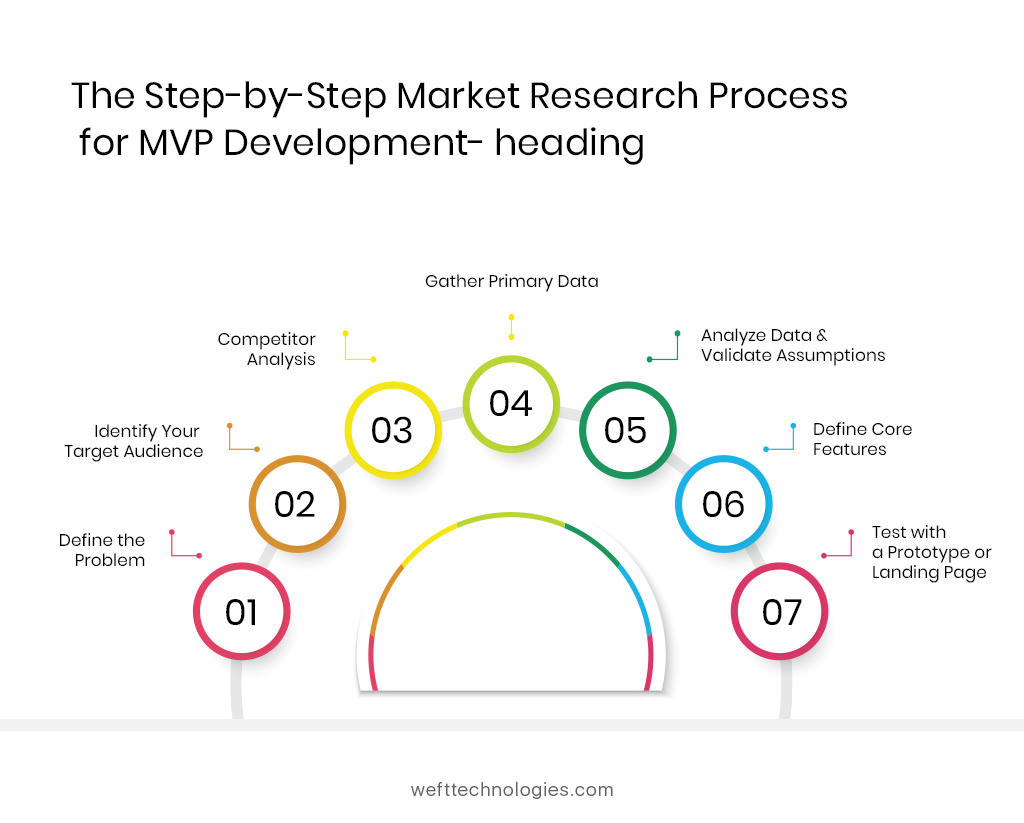
Define the Problem
Begin by defining the core problem you want to solve through your product. Focus on real user pain rather than just a cool idea.
Identify Your Target Users
Identify and understand your target users. Describe who your users will be, what they do, why they buy the product, whether they will pay for it, etc., specifically so that it will become easier to build something meaningful for them. Because user research for MVP is crucial.
Analyze the Market Size & Demand
Check whether enough people actually face this problem. Look at search trends, industry reports, and competitor activity to see if the market is worth building for Competitive Analysis fro MVP
Talk directly to potential users through interviews, surveys, or calls. Ask about their habits, frustrations, and what they currently use to solve the problem. Analyze Data and Validate Assumptions
Turn your findings into insights. Compare what you believed vs what users actually said, and adjust your idea if reality doesn’t match your assumptions.
Define Your Value Proposition and Core Features
Now decide the ONE key promise your product delivers and the minimal features needed to support it. This becomes your MVP, not the full product.
Test with a Prototype or Landing Page
Create a simple prototype or landing page and show it to users. Measure sign-ups, clicks, and feedback to confirm whether people truly care before investing more.
Methods and Tools You Can Use for MVP Market Research
The right tools can make your market research easier and more accurate. There are a number of tools available affordably. Here are the most practical methods and tools founders use during MVP development for market research:
Surveys & Interviews
This is a primary method where you can directly interact with people to understand accurate details about the problems they face and what their expectations are, which will lead you on the right path to build what people really need. To conduct surveys and interviews, you can use tools like:
- Google Forms – For free, easy survey creation
- Typeform – For interactive surveys
- SurveyMonkey – Gives advanced analytics.
- Zoom / Google Meet – Best for conduct live interviews.
- Calendly – Schedule research interviews.
Competitor & Market Insights
Understanding market demand and competition is also important to find out the gap and build something that can bridge the gap by developing a unique product that can do something more exceptional than your competitors do. The popular tools for this method are
- SimilarWeb – Traffic sources, audience behavior, competitor performance.
- Crunchbase – Funding, startup data, investor insights.
- Statista – Industry trends and market statistics.
- Google Trends – Demand trends and keyword interest over time.
- App Store / Play Store reviews – See what users love or hate about existing apps.
Prototyping & Validation
Prototyping is an effective method for market research before building the MVP to validate ideas, test UX, and measure real user interest. It helps you create something users can click, test, and react to. You can use tools like:
- Figma – Build interactive prototypes and gather feedback.
- InVision – Clickable mockups for usability testing.
- Marvel – Quick wireframes and visual prototypes.
- Carrd / Webflow / Wix – to launch quick landing pages.
- Unbounce – A/B test marketing messages before building the product.
Common Mistakes Founders Make During MVP Research
- Building a full product instead of an MVP
Many founders try to launch a full product with complete features without validating them or analyzing whether they are useful or not. But starting small is always best. So, first build only the core features that address the real problem.
- Ignoring users by guessing instead of asking
Bringing something by assuming that you know what users need is a common mistake that can lead to wrong development. Instead, interact with people and collect the details, and then start building.
- Copying competitors blindly
Being unique is important, but most founders are trying to copy their competitors. Rather than copying, you try to study them and bring something more unique and innovative than others.
- Skipping validation
Do not jump straight into development without validating the idea. It will lead to wastage of time and money.
- Choosing the wrong audience
Choosing too broad an audience or the wrong audience will lead to poor traction. During market research, define the problem, who feels it most, and who will spend on it. Understanding the audience is crucial.
- Biased research samples
Your friends may encourage your idea, but your actual customers may not. So, get feedback from real users, relevant online communication, and strangers in your target segment.
- Ignoring the competition
If you think your idea is unique, you are missing opportunities to differentiate and misunderstanding market expectations. You should analyze pricing, features, and user reviews and find the gap to build better.
- Treating market research as a one-time task
Market trends and user behavior are constantly changing. New competitors will appear with new ideas. So if you stop market research after you launch, you will become outdated, and growth will slow down.
Market research is an inevitable process that reduces MVP failure risks, as it helps you build an MVP for the right audience with essential features in the right way.
When Should You Work With an MVP Development Company?
When you build an MVP, partnering with experts is a wise choice. It can save your time, money, and costly mistakes. Not every MVP needs an external team, but if you are a novice in the field, taking advice and seeking help from experts is better than carrying everything alone and ending up with errors and loss. Not only for beginners and founders, but also for savvy individuals sometimes need the support of an MVP development company to bring their idea to a user-friendly result. Here are the scenarios that explain when you should consider bringing experts into the development process:
- If your idea involves integrations, APIs, payments, security, AI, or scalability, you need an expert team.
- When speed really matters, especially for startups racing to validate first.
- When you need a strategy along with execution, more than just coding.
- When you don’t have an in-house tech team or product manager.
- When your prototype needs proper UX/UI, not just a basic layout.
- When you want structured processes such as sprints, testing, QA, and documentation.
An MVP development service can help you from the first stage of market research. Clarifying the audience, analyzing competitors, and understanding market demand get easier with experts so that designing user flows will become simple, intuitive, and testable. A good company will support you in all aspects of technical architecture and faster iterations.
Hiring an experienced MVP development company in India can often provide the same quality as Western markets with significantly lower development costs, flexible engagement models, and strong technical expertise.
If you’re exploring partners, Weft Technologies is one such team that supports founders through research, UX validation, MVP development, and scalable product growth. Start building your MVP confidently with effective market research with guidance of the best MVP development company.