


Building a Saas product (Software-as-a-Service) in 2026 is different from what it was just a few years ago. For modern startups, choosing the right and best SaaS tech stack is one of the most critical business decisions. Today’s organizations operate in a highly competitive digital environment shaped by AI-assisted development, cloud-native infrastructure, automation, and rapidly evolving customer expectations, especially startups. The technologies behind a SaaS platform directly influence development speed, scalability, security, AI integration, maintenance costs, and long-term product flexibility.
In 2026, modern SaaS architecture is shifting toward AI-ready systems, serverless infrastructure, microservices, and automation-first development. A poor technology choice can create performance bottlenecks, technical debt, and expensive migrations later, while the right startup software development stack helps businesses launch faster, scale confidently, and adapt to future market demands. Let’s learn about the best tech stack for SaaS startups in 2026.
What is a SaaS Tech Stack?
A SaaS tech stack refers to the combination of technologies, frameworks, programming languages, databases, cloud platforms, APIs, and infrastructure tools used to build and run a SaaS application.
A modern SaaS development stack usually includes:
- Frontend technologies for user interfaces
- Backend frameworks for business logic
- Databases for storing and managing data
- Cloud hosting platforms
- DevOps and automation tools
- AI and analytics integrations
- Security and authentication systems
- Monitoring and performance tools
The right stack helps startups launch products faster, improve user experience, scale efficiently, reduce infrastructure costs, support AI-powered features, and maintain long-term flexibility. For startups building modern digital products, the technology foundation often determines how quickly the business can grow.
Wrong Tech Stack Costs A Lot
In earlier years, startups often focused only on launching quickly. But in 2026, SaaS platforms must support AI-driven workflows, real-time collaboration, cloud-native scalability, strong cybersecurity, and automation capabilities. Therefore, choosing the wrong startup software development stack can create major problems later, including:
- Slow product performance
- High server costs
- Difficult maintenance
- Security vulnerabilities
- Poor scalability
- Long development cycles
- Limited AI integration capabilities
Core Components of a Modern SaaS Architecture
Modern SaaS architecture is built around flexibility, scalability, automation, and cloud-native infrastructure. A Saas product is a layered ecosystem that has different components that work together for a specific purpose.
Here are the core components of SaaS architecture:
1. Frontend Technologies
The frontend is the user-facing part of a SaaS platform. In 2026, users expect highly interactive, responsive, and fast experiences.
Popular frontend technologies include:
React.js
- Highly scalable
- Large developer ecosystem
- Ideal for dynamic SaaS interfaces
- Strong community support
Next.js
- Built on React
- Excellent SEO performance
- Faster rendering and performance optimization
- Ideal for AI-powered SaaS platforms
Vue.js
- Lightweight and easy to learn
- Faster development for startups
- Good for MVP and mid-scale SaaS applications
Among these, Next.js + React remains one of the most preferred combinations for modern SaaS product development.
2. Backend Frameworks
The backend handles business logic, APIs, authentication, and server-side operations. Popular backend technologies for SaaS startups include:
Node.js
- Fast and scalable
- Excellent for real-time applications
- Large ecosystem
- Strong API support
Python + Django
- Ideal for AI-powered SaaS products
- Faster development cycles
- Strong security features
- Excellent machine learning integration
FastAPI
- High-performance Python framework
- Ideal for AI APIs and automation systems
- Lightweight and modern
Ruby on Rails
- Rapid MVP development
- Startup-friendly
- Faster prototyping
For AI-driven SaaS development, Python-based ecosystems are becoming increasingly popular due to seamless AI and ML integration.
3. Database Technologies
Databases affect scalability, speed, reliability, and data management.
PostgreSQL
- Reliable and scalable
- Excellent for structured SaaS applications
- Strong performance for enterprise systems
MongoDB
- Flexible NoSQL database
- Ideal for dynamic SaaS applications
- Good for rapid iteration
Redis
- High-speed caching
- Real-time data processing
- Session management
Vector Databases
In 2026, AI-powered SaaS applications will increasingly use vector databases for:
- Semantic search
- AI recommendations
- Natural language processing
- AI memory systems
4. Cloud Platforms and Infrastructure
Cloud-native development has become the standard for modern SaaS architecture.
Leading cloud providers include:
AWS
- Highly scalable
- Enterprise-grade infrastructure
- Extensive AI and DevOps services
Google Cloud
- Strong AI ecosystem
- Advanced analytics tools
- Excellent machine learning infrastructure
Microsoft Azure
- Strong enterprise integrations
- Hybrid cloud capabilities
- Advanced security features
Cloud-native infrastructure allows SaaS startups to scale resources dynamically while reducing infrastructure costs.
5. DevOps and Automation Tools
DevOps tools help automate deployment, testing, monitoring, and scaling. Essential DevOps tools include:
- Docker
- Kubernetes
- GitHub Actions
- Jenkins
- Terraform
- Prometheus
- Grafana
These tools improve faster deployments, system reliability, infrastructure automation, continuous integration and delivery, and performance monitoring. Automation is now a core part of SaaS software development trends for 2026.
Know the Best Tech Stack for SaaS Startups in 2026
In SaaS product development, choosing the right technology stack is an important decision that directly impacts your product’s scalability, performance, security, development speed, maintenance costs, and future AI capabilities. The ideal SaaS tech stack for startups should support rapid SaaS product development while remaining flexible enough for future growth, integrations, and automation. Below are some of the best tech stacks for SaaS startups in 2026 based on scalability, developer ecosystem, AI readiness, and long-term business value.
1. MERN Stack
The MERN stack continues to be one of the most preferred choices for modern SaaS product development because of its flexibility, speed, and full JavaScript ecosystem. MERN is widely used by startups building scalable dashboards, marketplaces, collaboration tools, and subscription-based SaaS platforms.
Components of MERN Stack
- MongoDB – NoSQL database
- Express.js – Backend framework
- React – Frontend library
- Node.js – Runtime environment
Why SaaS Startups Choose MERN
- Faster development using a single language across the stack
- Highly scalable for growing SaaS applications
- Large developer community and strong ecosystem
- Excellent for real-time and interactive applications
- Easy API integrations and cloud deployment
2. MEAN Stack
The MEAN stack is often preferred by businesses building complex enterprise SaaS solutions that require structured workflows and long-term maintainability and replaces React with Angular for more structured frontend development.
Components of MEAN Stack
- MongoDB
- Express.js
- Angular
- Node.js
Key Benefits You Get with MEAN Stack
- Strong architecture for enterprise-grade applications
- Better code organization and maintainability
- Ideal for large-scale SaaS platforms
- Strong TypeScript support for scalable development
3. Next.js + Node.js + PostgreSQL
This modern SaaS architecture is becoming one of the leading choices for high-performance SaaS applications in 2026. It is ideal for SaaS startups focused on performance, scalability, and SEO-driven growth.
Components
- Next.js – Frontend and server-side rendering framework
- Node.js – Backend services
- PostgreSQL – Relational database
Why This Stack is Trending
- Exceptional performance and faster page loading
- Built-in SEO optimization capabilities
- Highly scalable and developer-friendly
- Excellent for SaaS platforms requiring a strong user experience
- Supports modern cloud-native deployment
4. Python-Based Stack for AI SaaS Platforms
As the trend of AI-powered SaaS software development increases in 2026, Python-based stacks are becoming crucial for smart SaaS platforms that are commonly used for AI products, analytics, recommendation systems, and intelligent automation.
Components
- Python (Django or FastAPI)
- React or Vue.js
- PostgreSQL
- AI/ML frameworks like TensorFlow or PyTorch
Benefits of Python-Based Stack for AI SaaS Platforms
- Ideal for AI-driven SaaS applications
- Strong machine learning and analytics ecosystem
- Faster AI model integration
- Excellent for automation and predictive systems
- Supports data-heavy SaaS products
5. Serverless SaaS Stack
Serverless architecture is especially useful for early-stage SaaS startups that need agility, cost efficiency, and rapid scalability. It helps startups build and scale SaaS products by reducing infrastructure complexity and operational overhead.
Common Technologies of Serverless SaaS Stack
- AWS Lambda
- API Gateway
- DynamoDB
- React or Next.js
Why Startups Prefer Serverless
- No server management required
- Automatic scaling based on usage
- Lower infrastructure and maintenance costs
- Faster deployment cycles
- Ideal for lean startup teams
Best Practices for Startups to Build a Future-Ready SaaS Product
- Start with a scalable architecture
- Use cloud-native infrastructure
- Build modular systems
- Prioritize API-first development
- Integrate AI capabilities early
- Implement strong security practices
- Automate deployment and monitoring
- Continuously optimize performance
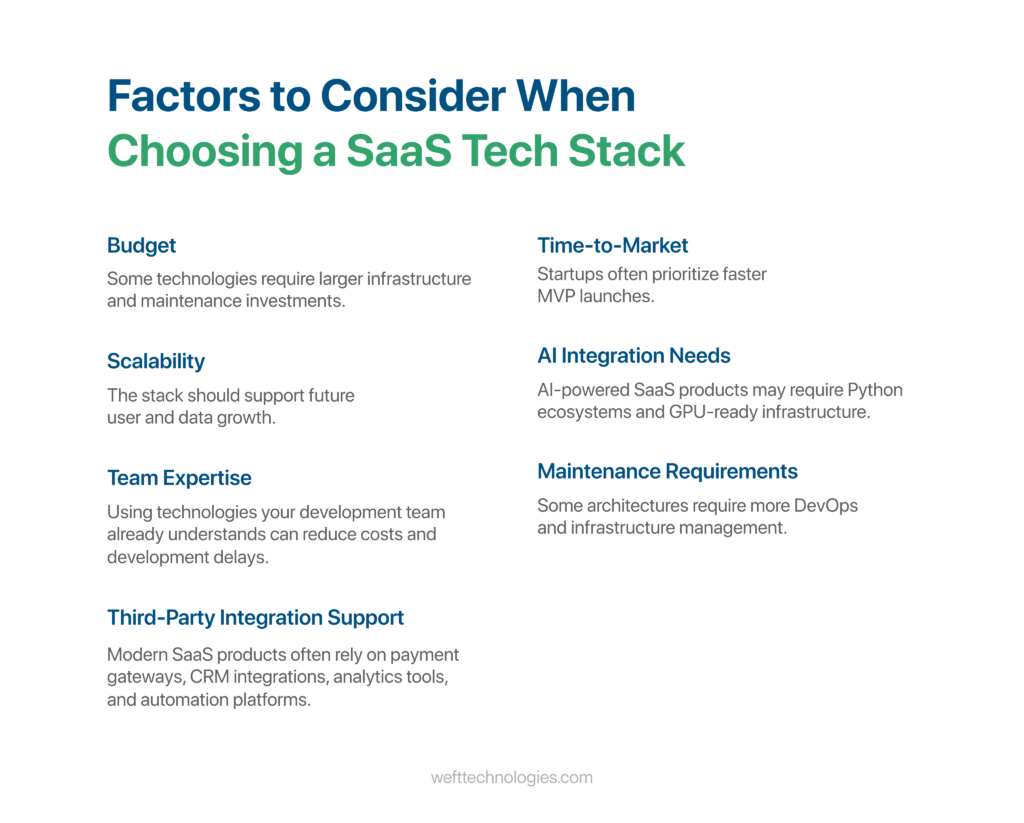
Factors to Consider When Choosing a SaaS Tech Stack
There is no universal “perfect” stack for every startup. Not all startups require the same tech stack strategy. There are many factors to consider before choosing a SaaS technology stack in this modern era.
Founders should evaluate the following factors to choose the best tech stack for SaaS startup:
- Budget– Some technologies require larger infrastructure and maintenance investments.
- Time-to-Market– Startups often prioritize faster MVP launches.
- Scalability– The stack should support future user and data growth.
- AI Integration Needs– AI-powered SaaS products may require Python ecosystems and GPU-ready infrastructure.
- Team Expertise– Using technologies your development team already understands can reduce costs and development delays.
- Maintenance Requirements– Some architectures require more DevOps and infrastructure management.
- Third-Party Integration Support– Modern SaaS products often rely on payment gateways, CRM integrations, analytics tools, and automation platforms.
Deciding the right SaaS tech stack for startups requires balancing short-term speed with long-term scalability. Therefore, choosing an experienced SaaS development company in India will make all the difference in getting your startup off the ground with the right tech stack.
Why Partnering with an Experienced SaaS Development Company Matters
Choosing the right technologies is only one part of building a successful SaaS product. Startups also need the right technical expertise, product vision, and long-term strategy to compete and sustain. A reliable SaaS development company in India helps businesses go beyond coding by providing end-to-end support across:
- Product strategy and MVP planning
- UI/UX design for better user experience
- AI integration and automation capabilities
- Scalable cloud and microservices architecture
- DevOps and CI/CD implementation
- Cybersecurity and compliance support
- Ongoing maintenance and product optimization
Instead of struggling with technical limitations later, startups can build scalable, secure, and high-performing SaaS products from day one by partnering with an experienced SaaS product development company.
Build Future-Ready SaaS Products with Weft Technologies
At Weft Technologies, we help startups and enterprises build high-performance SaaS platforms that are scalable, secure, and future-ready. As a trusted SaaS development company in India, we combine product strategy, modern engineering, and cloud-native technologies to create SaaS solutions that grow with your business.
Our expertise includes:
- Modern SaaS architecture and product engineering
- AI-ready SaaS development and automation
- Cloud-native and microservices-based development
- DevOps implementation and CI/CD automation
- Secure backend systems and API development
- High-performance frontend development
- Scalable database and infrastructure management
We focus on building SaaS platforms that deliver faster product launches, better scalability and flexibility, AI-powered innovation and automation, long-term operational efficiency, and many more capabilities.
Businesses and startups that invest in a modern SaaS tech stack early can launch faster, scale easily, and stay competitive in an increasingly AI-driven digital landscape. If you are planning to build or scale a SaaS platform, contact Weft Technologies to create a future-ready SaaS product with the right technology stack for long-term success.