


Top rankings on Google. That used to be the whole game. Get the top spot, and the clicks, the leads, the customers followed. That spot still counts for something. But a lot of the decisions your customers make never touch it anymore.
Someone asks ChatGPT to recommend a project management tool for a 20-person team. Someone opens Google’s AI Mode and asks it to compare CRM platforms for mid-sized retailers. Someone types into Perplexity, “which digital marketing company in India has actually worked with SaaS startups.” None of these searches end in a page of ten links to sift through. They end in one answer, stitched together from a small set of sources the AI system decided were worth trusting. If your brand isn’t in that small set, the customer never sees you. Doesn’t matter what your Google ranking looks like.
You could say search has changed. And this guide walks through what changed, why it changed, and what to actually do about it.
Search Has Stopped Being a List
Old-school SEO ran on a simple logic. Match the query to the most relevant page, rank it, done. The reward for good optimization was a position in a results list, and customers did the comparing themselves.
Now, AI search platforms don’t hand back a list. Google’s AI Overviews and AI Mode, ChatGPT’s search and browsing features, Perplexity, Claude, Microsoft Copilot; each of these reads the query, pulls from what it judges to be trustworthy sources, and writes an answer. Usually citing somewhere between three and five of them.
That one change breaks a lot of assumptions. Rank and citation correlate. They aren’t the same thing anymore, and treating them as interchangeable is how businesses end up confused about why their SEO numbers look fine while their AI visibility looks like nothing.
There’s a scale problem too. A single AI-generated answer can be the entire research phase of a purchase decision. If you’re not part of that first answer, you may not get a second chance at that customer’s attention.
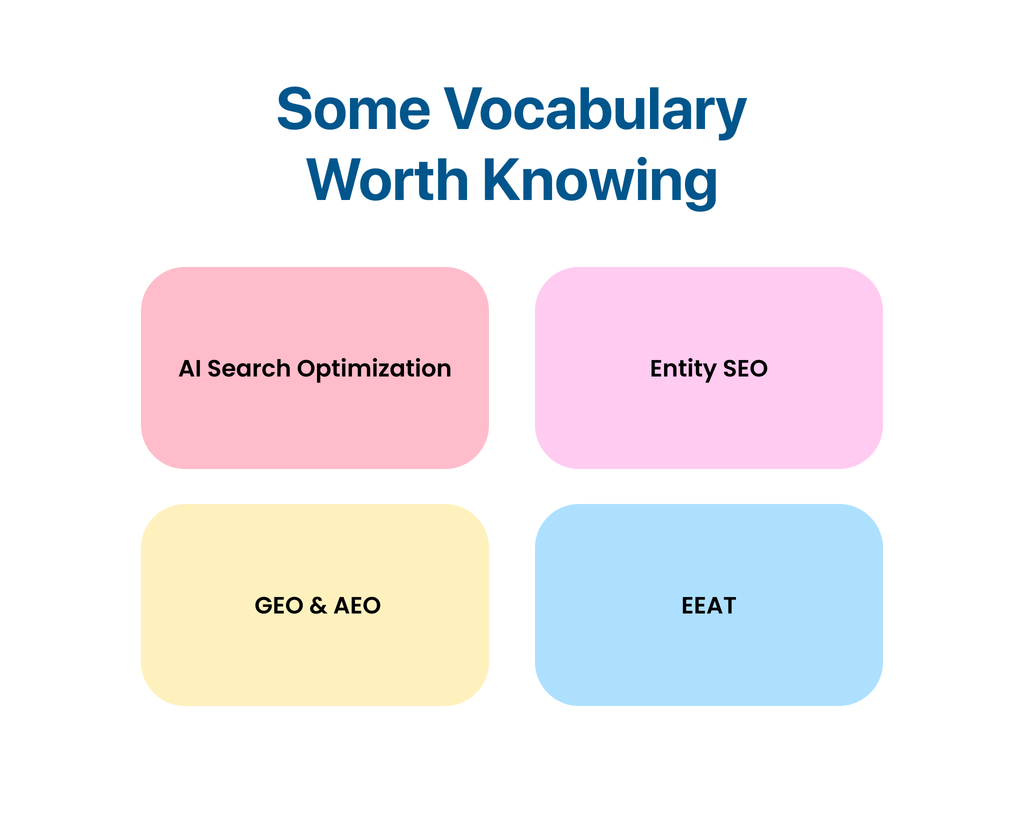
Some Vocabulary Worth Knowing
- AI Search Optimization
Think of it as the umbrella term for everything a business does to help AI platforms find, understand, and represent it accurately. This includes technical groundwork, content strategy, and reputation-building, all pointed at one outcome: getting recognized as a source worth citing.
- GEO & AEO
Underneath that umbrella of AI search optimization sit two more specific disciplines. Generative engine optimization (GEO) deals with how well your content performs inside a generated answer. Answer engine optimization (AEO) is narrower still: it’s about writing content that answers a specific question directly, the kind of thing someone might actually type into a search bar or ask a voice assistant on their commute.
- Entity SEO
An entity, in search terms, is just a distinct “thing” (a business, a person, or a product) that an AI search engine or model can recognize independently of any particular set of words describing it. Entity SEO is the discipline of making sure your business is unambiguous: what you do, who you serve, where you’re based, how you connect to other known entities in your space. Get this wrong, and even great content can’t save you, because the model isn’t sure who’s actually saying it.
- EEAT
EEAT stands for Experience, Expertise, Authoritativeness, and Trustworthiness. Google built this framework originally, but AI models lean on something close to it too. Has the source actually done the thing it’s writing about? Does it demonstrate real knowledge rather than surface familiarity? Do other credible voices point back to it? Has it been accurate and consistent over time, not just once? These four questions, more than any keyword, now shape whether a brand gets cited.
What Actually Happens When an AI Model Picks a Brand
Let’s try to understand the mechanics here.
An AI model isn’t scoring one page against another in isolation. It’s forming a picture of your brand as an entity by pulling from structured data on your site, cross-checking how consistently you’re described across the web, weighing how many credible third parties mention you, and gauging how deep your published content actually goes on the topic being asked about. When a query comes in, the model retrieves a set of candidates and ranks them by how directly they answer the question, how established the source seems, and how well other sources back up the same claims.
Mentions matter here more than most businesses expect, even the ones without a link attached. A brand that shows up favorably across a handful of trade publications, review sites, and forum threads builds a kind of background credibility that AI models seem to register, separate from any single backlink’s authority. Reviews do similar work, and they’re one of the clearer trust signals available when a model is choosing between two similar businesses.
Structured data closes the loop. Schema markup, consistent listings, a site that’s organized in a way that’s easy to parse – all of this gives an AI system confidence that it understands your business correctly before it decides to cite you. The opposite is also true. A business whose name, category, or details shift depending on where you look online gives a model good reason to hesitate, or to cite a competitor instead who’s easier to verify.
Why Ranking Well Isn’t the Same as Being Visible
To be clear, none of this replaces traditional SEO. Site health, on-page fundamentals, backlink quality, etc still hold up the rest of your brand visibility strategy. What’s changed is that it’s no longer the whole strategy. A business can hold strong Google rankings and still be completely absent from AI Overviews or ChatGPT answers, usually because the content isn’t structured for extraction, the entity presence is thin, or there just isn’t enough third-party corroboration for a model to feel confident citing it. The reverse happens too. A business with unremarkable traditional rankings but real topical depth and a clean, well-corroborated entity presence can outperform bigger, better-ranked competitors in how often AI platforms mention them.
So, keep the SEO fundamentals in shape and build the AI-facing layer on top of it. Skip either one, and visibility leaks out somewhere.
How to Actually Build AI Search Visibility
Most articles on this topic stop at explaining why any of this matters. Fewer get into what to actually build. Let’s mitigate that.
- Content Clusters
A single great blog post rarely moves the needle on its own. What works better is a pillar page on a subject central to your business, surrounded by a cluster of related articles, each tackling one subtopic or question in depth, all linked together deliberately. A marketing agency building brand authority around AI SEO, for example, might pair a pillar page with supporting pieces on GEO tactics, schema setup, brand monitoring, and sector-specific applications. Over months, that cluster tells a model something a single article never could.
- Writing for Extraction
Content that gets pulled into AI answers tends to share a habit: it answers the question early, instead of building up to it over three paragraphs of throat-clearing. Headers should map to real questions people ask, not clever wordplay. Where a list or a short table genuinely helps a reader follow along, use one. Specificity helps too. A concrete number, a named example, an original observation gives a model something worth quoting, where a vague generality doesn’t.
- Schema Markup
This is how you tell an AI system, in a format it can parse instantly, exactly what a page contains and how it relates to your business. Organization schema on your core pages, FAQ schema where you’re answering common questions, and article and review schema where relevant aren’t optional extras anymore. This improves how confidently a model can read and cite you.
- The Technical Layer
None of the above matters if an AI crawler can’t get through your site cleanly. Slow load times, broken internal links, or a mobile experience that breaks halfway through a page create friction that keeps content from being indexed or evaluated properly in the first place. Core Web Vitals are still worth watching for exactly this reason.
- Earning mentions
Backlinks from reputable, relevant publications still carry weight, both for traditional rankings and for how AI models judge your credibility. Digital PR, guest contributions, or being quoted as an expert source in someone else’s article build the kind of third-party validation a brand can’t manufacture on its own site. Beyond links specifically, the goal is broader brand visibility across places an AI model might look: industry directories, trade associations, review platforms, local news, niche community sites. Even a mention with no link attached adds to the picture a model is building of your legitimacy.
- Reviews of Actual Customers
Reviews on Google Business Profile, sector-specific review sites, and social platforms function as a trust signal AI models weigh when two competitors look similar on paper. Ask satisfied customers for details, not just stars, and respond to reviews thoughtfully when you get them. Case studies and genuine customer testimonials do similar work, adding texture that a brand’s own marketing copy can’t replicate.
- Original Content
Original research, a proprietary survey, or a well-argued piece of thought leadership give a model a reason to cite you specifically rather than any of the dozen other businesses saying roughly the same thing in roughly the same words.
- Multimedia
Descriptive alt text, sensible file names, and real surrounding context on images and video all matter more than they used to, as AI-powered search moves toward incorporating more than text.
- Consistency
Your name, description, category, address, and contact details need to match exactly across your website, your social profiles, your directory listings, everywhere. Inconsistency actively undermines the entity clarity a model needs before it’s willing to cite you with confidence.
- Owning Your Entity
Pull all of this together by actively managing how your business exists as a recognizable entity online. This includes a complete Google Business Profile, an accurate and active LinkedIn presence, structured entity data through something like Wikidata where it applies. Wherever an AI model goes to verify who you are, it should find the same answer, clearly documented.
Common Mistakes Businesses Make
- Inconsistent brand details across the web
- Thin content that doesn’t demonstrate real depth
- Skipping schema and technical SEO
- Ignoring reviews and third-party mentions
- Treating this as a project with an end date
Measuring AI Search Visibility
How often does your brand actually appear in AI-generated answers for the queries that matter to your business? That’s citation frequency, and it’s worth tracking query by query rather than as one vague aggregate number. It’s also worth comparing that number against your named competitors (sometimes called share of AI voice) because a raw citation count means less without context on how the market around you is performing. And referral traffic from AI platforms is increasingly trackable through standard analytics, once you know what to segment for. In fact, a growing number of these tools now send genuine click-through traffic, not just answers that end the search entirely.
A handful of tools have shown up specifically to help with measuring brand visibility in AI search. Dedicated AI visibility trackers now monitor citation frequency across ChatGPT, Perplexity, and AI Overviews. Brand monitoring platforms cover mentions and sentiment more broadly across the web. Schema validators catch structured data errors before they become invisible problems. And Google Search Console, for all its age, still surfaces signals that remain relevant even with AI features layered on top of classic search.
A Starting Checklist
If you’re looking for where to begin, start here:
- Audit brand consistency across your website, directories, and social profiles
- Add organization, FAQ, and article schema to your most important pages
- Build out a content cluster around one core area of expertise
- Rewrite key pages so the actual answer appears in the first few lines
- Set up basic monitoring for citation frequency across ChatGPT, Perplexity, and AI Overviews
- Pitch a guest contribution or expert quote to one relevant industry publication
- Ask three recent customers for a detailed review, not just a star rating
- Draft one piece of original research or genuine thought leadership this quarter
- Add proper alt text and context to your existing images and video
- Claim and fully complete your Google Business Profile
- Fix any brand detail that doesn’t match across your own listings
Final Thoughts
None of this resolves in a week. AI search visibility gets built through consistent signals compounding over time. Businesses treating this as an ongoing discipline, not a one-time fix, are the ones still getting cited and recommended a year from now, while competitors who did the work once and moved on quietly fade out of the answers.
If you’re working on your online brand visibility and want a digital marketing company that handles both the technical groundwork and the content depth this requires, that’s the work we do day to day, from entity setup and schema implementation through to content clusters and ongoing visibility tracking. The aim throughout is the one this guide keeps circling back to: making sure your brand is the one AI platforms trust enough to actually recommend.